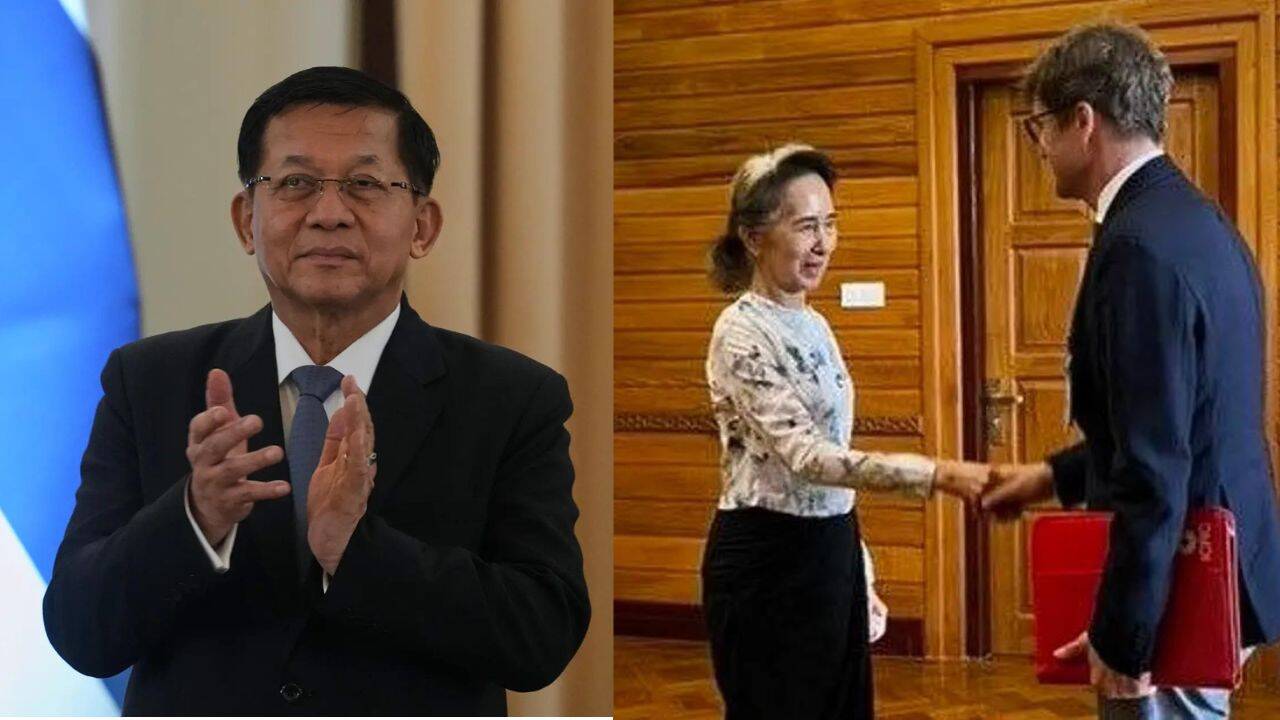
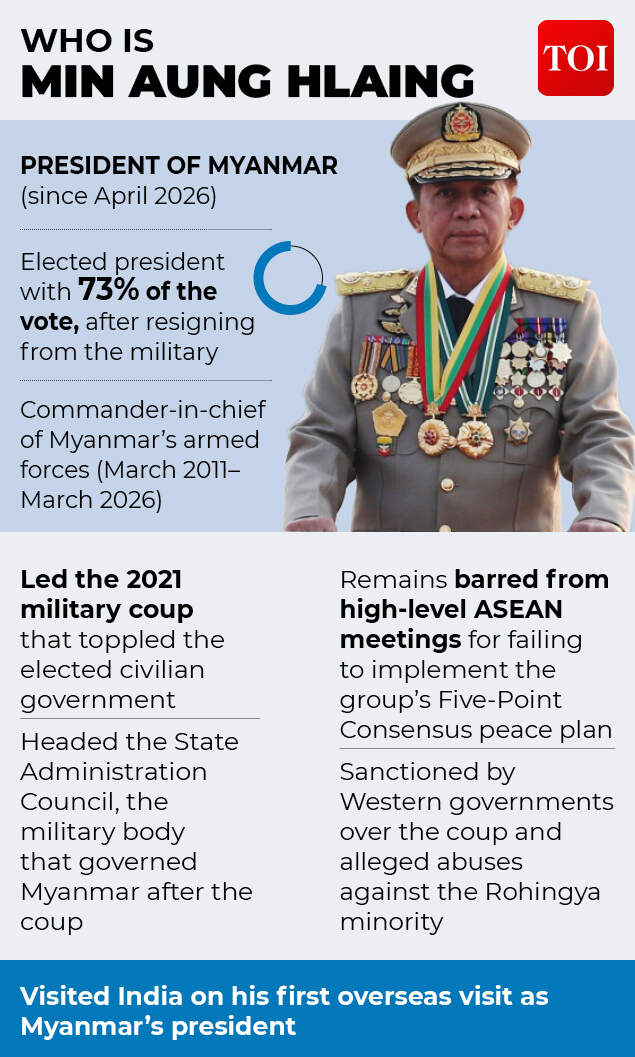
Myanmar President Min Aung Hlaing made a two-day state visit to Thailand last week, in a trip that carried significance beyond routine diplomacy. He remains internationally isolated because, in his earlier role as supreme commander of Myanmar’s armed forces, he led the 2021 coup that overthrew the elected civilian government. He subsequently ruled as head of the junta for five years before formally assuming the presidency.
Get breaking news anytime, anywhere. Download the TOI app now!
That visit to Thailand coincided with another significant development in Myanmar. Aung San Suu Kyi, the former leader whose government was ousted in that coup, was allowed to receive a visitor. On August 3, Suu Kyi met Arnaud de Baecque, the International Committee of the Red Cross' (ICRC) resident representative in her country.
Naypyidaw also released photographs of the meeting—the first official images of the former State Counsellor in years.
Was the close timing of the two developments just a coincidence? For Min Aung Hlaing, who came to power by overthrowing an elected government rather than through the ballot box, both developments could be part of a broader effort to build political legitimacy and gain wider international acceptance.
Min Aung Hlaing's ascent to power
During his visit to Thailand, the 70-year-old former military leader sought to reassure his host, Thai Prime Minister Anutin Charnvirakul, that Myanmar was “returning to democracy.”
"Myanmar has now re-established itself on the path to democracy and is moving toward a better future," Min Aung Hlaing told Charnvirakul.
The remarks stood in sharp contrast to the circumstances of his rise to the presidency. His claim that Myanmar is on a “democratic path” also comes against the backdrop of a bloody civil war triggered by the coup that brought him to power.
According to the Assistance Association for Political Prisoners, an independent organisation that documents arrests and casualties linked to the Myanmar civil war, more than 8,200 civilians had been killed and 31,645 people arrested by the regime's security forces as of August 5.
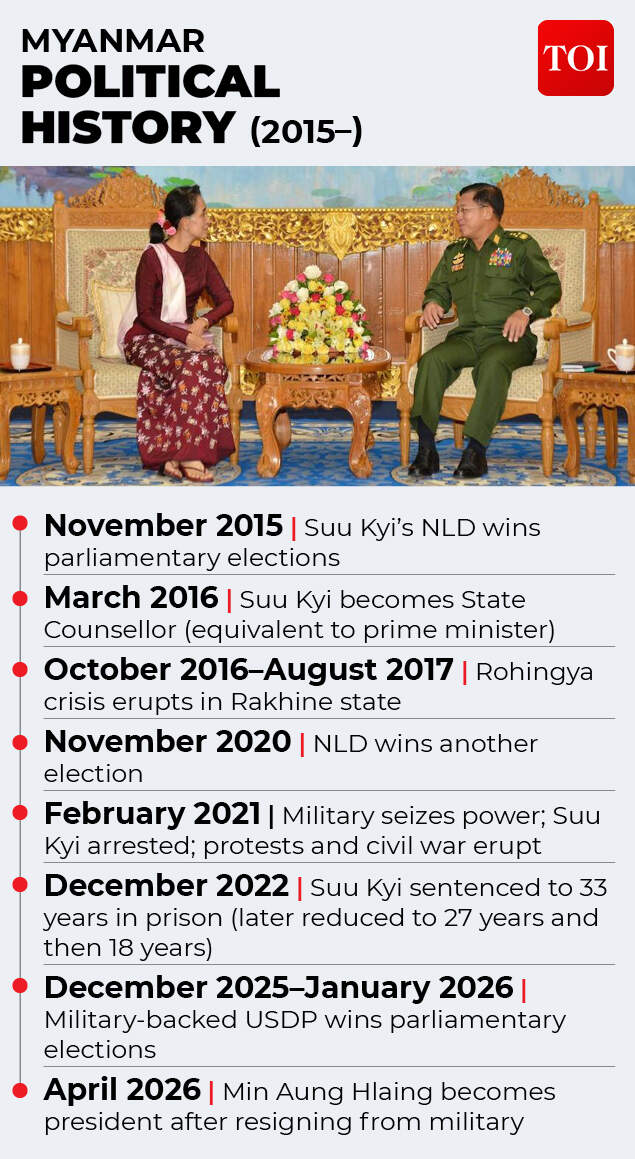
Besides, the parliamentary elections under Min Aung Hlaing in late 2025 and early 2026 were also widely criticised as “neither free nor fair” as the army-backed Union Solidarity and Development Party swept the elections, winning 232 of the 263 contested seats in the lower house and 109 of 157 seats in the upper house. Ahead of the presidential election in April—Myanmar's first since 2018—he resigned from the military and was subsequently elected president.
However, his transition to the presidency did little to ease international scepticism. Major democracies withheld congratulations following his victory.
Significance of Aung San Suu Kyi
For Myanmar, Aung San Suu Kyi’s significance extends beyond her role as the head of the country’s first democratically elected civilian government in 50 years and the military’s toppling of her administration.
For many inside and outside Myanmar, the 1991 Nobel Peace Prize laureate remains the country's most recognisable symbol of democratic rule and civilian legitimacy.
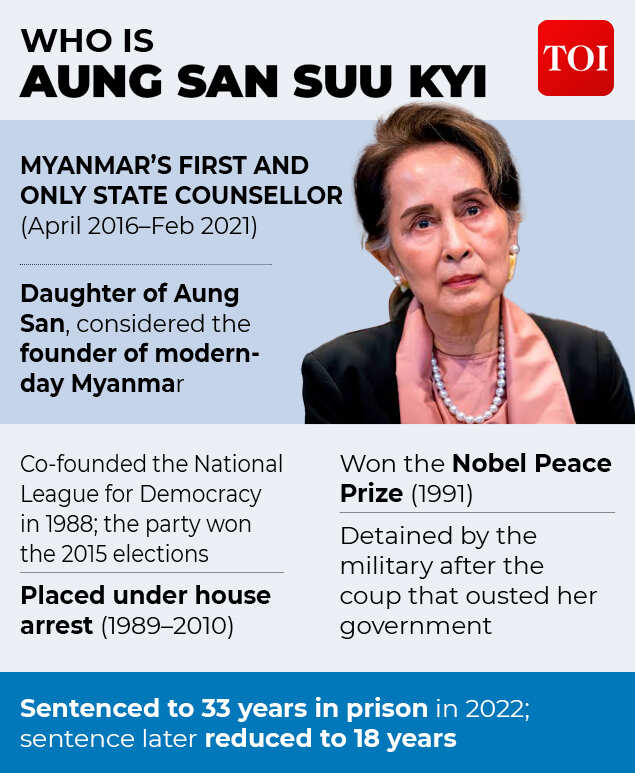
In 2022, Suu Kyi was sentenced to 33 years in prison on a series of charges that her supporters and rights groups described as “politically motivated” and intended to prevent her return to politics. Later, her sentence was reduced to 27 years and, in April, to 18 years, while she was transferred to house arrest.
Against this backdrop, the meeting with the ICRC representative was significant because it marked the first confirmed contact between Suu Kyi, 81, and an independent international organisation since her house arrest. It was also her first confirmed communication with the outside world since she wrote a letter to her son from prison in early 2024.
Sreeparna Banerjee, an Associate Fellow at the Observer Research Foundation (ORF), agreed that both developments could be seen as part of Myanmar’s broader effort to “manage its international image,” but said it cannot be assumed that the moves were directly linked.
“The timing is noteworthy, but it would be difficult to establish a direct connection between the two developments at this stage… Access to Aung San Suu Kyi after a prolonged period of isolation could signal some limited openness, while Min Aung Hlaing’s high-profile visit to Thailand demonstrates Myanmar’s attempt to expand diplomatic engagement,” Banerjee, whose work focuses on Myanmar and Thailand, told The Times of India.
For Min Aung Hlaing, the bigger challenge remains turning such diplomatic engagement into wider political legitimacy and international acceptance.
Why Thailand visit matters for Min Aung Hlaing - and how Bangkok differs from ASEAN
According to Banerjee, the visit was important for Min Aung Hlaing because it offered him a degree of political normalisation.
“Being received at the highest level by an ASEAN neighbour allows him to project the image of a leader whose government is once again engaging with the region rather than remaining diplomatically isolated,” she said.
Significantly, while Thailand and Myanmar are both ASEAN member states, Bangkok’s approach towards Naypyidaw differs from that of the rest of the 11-nation bloc of Southeast Asian states.
Thailand has continued to engage with Myanmar despite ASEAN barring Min Aung Hlaing from its top-level meetings over the non-implementation of the Five-Point Consensus agreed with the grouping after he seized power.
On this, Banerjee observed that the real value of Bangkok’s “bridge” diplomacy — acting as a bridge between Myanmar and ASEAN — would depend on whether Thailand can use it to encourage some meaningful progress on the Five-Point Consensus.
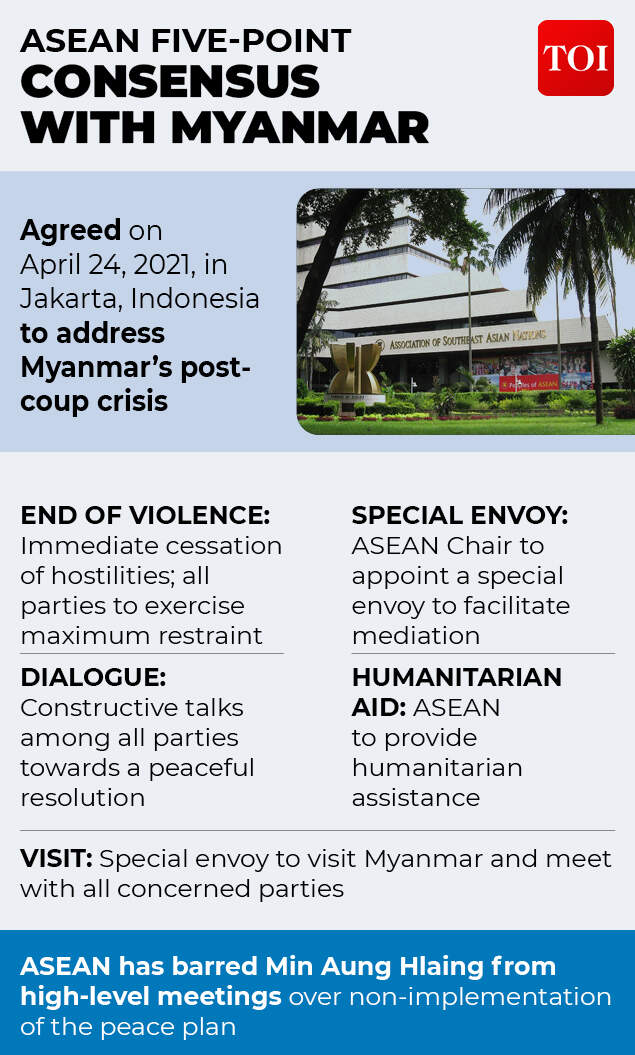
Additionally, ASEAN is yet to recognise the results of Myanmar’s 2025–26 parliamentary elections. The bloc has also repeatedly called for Suu Kyi’s unconditional release, renewing the demand after her meeting with the ICRC official. The regime rebuffed this call too.
For its part, Thailand has described its approach vis-à-vis Myanmar as one of “calibrated re-engagement” aimed at keeping dialogue open while responding to “realities on the ground.” Bangkok has also argued that Myanmar is essential to ASEAN unity and regional stability, provided it remains peaceful and stable.
Can regional engagement help Min Aung Hlaing’s legitimacy push?
In addition to being barred from top-level ASEAN summits, Min Aung Hlaing faces Western sanctions over his role in toppling Suu Kyi’s government, the subsequent civil war, and the alleged persecution of the Rohingya minority in the Rakhine province.
The Thailand visit was his fourth overseas trip since becoming president, following visits to India, China, and Laos. India was the only democratic country among the four destinations, underscoring the limited engagement he has so far had with democratic governments.
Despite this, and close ties with Russia, he has remained largely isolated internationally.
So, can his engagement with Thailand and his wider regional outreach — help him in his bid for greater international recognition and acceptance?
Sreeparna Banerjee, the ORF Associate Fellow, suggested that even regional acceptance remains uncertain at this stage, despite such engagement being an important part of Myanmar’s quest for political legitimacy.
“Naypyidaw appears determined to engage on its own terms rather than fully follow the ASEAN framework. Thailand's outreach may create space for dialogue, but whether this translates into wider regional acceptance remains uncertain,” she explained.
She also highlighted that uncertainty over Myanmar’s regional acceptance stems in part from the fact that Singapore will take over the ASEAN chairmanship in 2027. The city-state has repeatedly called for full implementation of the Five-Point Consensus.
This underscores the scale of the challenge facing Min Aung Hlaing in his bid for wider acceptance.
Min Aung Hlaing’s continuing legitimacy challenge
For a leader who rises to power as Min Aung Hlaing did, securing international recognition is likely to remain a gradual and difficult process.
The regime’s refusal to release Suu Kyi, a global icon, further complicates that effort.
Engagement with neighbouring countries can provide an important opening, but broader recognition often depends on how other governments assess the resulting political situation. Yet for Min Aung Hlaing, this remains the only option to secure recognition.
For now, engagement with Thailand may offer Min Aung Hlaing some diplomatic space, but whether it can translate into legitimacy for him remains uncertain.