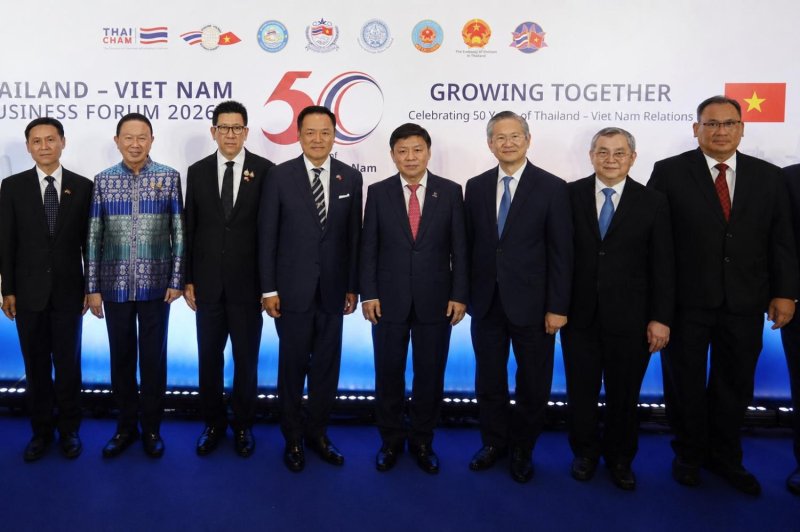
As Thailand and Vietnam mark the 50th anniversary of diplomatic relations in 2026, the relationship between two countries is entering a new era. What began as a diplomatic relationship between close neighbours has evolved into one of Asean's most important economic partnerships.
Recent high-level exchanges have reflected this growing momentum. Thailand and Vietnam elevated their relationship to a Comprehensive Strategic Partnership last year with the aim to focus on the "Three Connects" strategy to promote their economic connection in three major areas namely supply chains, local economies and sustainable development.
Vietnamese President and Communist Party General Secretary To Lam visited Thailand in May 2026 while Thailand's prime minister Anutin visited Vietnam in June 2026, as the two countries prepared to commemorate the 50th anniversary of formal diplomatic ties on today.
These visits were more than symbolic. They signalled a shared commitment to turn friendship into practical outcomes, with both governments focusing on trade, investment, innovation, supply chains, sustainable development and future industries. Their timing could not be better.
The world is undergoing one of the biggest shifts in global manufacturing and supply chains in decades. Companies are diversifying production networks, seeking greater resilience and looking beyond individual markets towards integrated regional ecosystems. Against this backdrop, Thailand and Vietnam have an opportunity to create something greater than the sum of their individual economies.
For many years, Thailand and Vietnam were often viewed as competitors for investment. Today, that thinking is becoming outdated. The real opportunity lies not in competition, but in complementarity.
Vietnam is one of Asia's most dynamic manufacturing centres. With a population of more than 100 million, a young workforce, rising productivity and a rapidly expanding middle class, it is also an increasingly attractive consumer market and with GDP growing by 8.02% in 2025 it is one of the fastest growing economies in the world.
Thailand brings different but equally valuable strengths. Decades of investment have created sophisticated transport infrastructure, deep logistics networks, advanced industrial capabilities, strong financial institutions and extensive international business connections. Thailand remains one of Asean's most established bases for regional headquarters, treasury operations, supply-chain management and cross-border business services.
By combining these strengths, we can create a powerful economic corridor.
The foundations already exist. Thailand is Vietnam's largest Asean trading partner within, while Vietnam is Thailand's Asean second-largest trading partner. Bilateral trade is already worth more than US$24 billion (797 billion baht) a year, and both governments have expressed their commitment to expand it further. Thailand is also among Vietnam's leading foreign investors, with more than 700 Thai companies involved in hundreds of projects worth more than US$15 billion.
The next phase of growth, however, is likely to look very different from the last. Historically, much Thai investment in Vietnam has centred on retail, consumer products and industrial estates. These sectors will remain important, but the new opportunities are higher up the value chain: electric vehicles, advanced manufacturing, smart industrial cities, food innovation, renewable energy, digital technologies and integrated logistics systems.
Thailand has long been known as the 'Detroit of Asia' and possesses extensive expertise in automotive supply chains, parts manufacturing and industrial production.
Vietnam has been rapidly developing manufacturing capabilities and nurturing domestic champions in the EV sector. Together, we can create a more integrated regional ecosystem that is attractive to global investors seeking alternatives to concentrated supply chains.
The same logic applies to food and agriculture. Vietnam is a major agricultural producer and exporter. Thailand possesses world-class expertise in food processing, branding, packaging, quality standards, logistics and international distribution. Combining these capabilities could create new value-added export opportunities and strengthen regional food security.
As manufacturers increasingly seek low-carbon production, demand for renewable energy is rising across Southeast Asia. Cooperation in solar power, wind energy, sustainable infrastructure and green industrial development could help both countries achieve their climate goals while also supporting industrial growth.
For businesses, the message is clear. Companies that integrate Vietnamese manufacturing strengths with Thailand's logistics, financial services and regional connectivity will be best placed to capture the next wave of Asean growth.
Tharabodee Serng-Adichaiwit is SVP & General Manager, Bangkok Bank Vietnam.