When charter writers claimed every vote would not be wasted under the one ballot election system, politicians appeared to understand what was lying ahead.
Major parties viewed the new rule as discriminatory against them with medium-sized and small political parties tipped to play a critical role in forming a coalition government.
The vote count in the March 24 general election solidified their observation. The Future Forward Party (FFP), a political rookie speculated in several pre-election opinion polls to lose in the constituency system but eventually to win a sizeable number of seats under the new system, arguably emerged as the "biggest" winner.
According to political observers, the party had secured two resounding victories -- defeating political heavyweights in 30 constituencies and capturing 6.2 million votes which determine the share of party-list seats it will get.
During the first few days after the poll, the focus was on 16 political parties based on the assumption they were the only ones to be awarded party-list seats, and were only a few steps away from entering parliament.
The Pheu Thai Party, which won 137 constituency seats and will not get any party-list seats, announced a seven-party alliance.
Its arch-rival, the Palang Pracharath Party (PPRP), played things close to its chest but was believed to be lobbying quietly, according to political observers.
The initial result appeared to favour the Pheu Thai-led front, but not for long.
Then entered a dozen small parties which announced it was too early to rule them out.
Citing the Election Commission (EC), these parties, headed by the Thai Civilised Party, claimed they were entitled to receive at least one party-list seat each.
These parties each received between 30,000-50,000 votes nationwide, but when combined, their votes were equivalent to 14 party-list seats.
Their claim was backed by Jade Donavanik, a former adviser to the Constitution Drafting Committee, who insisted all votes would be calculated to ensure all of the parties receive the right number of seats in relation to their respective share of the vote.
Even though many assumed the new system would benefit smaller parties, the parties claim they did not see this coming.
The Pheu Thai bloc argued the calculation method could not be right, and critics alleged it was twisted to help the PPRP gather seats from those small parties to form a rival coalition with the majority votes and gain political stability.
Several observers believed the PPRP was likely to proceed with its nomination of Gen Prayut Chan-o-cha as prime minister, claiming it would succeed with support from the 250-member Senate, which is being handpicked by the regime.
This would pave way for the PPRP to form a government, possibly a minority one.
But that was before the small parties claimed to have 12 seats in their hands.
If the small parties are eventually awarded the party-list seats, it could be a whole new ball game. The FFP's share would be scaled down and as many as seven seats might slip away from it.
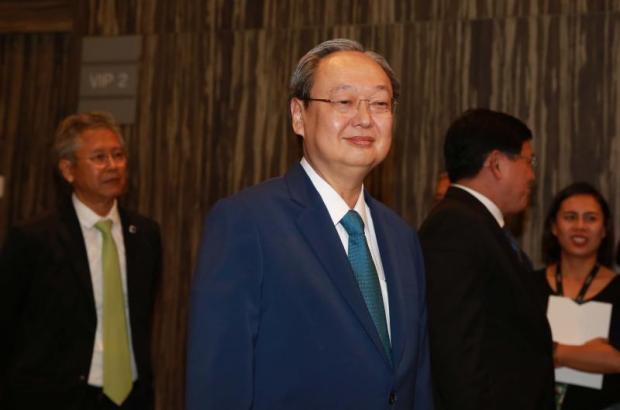
Sontirat Sontijirawong, secretary-general of the PPRP, does not seem to have any objection to the EC's calculation method. Moreover, he appears ready to hold talks with them.
The PPRP would gain 19 party-list seats instead of 21 if the smaller parties receive their seats according to their preferred method of distribution.
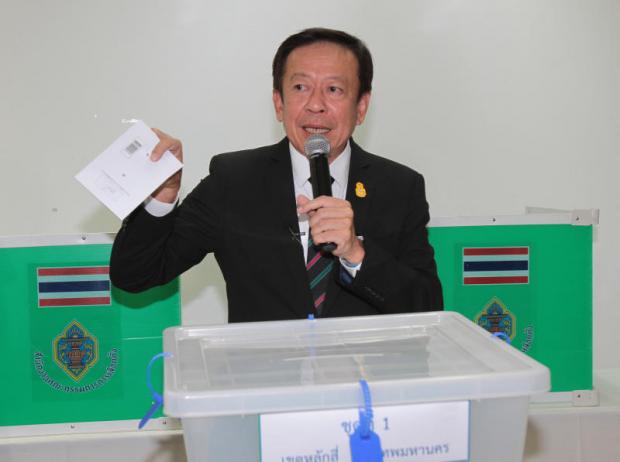
May 9 has been established as the deadline for the EC to announce the election result.
In the meantime, the number is subject to change as the EC has begun looking into complaints and irregularities.
Already, the commission has announced it will recount ballots in at least two constituencies, and organise election reruns in at least six others, including one in Bangkok.
EC builds poll suspense
Just when politicians thought they had won constituency seats, a new reality has set in, which means not everyone is out of the woods yet.
In fact, April 28 has been marked as a day of reckoning on political calendars when some politicians may be handed different-coloured cards that could see them fall from grace.
While the March 24 election may be over, the Election Commission (EC) -- which is fumbling to explain what some critics chided as an overly complicated method of calculating party MPs for political parties -- has another equally important task before it.
The EC is bound by duty and responsibility to investigate complaints of electoral fraud allegedly committed during the election.
The investigation will have an immense bearing on the formation of the next government, given the razor-thin House majority which the two main party blocs are staking claim to.
The Pheu Thai Party-led camp has tried to muster a host of allied parties to form a government with combined majority support exceeding 250 MPs, half of the total number of the Lower House seats. Its rival and the second-biggest party, Palang Pracharath (PPRP), is doing exactly the same.
If either party loses even a few seats through post-election disqualification on the grounds of electoral irregularities, as determined by the EC, that bloc runs a risk of swinging to the opposition's chamber.
Political experts say most of the parties are being kept in suspense over how many House seats they have garnered as the EC has not finalised its tabulation of the votes.
But several that have picked up constituency seats realise the biggest hurdle yet is the EC's investigation into poll complaints targeting them.
An EC source said the party facing the most complaints is the pro-regime PPRP, which won 97 House seats. Even though it is billed as the vehicle for Gen Prayut Chan-o-cha's return as premier, PPRP has admitted into its fold seasoned ex-MPs of other parties.
They were counted on by the PPRP to triumph in the poll. Pundits claim the likelihood of them resorting to electoral malpractice to stay ahead of the game cannot be discounted.
The Bhumjaithai Party could also be in for a long and tedious investigation, experts say.
PPRP and Bhumjaithai are tipped to team up to form the next government after the latter captured 39 constituency seats.
They are now awaiting word from the EC about whether their MPs-elect will be subject to investigation.
As far as its legal authority is concerned, the EC can issue an orange or yellow card against constituency MP candidates suspected of electoral fraud.
There are also red and black cards reserved for suspects who must stand trial in the election court. If convicted, those facing red cards would be liable for punishment, with their right to vote suspended for 10 years. A black card, on the other hand, revokes a person's right to vote for life.
Orange cards have been added to the list of penalties. One of these would see the election rights of a winning candidate suspended for a year if there is sufficient evidence to support the charge against them.
EC secretary-general Pol Col Jarungvith Phumma said the EC's report will provide the basis for the courts to consider issuing red or black cards against poll candidates involved in fraud.
If a winning candidate is found guilty, the poll result will be annulled and a re-run ordered within six months. The offending candidate will be ordered to foot the 10-million-baht bill, Pol Col Jarungvith said.
FFP hits PTP where it hurts
Even though Pheu Thai appeared to have won the most constituency seats on March 24 -- 137 out of 350 available -- the party seems to be dissatisfied with the below-target outcome.
An earlier survey showed the party stood to gain 180-200 constituency seats.
Pheu Thai fielded candidates in 250 constituencies where it had the strongest chances of success. Most emerged as winners.
Those who lost still performed well, ending up first- or second-placed runners-up.
Some new parties had an advantage over Pheu Thai by offering candidates with "charisma" to attract voters' attention, political observers noted.
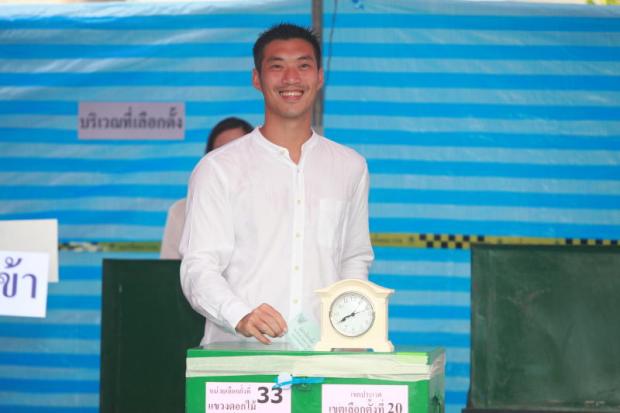
Future Forward Party (FFP) leader Thanathorn Juangroongruangkit led the party to at least 80 seats, according to the preliminary election results.
A Pheu Thai source said several candidates who failed pointed the finger of blame at Khunying Sudarat Keyuraphan, a Pheu Thai PM candidate and chair of its strategy committee, for their losses.
They could not help but compare Khunying Sudarat with Mr Thanathorn before concluding the latter outshone her in opposing the regime and Prime Minister Prayut Chan-o-cha's return to power, the source said.
After Mr Thanathorn repeatedly drove home his message, many voters were impressed and sided with the FFP candidates over their Pheu Thai rivals.
Even though the FFP's candidates won in 30 constituencies, according to the unofficial results, they did not meet voters there during campaigning as the party wanted Mr Thanathorn to be its face, another source said.