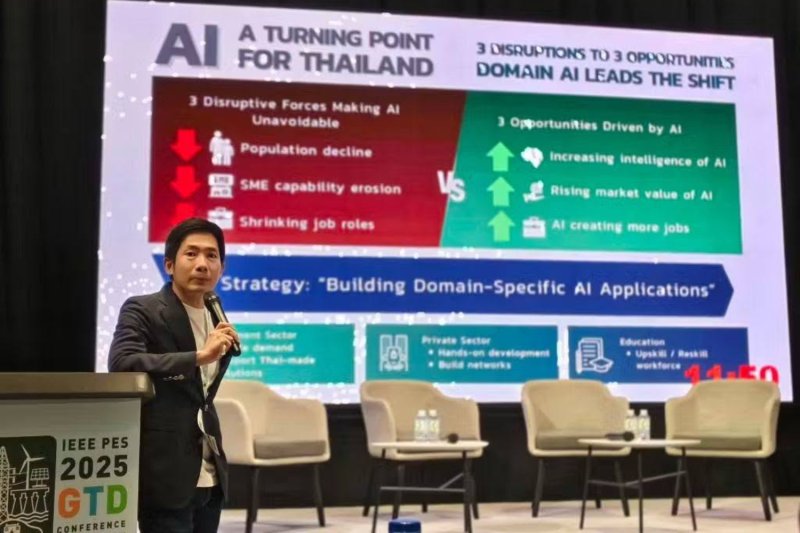
Thailand must shift its artificial intelligence (AI) strategy from basic workforce training to developing world-class "super talents" and robust deep-tech systems if it wants to establish a new economic S-curve, says Chanwit Boonchuay, president of the AI Entrepreneur Association of Thailand.
"Developing general users will address unemployment and help people adapt, but it will not drive a new economic S-curve," he said.
Current national strategies and government initiatives focus on human resource development, specifically training basic and advanced AI users. While this is a foundational step, the missing link is the top-tier innovators who are capable of building from scratch and optimising advanced AI models, he noted.
"These talents are the elite minds often heavily recruited by global tech giants," said Mr Chanwit.
If Thailand lacks a sufficient number of these talents, the country should import them from across the region to work with domestic teams, allowing local developers to upskill and elevate their capabilities, he said.
Thailand should aim to build entrepreneurs equipped with highly advanced knowledge who can merge AI with domain expertise to grow, said Mr Chanwit.
To compete globally, the nation should leverage its unique datasets and existing expertise in specific domains such as healthcare, agriculture, wellness and services, he noted.
Relying solely on basic AI in these sectors will not guarantee a leadership position, as maintaining a competitive edge requires blending this domain expertise with advanced, resource-intensive AI models, said the association.
Achieving this high-level AI development requires significant investments in infrastructure, particularly high-performance computing resources and robust data systems, which remain scarce in the country.
Furthermore, local AI startups face a closed domestic market. Large corporations and leading hospitals are typically reluctant to engage with small tech firms consisting of 3-5 people due to traditional corporate cultures, Mr Chanwit said.
To overcome these barriers, Thailand must establish supportive sandboxes or incubation spaces, he said, which would open markets for deep-tech startups, allowing them to collaborate with major industry players, access dedicated funding, and successfully scale their businesses.
The Technology and Innovation in Life Sciences National Agency is initiating incubation programmes aimed at high-potential AI ventures in the healthcare and wellness sector, helping to establish a solid local footprint before expanding overseas.
By providing the appropriate infrastructure, funding, and an open market for these "seedlings" to grow, Thailand can build a generation of high-level entrepreneurs rather than just academic researchers, said Mr Chanwit.
"Problems in healthcare and agriculture are globally scalable, which means successful local AI solutions can eventually be exported worldwide, creating a crucial new business engine for the Thai economy," he noted.