At least four people have been killed in a series of bombings targeting some of Thailand’s most popular tourist resorts.
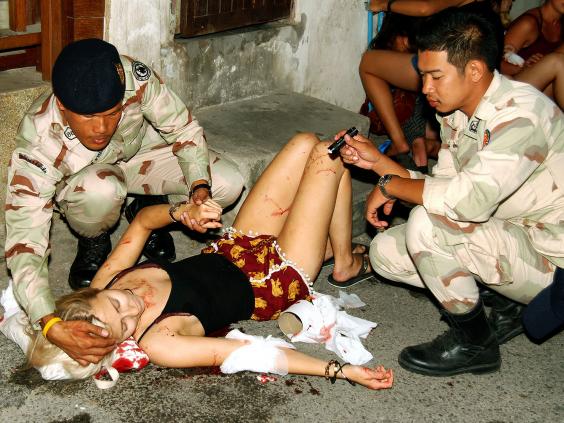
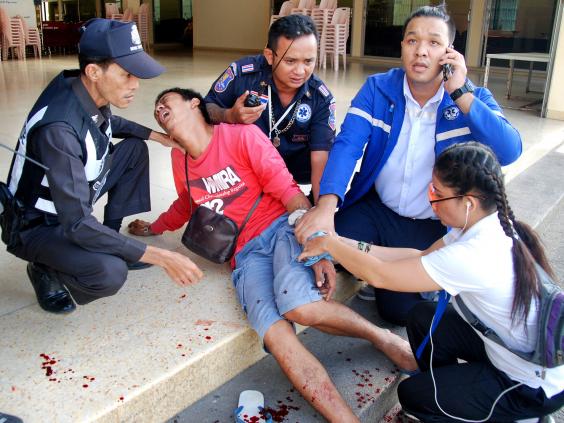
The attacks started with two explosions in the beachside town of Hua Hin that were detonated remotely just minutes apart in a bar area popular with foreigners.
Police said a Thai woman was killed and 21 people were injured, sparking chaos as crowds fled and local shops and restaurants were shut down on Thursday night.
There were signs of recovery in the morning, with a Buddhist ceremony to celebrate the Queen’s birthday and Mother’s Day going ahead near the town’s clock tower landmark.
But shortly after it ended two more bombs exploded nearby, killing at least one victim and injuring several more.
Two bombs also exploded on the island of Phuket, in the town of Patong, and a further two in nearby Phang Nga.
Another two explosions were reported in the southern province of Surat Thani, killing one person and wounding five, and another person was killed in a blast in Trang.
The British government was warning tourists to be vigilant and follow the advice of local police, while several other nations released warnings.
No group has yet claimed responsibility for the attack but Thai authorities described them as “local sabotage” that were not believed to be linked to Isis or foreign Islamist groups.
The targets were symbolic and came at a sensitive time in Thailand, days after increased powers for the military junta ruling the country were approved in a referendum.
Friday was also designated a public holiday to mark Queen Sirikit's birthday.
Hua Hin is home to the Klai Kangwon royal palace, which translates as “Far from Worries Palace”, where she and King Bhumibol Adulayadej, have often stayed in recent years.
It is also a tourist hotspot popular with visitors from around the world, like Phuket, which is Thailand’s largest island and one of the best-known.
Police Colonel Krisana Pattanacharoen told reporters investigators were not jumping to conclusions.
He added: “But what we know for sure is that the incidents are not linked directly to any kinds of terrorism, in fact it's local sabotage and we are trying to identify those responsible behind the scenes.
"There are no conflicts in the country that may lead to terrorists being in the country. That's why we can say that these incidents are not terrorist attacks.”
The Foreign and Commonwealth Office said it was urgently seeking more information from local authorities on the safety of British citizens and was ready to provide assistance.
It was urging tourists to exercise “extreme caution”, avoid public places and follow the advice of local authorities.
The Government had already designated Thailand, the destination of more than a million visits by British nationals every year, as having a high terror threat and warned of indiscriminate bomb and grenade attacks.
It was unclear whether Thursday and Friday’s blasts were co-ordinated or related to an insurgency in Muslim-majority provinces in the south.
Hua Hin, Phuket, Trang and Phang Nga are far from the conflict zone, where attacks have typically targeted security forces.
The bloody insurgency has killed more than 6,500 people since 200 and further turmoil was expected after the three provinces rejected the referendum on a new military constitution backed by the rest of the country.
Violence has occasionally spilled over to areas outside the region which were part of a Malay sultanate until it was annexed by Buddhist-majority Thailand a century ago.
Small improvised bombs have been used frequently for attacks during periods of unrest over the past decade of political turmoil, although they have been rare since the military seized power in a 2014 coup.
The latest attacks came almost a year after a blast at a Hindu shrine and tourist attraction surrounded by tourists in central Bangkok, which killed 20 people and wounded more than 120.
Thai police have accused two ethnic Uighur Muslims for the attack.
Additional reporting by agencies