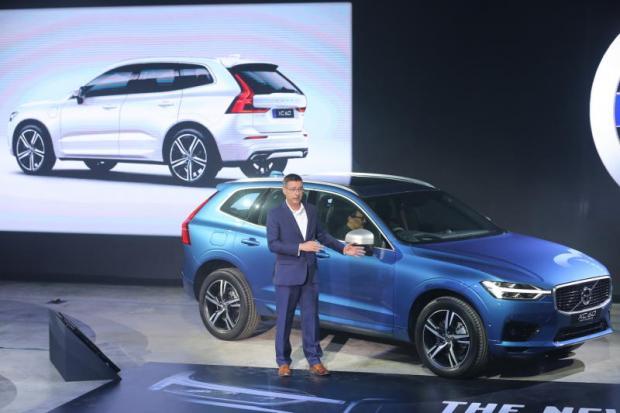
Swedish brand Volvo Car Thailand has a positive outlook on sales performance for 2018, predicting sales of 1,500 vehicles after posting a strong performance last year.
The company reported sales in 2017 of 1,263 vehicles, a 32.4% growth thanks to the introduction of four models last year -- the S90, V90, XC90 and XC60 -- as well as a plug-in hybrid platform meant to beef up sales of eco-friendly cars in the Thai market.
Managing director Chris Wailes said Volvo Thailand expects significant growth by 2020, with a 10% market share in the luxury car segment from around 5-6% in 2017.
"Volvo believes in its Scandinavian designs will appeal to Thai buyers," he said. "As competition in the luxury car market has become aggressive, Volvo must respond to what customers want."
Moreover, Volvo plans to improve customer satisfaction in the long run with its 11 local car dealers adopting its global concept, Volvo Retail Experience.
The luxury car market in Thailand is dominated by Germany's Mercedes-Benz and BMW. Audi, Lexus and Volvo also make up the segment.
Volvo has kept a low profile in the Thai market for the past six years after its sales peaked in 2012 with 1,854 cars sold before dropping 13.5% to 1,603 in 2013.
The company sold 1,260 cars in 2014 before declining further to 935 in 2015.
In 2016, Volvo's performance improved for the first time in four years with 954 cars sold, up by 2%.
Some Volvo cars sold in Thailand are imported from a plant in Malaysia with a production capacity of 3,000 units per year, while other models come from Sweden and Belgium.
Globally, the Gothenburg-based company's sales in 2017 grew 7% to 571,577 cars, driven by growth in all regions.
In the Asia-Pacific region, sales grew by a strong 20.9% to 152,668 units on the back of a record performance in China, Volvo's largest market.
Meanwhile the sales in Europe, the Middle East and Africa region grew by 3.3% in 2017 to 320,988 units, while the Americas region grew by 0.7% to 97,921 units.
Volvo plans to focus more on electric vehicles as part of the company's strategy to cope with low-emission vehicles from 2019 onwards.
Volvo Cars has been under the ownership of the Chinese firm Zhejiang Geely Holding since 2010, and both companies recently announced an investment of 5 billion yuan (24.8 billion baht) to develop high-performance electric cars under the Polestar brand.