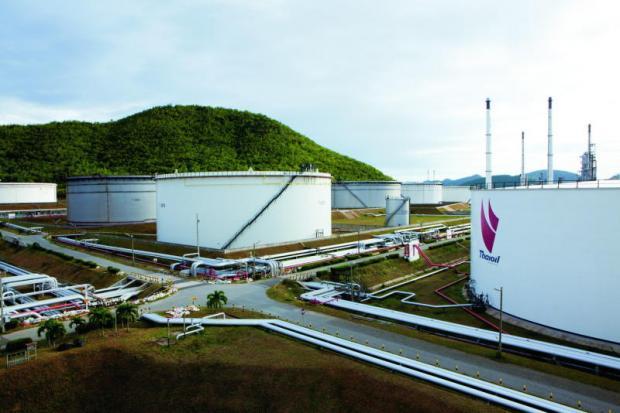
Thai Oil Plc, Thailand's largest capacity oil refinery, expects sharp growth for its margins in 2019 thanks to global crude oil prices remaining lower, making the spread between raw materials and finished oil wider.
Thai Oil forecasts its gross integrated margin in 2019 will rise by 33% to US$8.9 per barrel from $6.7 per barrel in 2018, while the gross refinery margin for the period will increase by 43% to $6.7 per barrel from $4.7 per barrel in 2018.
Chief executive Atikom Terbsiri said demand for refined oil and petrochemicals will continue to rise, helping the company increase margins.
The gross integrated margin includes both petroleum and petrochemicals, but the margin for petrochemicals alone is expected to suffer from surplus supply from new output of 3 million tonnes per year from several petrochemical operators in Asia-Pacific.
"Finished products from petrochemicals will have lower prices than refined oil products such as paraxylene, a fundamental feedstock of fibre and bottles," said Mr Atikom. The spread of paraxylene in 2019 will stand at $360 per tonne, down from $380 in 2018, he said.
But demand for purified terephthalic acid (PTA) and polyethylene terephthalate (PET) will continue to trend upwards, in line with the Chinese economy.
Mr Atikom said the capacity utilisation rate for its oil refinery unit in 2019 is expected to decline to 103% from 112% in 2018 because of a temporary operation shutdown in some units for annual fixing and maintenance.
Thai Oil is committed to continue its productivity improvement programme to widen margins by another $1 per barrel.
This programme is aimed at reducing operating costs. In 2018, Thai Oil reduced operating costs by $1.25 per barrel, raising profit to 4.6 billion baht, higher than the expected 1.5 billion baht or $0.50 per barrel.
"Margins of just $1 per barrel will automatically raise Thai Oil's profit by 3 billion baht in 2019, based on the average output and crude oil price," said Mr Atikom.
In 2019, Thai Oil forecasts Thailand's total demand for refined oil will grow slightly by above 1% to 1.4 million barrels per day.
He said refined oil demand in Asia will continue growing in 2019, but the new oil refinery capacity will be lower than demand, resulting in refined oil prices fluctuating higher than in 2018.
Mr Atikom expects global crude oil prices will remain low for a short period on sentiment from the Sino-US trade war and Brexit.
With increasing demand and limited supply, Thai Oil expects the average oil price in 2019 to stay at $70-75 per barrel, up from $69.5 per barrel in 2018.
He said Thai Oil's sales in 2018 dropped to 300 billion baht, compared with 337 billion the year before, because of the decline in global oil prices.
Profit fell below 24.9 billion baht in 2017 from declining margins.
In a related development, Thai Oil granted a $4-billion contract to a consortium of Saipem, Petrofac, and Samsung for engineering, procurement and construction of the Clean Fuel Project (CFP) in Sri Racha, Chon Buri.
The CFP is designed to complement Thai Oil's existing oil refinery and utility units and is set for development over 2019-22 at a total cost of $4.73 billion.
Capacity for oil refining will increase by 45% to 400,000 barrels per day, up from 275,000 barrels per day.