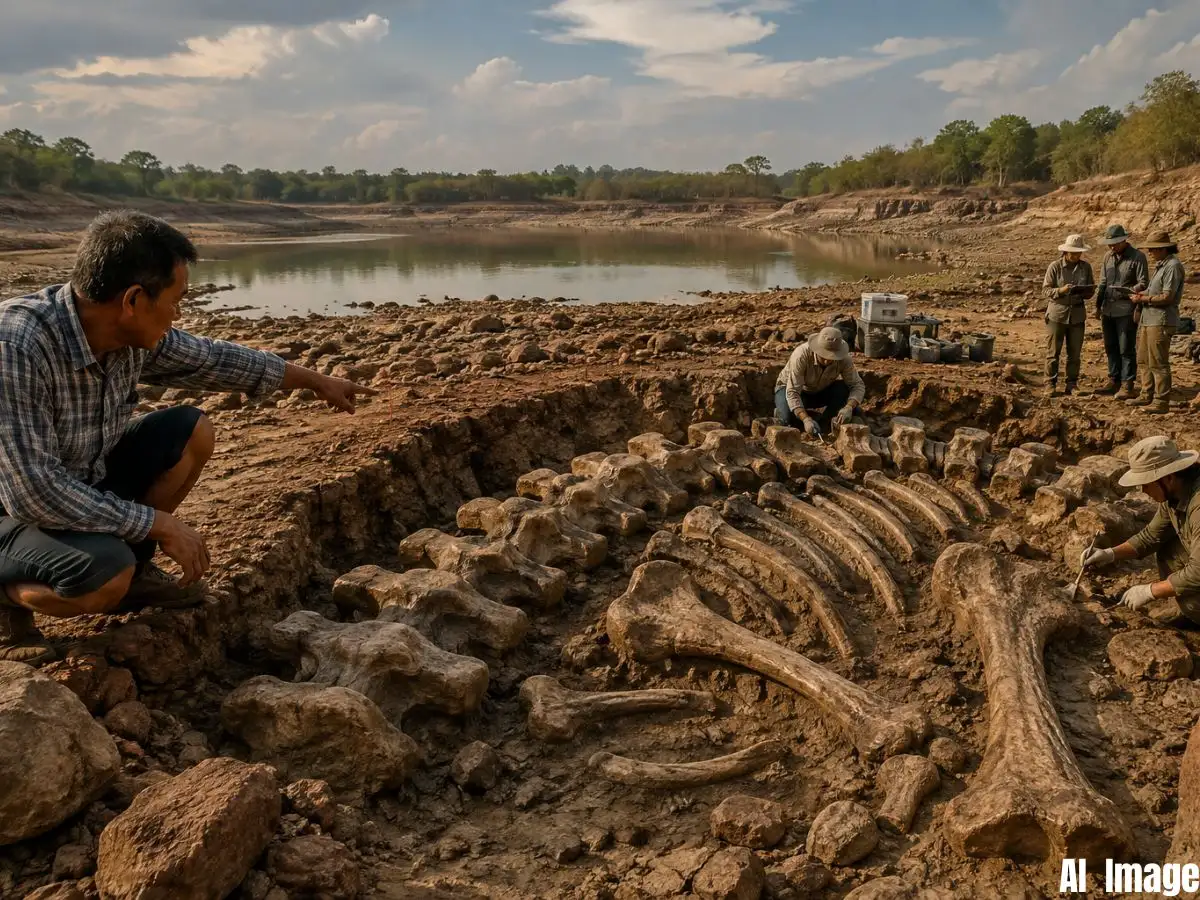
A shrinking village pond in Thailand has helped uncover what is now considered the largest dinosaur identified in Southeast Asia. The fossilised remains, first spotted on the exposed bank in Chaiyaphum province during the 2016 dry season, have now been identified as Nagatitan chaiyaphumensis , a giant long-necked dinosaur that weighed an estimated 25 to 28 tonnes and stretched about 27 metres.
The dinosaur was formally described in a paper published in Scientific Reports in May 2026. Researchers recovered the remains over two field seasons after local residents noticed unusual rocks along the edge of the drying pond.
The discovery took years to reach its full significance, with the fossils eventually revealing a previously unknown species that once lived in what is now Thailand.
A giant skeleton hiding beside a pond
The fossils were not found as a complete dinosaur. Instead, researchers recovered part of the skeleton, including four back vertebrae, four fused vertebrae from the hip, ribs, a right hip blade, both pubic bones, most of a right thigh bone and a complete upper arm bone.
The upper arm bone alone measured 1.78 metres long.
Researchers found no duplicated bones and said the size of the remains matched closely enough to conclude that they belonged to a single animal. The fossils are now housed at the Sirindhorn Museum in Kalasin province.
For a discovery that began with some strange-looking rocks beside a pond, the final result was considerably bigger than expected.
How big was Nagatitan?
The study estimates that Nagatitan chaiyaphumensis weighed between 25 and 28 tonnes and measured around 27 metres from head to tail. The figure of 27 tonnes has been used as a convenient estimate for the dinosaur's size.
University College London, which worked on the research with Mahasarakham University, Suranaree University of Technology and the Sirindhorn Museum, compared its weight with roughly nine adult Asian elephants.
Lead author Thitiwoot Sethapanichsakul, a Thai PhD student in UCL's earth sciences department, placed the animal somewhere between some of the better-known giants in the dinosaur world.
Nagatitan was likely at least 10 tonnes heavier than Dippy, the famous Diplodocus skeleton, but it was still smaller than giants such as Patagotitan , estimated at about 60 tonnes, and Ruyangosaurus , estimated at around 50 tonnes.
So while Thailand's new dinosaur was enormous by regional standards, it was not the biggest dinosaur known globally.
Why researchers call it the “last titan”
The nickname comes from the dinosaur's position in Thailand's geological record.
Sethapanichsakul calls it “the last or most recent large sauropod we will find in Southeast Asia.”
The remains came from the Khok Kruat Formation, the youngest dinosaur-bearing rock formation in Thailand. Researchers found that the layers above this formation were deposited after the area became a shallow sea.
That does not necessarily mean large sauropods disappeared from Southeast Asia at that point. Instead, the geological conditions changed, meaning the sediments needed to preserve their remains were no longer being deposited in the same way.
In other words, the region may have had more giant dinosaurs after Nagatitan , but the rocks may not have been there to preserve them.
What Thailand looked like 100 million years ago
The landscape inhabited by Nagatitan was very different from modern Thailand.
The geological evidence points to a hot, relatively dry environment crossed by a wandering river. The region was home to a variety of animals, making it far from an empty landscape dominated only by giant sauropods.
Fish, freshwater sharks and crocodiles lived in the water. Smaller plant-eating dinosaurs, including iguanodontians and early relatives of Triceratops, occupied the surrounding land.
Large meat-eating dinosaurs, including members of the carcharodontosaur and spinosaur groups, also lived in the area. Pterosaurs flew above the landscape.
Researchers believe the long necks and tails of sauropods may also have helped them deal with heat by providing a large surface area through which they could lose excess body heat.
The discovery may also point to something bigger than one unusually large dinosaur. The researchers suggest that Nagatitan could have been part of a broader increase in body size among Asian titanosauriforms during the middle Cretaceous.
Higher temperatures and expanding habitats may have helped these animals grow larger.
Where does Nagatitan fit in the dinosaur family?
The new species also adds another complication to the already difficult task of reconstructing the sauropod family tree.
Researchers placed Nagatitan in Euhelopodidae, a group of long-necked herbivorous dinosaurs known from Asia. Scientists have debated the group's members and evolutionary relationships for decades.
Thailand and neighbouring Laos had already produced two euhelopodid dinosaurs — Phuwiangosaurus from Thailand and Tangvayosaurus from Laos.
Those two dinosaurs have generally been considered close relatives, supporting the idea of a relatively local evolutionary lineage.
Nagatitan , however, does not fit neatly into that picture. Features in its spine, hips and legs place it outside that pairing, suggesting that the evolutionary history of these Asian sauropods may have been more complicated.
The researchers themselves acknowledge that sauropod family trees can change as new fossils are discovered and analysed.
Thailand's dinosaur discoveries are far from over
Nagatitan is the 14th dinosaur formally named from Thailand. The country's dinosaur naming record began in 1986 with Siamosaurus suteethorni .
The discovery also highlights how much of Thailand's dinosaur record may still be waiting to be studied.
Project leader Sita Manitkoon of Mahasarakham University has said Thailand could rank among Asia's leading countries for the abundance of dinosaur remains.
The excavation was carried out as part of Project Thaitan, a national research programme, with funding from the National Geographic Society.
The discovery site now has a research centre, while a life-sized reconstruction of Nagatitan has been displayed at the Thainosaur Museum at Asiatique in Bangkok.
For visitors, that means the entire 27-metre scale of the animal can now be seen rather than imagined from a few bones.
But perhaps the biggest surprise is that Nagatitan may not be the end of the story.
Thai museums hold a sizeable collection of sauropod fossils that have yet to be formally described. Some of those specimens could belong to species that scientists have not identified yet.
So Thailand's newly crowned giant may eventually have to share the spotlight with another dinosaur still waiting to be named.