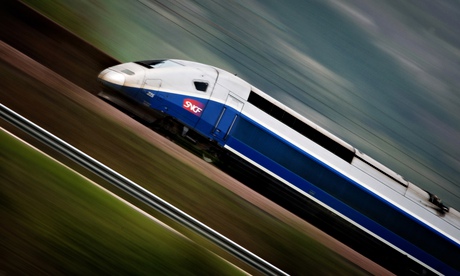
There are indeed lessons to be drawn for HS2 and HS3 from the report on the TGV in France by the French audit office (France’s ‘incoherent’ TGV network fails to live up to high-speed promise, 27 October). The report has been used to suggest that the TGV network is “running out of steam”. The report appears to justify this opinion by presenting a headline statistic that states that 40% of journey times on TGVs are spent on non-high-speed routes. The strength of high-speed trains is to cover distance. Given that the average speed of a TGV on a high-speed line is nearly three times that on a conventional route, the distance travelled on conventional lines is only around 10% or 15% of the total distance travelled. Lesson one – beware the misuse of numbers to support a politically motivated argument.
The network of services provided by TGV trains is very extensive – it serves 230 destinations, despite the fact that there are only five high-speed routes. That is its strength – it offers a network of services between all major French cities and most of the country’s rail-served towns. It does this by trains that serve a small number of major centres and then run seamlessly on to conventional lines, something that will not be achieved by the dead-end terminal stations proposed for HS2 in London, Birmingham, Manchester and Leeds. The adoption of terminal stations will reduce the frequency of services between individual pairs of cities. It will also waste capacity on the high-speed line because of the need to provide separate medium-distance point-to-point services, such as Birmingham to Manchester. Lesson two – high-speed lines must be designed to allow the operation of frequent, regular-interval train services that are fully integrated into public transport networks, and not just to provide point-to-point services like an airline.
Greg Haigh
Dorking, Surrey