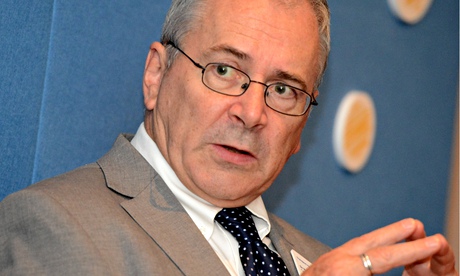
Transport for London’s commissioner Sir Peter Hendy has dismissed fears that the popular taxi hire app Uber threatens the future of London’s black cabs, stating that cabbies’ anger at the startup business is “misplaced”.
London black-cab drivers staged a ‘go slow’ protest around Trafalgar Square in July 2014 to demonstrate their opposition to the smartphone app that allows users to book and pay for unregulated private hire vehicles. The protest was replicated in many other major European cities in which Uber operates.
But speaking at the Guardian’s transport debate at the Conservative party conference this week, Hendy insisted the Silicon Valley startup would not displace London’s classic black cabs.
“There’s always likely to be a future, in the centre of one of the world’s great cities, for a taxi service that you can hail,” he said. “I don’t come out of my office and think I’m going to get onto my phone to look for a car. I look down Victoria street and I find a vacant taxi. I know the driver knows where he’s going and I know he’s licensed, because apart from anything else I license him.”
The Licensed Taxi Drivers Association believes Uber drivers operate illegally. The dispute hinges on whether an Uber driver’s smartphone qualifies as a meter – a device that currently only strictly regulated black cabs can use.
Hendy, who leads TfL’s management team insisted that Uber was operating legally. “There’s a dispute that we have with the taxi trade about whether or not an iPhone is a taximeter or not. It’s pretty obscure because the legislation was written before mobile phones were invented,” he said.
However Hendy admitted that he did have concerns about consumer safety within the ‘sharing economy’, in which apps such as Uber operate. Most transport-sharing apps connect citizens with drivers who are not registered by central or local government. “Some of it is akin to hitchhiking,” he said.
London’s transport commissioner also warned delegates at the conference in Birmingham that new plans for segregated cycle lanes in the capital could be toned down after criticism. Opponents say the scheme would reduce road space and increase congestion. “They have engendered a fair amount of controversy, both in favour of them and against.” Hendy admitted. “There might be some compromises in the end because there’s a world of difference between cycling down a road with all other road users and a completely segregated cycle lane which takes space out of the road.”
Meanwhile, other panellists grappled with the wider transport challenges facing the UK. The chief executive of Gatwick Airport, Stuart Wingate, warned that the next generation of passenger airplanes would disrupt the European aviation industry. Smaller, long-haul planes such as the Dreamliner and Airbus A350, which hold around 100 fewer passengers than a jumbo jet, will open up long-haul travel to many smaller airports. The result will be that long-haul flights will no longer be limited to a select few major airports, he claimed. “Norwegian [airlines] earlier this year disrupted the market in the southeast by starting to fly direct to JFK [airport, New York]. Previously your only choice was to go from Heathrow. Norwegian have come on with a low-cost model and you can get there, including taxes, for £150,” he said.
According to Wingate, airlines are ordering newer, smaller aircrafts at 10 times the rate of older models; Gatwick expects long-haul travel to soon be dominated by new aeroplanes
Back on the ground, Jon Lamonte, chief executive of Transport for Greater Manchester, urged future governments to invest in city infrastructure including transport as a way to boost economic growth. “[Cities] only represent around 5% of the land, but well over half the population and certainly 60% of the jobs and 60% of the output,” Jon Lamonte said. “That’s where you’re going to get your growth from.”
Lamonte said government would also need to offer cities more individual powers to achieve maximum growth. “It requires a good knowledge of what’s required locally and that’s why we advocate devolving decision-making to the lowest practical level – because that’s how you can make that growth work,” he said.
This conference fringe debate was designed and produced by the Guardian to a brief agreed by partners Gatwick Airport, Transport for London, Transport for Greater Manchester and the Transport Systems Catapult. All content is editorially independent.
Read more from the Guardian Big Ideas at the 2014 party conferences.