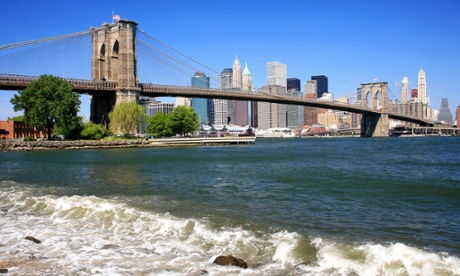
“You guys wanna talk about sex?” Jami Attenberg teased the crowd at Monday night’s Books Beneath the Bridge reading series in Brooklyn Bridge Park. But the mostly female audience was more interested in discussing questions of perennial interest to New Yorkers – the city’s history, its inspiration for writers, and how hard it is to get a date in this town. After a stiflingly hot day, the evening reading at the water’s edge was a relaxed occasion, disturbed only by the occasional foghorn of a passing ship.
Attenberg is the author of the recent novel Saint Mazie, which reimagines the jazz age life of Mazie Phillips, proprietress and benign spirit of the Lower East Side movie theater the Venice. Phillips’s life unfolded, Attenberg said with a wave of her hand, “right over there”, between the bridges that form the backdrop to the park. The novelist was joined by Kate Bolick, author of the history-infused memoir Spinster, in a reading of vivid, personal and, in Attenberg’s case, distinctly racy slices of their books to the crowd gathered at the edge of the river. (Attenberg said she warned the parents of the few children present in advance, but “they’re city kids, they don’t care”.)
A different city bookstore curates each instalment of the Books Beneath the Bridge series, which runs Monday evenings throughout the summer. Attenberg and Bolick were there at the invitation of Powerhouse Arena, in nearby Dumbo, which has made a tradition of pairing female authors for its event. In this case, both writers’ books are works of discovery and homages to unconventional women with lives that are interlaced with the city’s history.
Both authors live in Brooklyn themselves. Bolick’s reading recalled her move to the city in 2000, to a street “actually called Cranberry”, a few blocks from where we sat. But the Boston transplant found the neighborhood disappointingly similar to what she had left behind, too wealthy and genteel for the restless new New Yorker she wanted to be: “I was smothered by the sensation of being handed a prize I had yet to earn.”
In the archives of Vogue magazine she discovered a series of columns by Neith Boyce, a journalist who had also made the move from New England, and who wrote of her life as a “bachelor girl” at the tail end of the 19th century. In what Bolick called the “retrograde world” of the turn of the 21st century, when being single was “a choice between Carrie Bradshaw and Bridget Jones”, Boyce’s resistance to the prevailing matrimonial narrative was an unexpected inspiration that seemed to mirror Bolick’s own experience. The connection was one of those “interesting cycles about New York City that repeat themselves”, she said.
The talk of singleness struck a nerve with the audience, who wondered whether it was a particular problem of the city. But instead of seeing singleness as a problem, Bolick’s book sets out to reclaim the word “spinster” from the “lonely old, frigid cat lady”. It explores what she calls her “spinster wish”, a longstanding fantasy of being alone, free to retreat into a cocoon between forays out into the crowd. Attenberg’s take was a little more down-to-earth: “I literally have no fantasy about the single life,” she told the crowd drily. “I am single.”
As she wheeled her yellow bike out of the park, Attenberg explained the shared origins of her book and the Williamsburg bar St Mazie, owned by her friend John McCormick, who was in the audience. It was McCormick and his wife, Vannessa, who first introduced her to Mazie Phillips, a character in New Yorker writer Joseph Mitchell’s legendary collection of real-life city stories, Up in the Old Hotel. “All stories start with interesting things your friends talk about,” she said. Inspired by Phillips’s life story – “She was the closest thing to a saint I’d ever heard of” – the novelist plunged into research about the city in the 1920s, 30s and 40s. But more than that, she tried to recapture the essence of that history physically. “I would walk the cobblestone streets,” she recalled, in order to retrace her character’s steps and meditate on what had gone before. The movie theater where Mazie presided, which became a place of rest and respite for the homeless men and women of the Bowery, is “just air now”. But its spirit lingers.
After the reading, Attenberg was approached by one of the city’s many amateur historians and obsessive chroniclers of its changes. David Bellel, who runs the Knickerbocker Village blog corralling memories of a pre-gentrification Lower East Side, presented her with a printed copy of Mazie Phillips’s census record (and offered to help her with that single issue). It was a reminder of how personally New Yorkers take their history, and how vividly it can come to life in such a setting.