Texas is set to put to death a second prisoner in less than a week as the state ramps up its execution rate despite struggling to source lethal injection drugs.
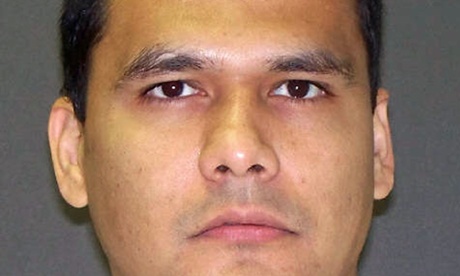
Manuel Garza is scheduled to die in the Texas state penitentiary on Wednesday evening for the murder of a Swat officer in San Antonio in 2001.
Last Thursday, Texas officials used the last of a batch of compounded pentobarbital to execute Kent Sprouse, who also killed a police officer. They have secured more supplies of the sedative – but only enough to carry out the three other executions they have planned for April. Another three are scheduled in May and June.
Garza would be the sixth man executed in Texas this year out of a national total of 13.
If the country’s most active death penalty state cannot find more pentobarbital, it may be forced to change its protocol and use a different drug or combination of drugs. However, other states that have resorted to experimental protocols after similar supply problems have faced lawsuits after a series of botched lethal injections that have placed the legality of the process into question.
Garza, now 35, was convicted in 2002 of killing John Riojas. Garza had an extensive prior criminal record and had outstanding warrants. Riojas chased him into an apartment complex, where according to testimony, there was a struggle and Garza grabbed the officer’s gun and shot him in the head.
“As I started running, the cop was telling me to stop. I just wanted to get away. I knew I was gonna go to jail and I didn’t want that,” Garza said, according to court documents. He was arrested two days later.
He said in a statement to police: “I want to say to the media and to the officer’s family and everybody out there that this wasn’t intentional and I truly think this was the cop’s fault. I don’t see why he wanted to pull out his gun. I want to say to the judge and the jury to please do justice and please have mercy on me and give me the benefit of the doubt. I don’t think I should get death or life in prison. I think I deserve something under that. I need a lot of help about how to do life. I wasn’t raised right.”
Garza mounted unsuccessful appeals based on claims that his trial lawyers were ineffective for failing to establish that jurors were not biased in favour of the death penalty for cop killers and because they did not introduce witness testimony raising the possibility that the gunshot was accidental or medical records suggesting that he was so badly beaten that he might have acted in self-defence.
Garza also argued that his troubled upbringing in a violent, crime-ridden family helped explain his antisocial behaviour and criminal history, that he may have been a victim of fetal alcohol syndrome and that his background should have been considered as a mitigating factor.
Information from the Associated Press was used in this report