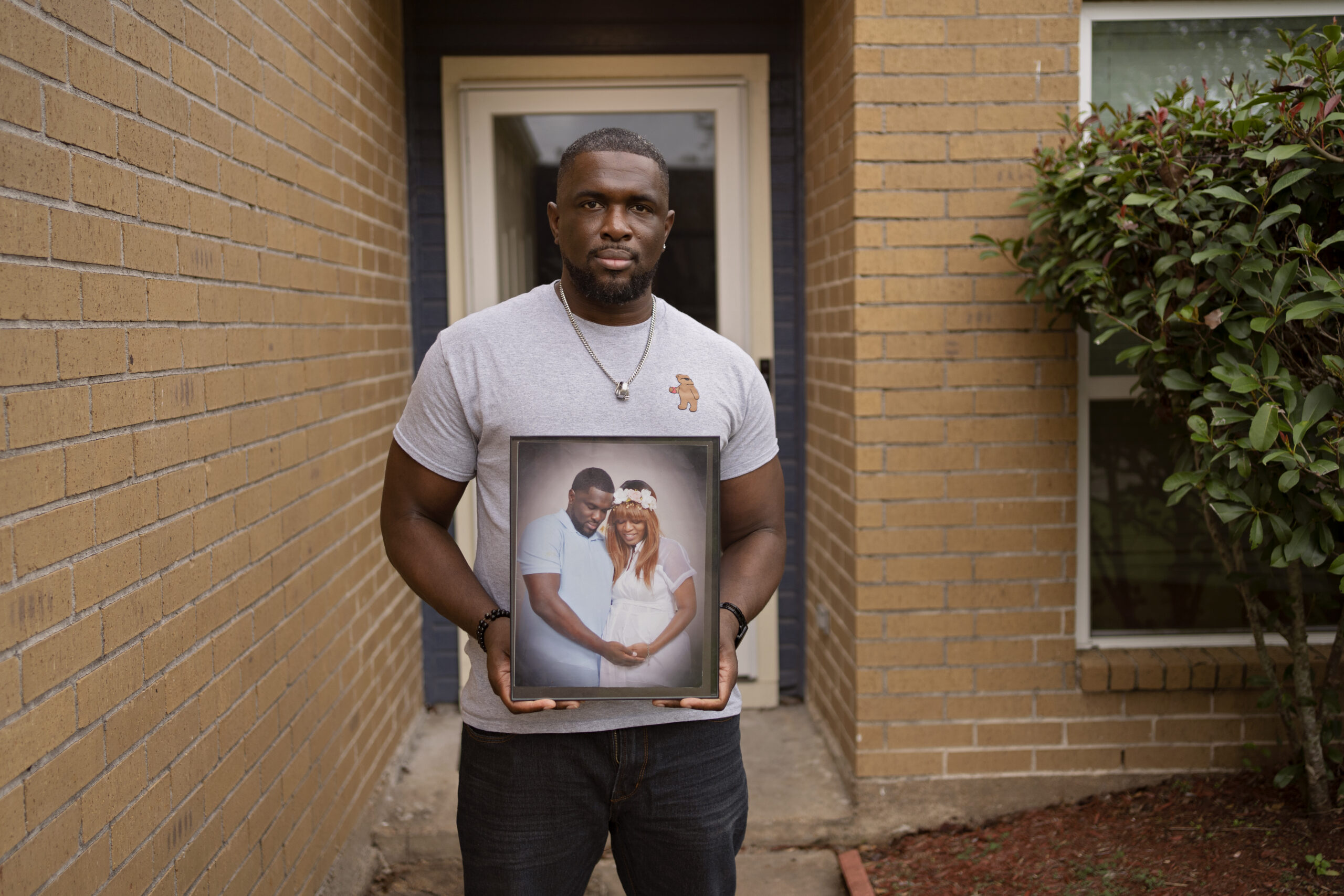
Hope Ngumezi never imagined he would be a single father.
When he met his late wife Porsha at Lamar University in Beaumont, Ngumezi was instantly enamored of her energy, drive, and compassion. Both Ngumezi and Porsha came from large families and were eager to start their own. After getting married in their late 20s, they happily welcomed two sons, ages 3 and 5 at the time. Porsha got pregnant again in early 2023, this time with a girl.
But, rather than welcoming a daughter into their home, Ngumezi was forced to bury his wife.
At 11 weeks into her pregnancy, Porsha, 35, began to miscarry and bleed excessively, passing large clots “the size of a grapefruit,” as previously reported by ProPublica. When rushed to the hospital, she needed an emergency dilation and curettage (D&C)— a procedure that gently suctions the uterus. D&Cs can be life-saving, and they can also be used for first-trimester abortion care. Instead of the needed procedure, doctors offered Porsha misoprostol. The medication, which softens the cervix and helps contract the uterus, is considered less risky for fearful doctors facing up to life in prison for violating Texas’ criminal abortion ban, yet it’s far less effective at stopping hemorrhage. Just hours later, Porsha was dead.
“My wife should still be here. Her death was preventable,” Ngumezi, now 39, told the Texas Observer in February. “This law came and disrupted the medical system and took my college sweetheart away from me. Now my boys are forced to live without a mother.”
Since Porsha’s death, the Houston-area airline engineer has sought to turn his grief into activism, sharing his story far and wide with the goal of preventing another tragedy. His mission feels cathartic, and it serves as a way to honor his late wife.
But Ngumezi said the pain of losing Porsha has been “retriggered” since he learned in 2024 that a state health committee tasked with reviewing cases of women who died during pregnancy or childbirth would skip analyzing data from 2022 and 2023—the two years including and following the fall of Roe v. Wade at the hands of the U.S. Supreme Court and the enforcement of the state’s criminal abortion ban. The year 2022 also marks the first full year after Texas passed Senate Bill 8, the state’s earlier ban that relied on civil litigation for enforcement and took effect the prior fall. The committee’s decision meant it would not investigate Porsha’s death.
Instead, the forthcoming report of the Maternal Mortality and Morbidity Review Committee (MMRC), due September 1, will leapfrog those pivotal years and focus on cases from 2024, leaving those eager to assess the immediate impact of the state’s abortion bans frustrated. The 23-member committee is composed largely of physicians in various fields as well as nurses, health researchers, and two community roles. The members are appointed by the head of the Texas Department of State Health Services (DSHS), who is in turn appointed by the leader of the state’s Health and Human Services Department, a position chosen by Republican Governor Greg Abbott. Dr. Jennifer Shuford, who led DSHS starting in late 2022, was appointed by President Trump in April to serve as deputy director of the Centers for Disease Control and Prevention, and an interim commissioner now holds the DSHS role. The MMRC issues biannual reports that offer recommendations to the Texas Legislature about how to reduce maternal deaths through policy, but, as the 2027 session looms, they’ll do so based on a partial picture.
“I feel embarrassed and ashamed that our state isn’t doing what it should to investigate these deaths,” said Hope. “How are they going to meaningfully find a solution? They are not holding themselves accountable. … It triggers memories of how those in charge didn’t really care about my wife or her life.”
The committee’s most recent report, released in 2024, showed a surge in maternal deaths in 2020 and 2021, even while excluding deaths related to COVID-19, marking the highest rate since the MMRC started examining these cases in 2014. In 2021, the rate was nearly 38 deaths per 100,000 live births—and 27.7 the year prior——compared with 17.2 in 2019. Texas had a higher maternal death rate than the national average in both 2020 and 2021, and, more recently, it still has a higher rate than the national figure.
The overwhelming majority of maternal deaths in Texas, around 80 percent, were preventable, the MMRC found in 2024. Infections were reported to be the most common cause, followed by conditions including cardiovascular problems, obstetric hemorrhage, and embolisms. And Black women, like Porsha, continue to be disproportionately affected; they are 2.5 times more likely to die from pregnancy-related causes than white women. In its last report, the MMRC found that Black women’s mortality from 2019 to 2020 jumped by 11 points, to 39 deaths per 100,000 live births, and for Hispanic women by 13 points, reaching 22.2 per 100,000.
“Black women carry the greatest burden when it comes to barriers to abortion rights and to maternal deaths,” said Marsha Jones, a longtime Texas reproductive justice advocate who is now with the Dallas-based Women’s Health and Evolutionary Wellness Project. “So it’s a slap in the face to all Black women for the state to choose not to evaluate the impact of what happened right after Dobbs. It’s totally irresponsible.”
Jones continued: “I believe this was absolutely a politically influenced decision.”
Since Texas barred abortion care in late 2021, a series of harrowing stories of women who have died, or faced the brink of death, has ensued. These include Texas women Josseli Barnica, a 28-year-old mother who died after doctors told her it would be a “crime” to intervene in her miscarriage; Nevaeh Crain, a teenager who died despite three separate emergency room visits to seek care; and Tierra Walker, who died of preeclampsia after not being able to access abortion. Nearly two dozen women who were denied abortion care, resulting in traumatic health complications for some, sued the State of Texas in 2023 to clarify the ban’s vague emergency care provision. (Ultimately, the state prevailed.) The tragic stories underscore how the abortion bans have pitted Texas doctors’ medical ethics against punitive state laws that could land them in prison for life, forcing them to delay or deny sometimes life-saving care.
While Republican lawmakers (who themselves authored the abortion ban legislation) have belatedly sought to clarify when doctors can save lives, namely through last year’s Senate Bill 31, and the Texas Medical Board, after years of silence, this year issued training for doctors on how to provide pregnancy termination if the life of the mother is at risk, reproductive rights health experts and advocates stress that many of these efforts fall far short of solving the problem.
During public hearings in 2024, Dr. Carla Ortique, a Houston OB-GYN who chairs the MMRC, defended the committee’s decision not to review maternal deaths during the crucial post-ban years, saying there was “no nefarious intent” or political motivation behind the decision. She said the move was simply meant to keep the focus on more recent cases and, she believes, women in the subsequent years likely face comparable impacts.
“There was no input from the executive or any other branch of our state government regarding our plans for cohort review,” she said. “It is imperative that we become more contemporary in our review process.”
After discussing media coverage revealing potential political interference with the MMRC, Ortique reminded her fellow members that “regardless of personal beliefs and opinions,” they’d vowed to “protect the integrity” of the work and the “[state] agency that supports” the work—and that they were all bound by signed confidentiality agreements.
Nevertheless, the committee has faced backlash from medical professionals, advocates, and politicians for its choice to seemingly evade the immediate post-Roe fallout, with many believing politics played a role, at least tacitly.
“It does absolutely make me suspicious,” Austin Democratic state Representative Donna Howard, who serves as chair of the Texas Women’s Health Caucus, told the Observer. “It’s clear from media reporting there have been deaths directly related to the abortion law in those two years, and yet these deaths are not going to be reviewed? I have my doubts about why and how this choice was made.”
Howard casts a skeptical eye on the claim that the committee is forgoing those two years simply to stay current. Responding to criticism that the MMRC has historically lagged behind in its data collection, Howard authored and passed a law during the 2025 legislative session to help speed up the process. House Bill 713 allows nurses reviewing maternal health documents to examine unredacted data, saving hundreds of hours of work and months of delays.
“I was trying to remove one of the MMRC’s biggest stumbling blocks,” said Howard. “We passed it, and it put in place an opportunity to expedite the review, which should have helped.”
Other attempts to accelerate data collection stalled, including a measure from Houston Democratic Representative Armando Walle that sought to require the committee to annually review cases from the previous year, rather than reviewing cases every two years as it does now. Walle, who helped author the 2013 law that created the MMRC, told the Observer his “original intent” was not to place any limits on what years the committee would review. He has urged the MMRC to analyze the two years they’ve decided to gloss over, calling the move “short sighted.”
Walle added, “I can’t say why for sure, but I certainly suspect I know why they are not reviewing those years.”
Nakeenya Wilson, a former member of the MMRC, has testified before the committee to express her reservations about the decision. Wilson doesn’t believe the committee is necessarily at fault; rather, members may have received pressure from Republican lawmakers or state officials that stand to benefit from concealing the consequences of their anti-abortion laws.
“I understand that the committee says they want to be contemporary and catch up with the data, but it’s very concerning that they happen to be skipping over the two most significant years of reproductive health in the state and nation’s history,” she told the Observer. “It’s clear to me that somebody has an agenda here.”
In response to an Observer request for comment, DSHS echoed the MMRC’s stated reasoning. “The purpose is to make sure reviews are more contemporaneous, which will help support the committee’s recommendations on addressing maternal health,” said agency spokesperson Lara Anton.
DSHS says it will make the raw data for the overlooked two years available on its website even if it doesn’t review individual case records. However, without the deeper analysis, those numbers won’t have much meaning, argued Howard.
“I’m glad to at least have the numbers, but that’s all they’re going to be—just numbers, not the critical information and review we need as lawmakers to ensure moms stop dying in this state,” she said.
This isn’t the first time a decision to withhold Texas maternal mortality data has come under fire for possibly being politically motivated. In 2022, then-commissioner of DSHS John Hellerstedt—just three months after the overturning of Roe—announced that the MMRC’s report, slated to be out that September, would be delayed until the following summer purportedly due to “incomplete 2019 data.” (Hellerstedt retired soon after the announcement.)
At the time, maternal health advocates criticized the move as politically “strategic,” as the report would now coincidently be released after the midterm elections. Ultimately, the report came out that December, after the election but prior to the Texas legislative session.
Wilson, who served on the MMRC at the time of the delay, was vocal about what she considered data suppression, calling it tantamount to “dishonorably burying” the women who died and championing its timely release.
She eventually found herself pushed out of the committee. Having nearly lost her own life while giving birth, Wilson sat on the MMRC as an outspoken advocate and voice for other women of color who experienced similar birth and pregnancy trauma. When a 2023 law eliminated her “community advocate” position, she applied for a different role on the MMRC but did not get the job. Instead, the head of DSHS appointed Ingrid Skop, a leading U.S. anti-abortion activist, as a “rural community” member, despite the fact the OB-GYN is based in San Antonio. Among her extremist views, Skop believes abortion bans do not lead to an increase in maternal deaths and in fact may actually help reduce those rates.
“I think the appointment of [Skop], who has been fighting abortion access, including abortion pills, which research shows are safe and effective, raises questions about whether the Texas MMRC might be a target for political interference,” Pilar Herrero, senior attorney with the Center for Reproductive Rights, told the Observer.

As abortion restrictions proliferate across the United States, maternal mortality committees in Republican-led states have seen a trend of possible political intrusion. In 2024, following investigative reports that showed a connection between the deaths of two women and the state’s abortion ban, Georgia officials dismissed all 32 members of their maternal mortality review committee. Idaho quietly disbanded its committee in 2023 after conservative groups pushed back on the committee’s calls to help save the lives of new moms by expanding post-partum Medicaid coverage. When Arkansas’ committee similarly recommended extending Medicaid, Republican Governor Sarah Huckabee Sanders created her own maternal advisory group, and Florida’s committee went dark as the state restricted abortion.
MMRCs are relatively new, established over the past decade, after the revelation in the early 2010s that the United States suffers from one of the highest maternal death rates in the world compared to other similarly developed countries. Nearly all U.S. states today have a committee responsible for tracking pregnancy-related deaths and offering recommendations for prevention. Herrero, who served on an MMRC in New York from 2020 to 2024, worries about the future of the committees, whose work is now becoming even more essential amid the deadly consequences of abortion bans.
“I’m deeply concerned about the levels of suspicion and mistrust around MMRCs,” she said. “As our politics have gotten increasingly hostile around reproductive health, I think these committees are getting caught up in that.”

Walle, who was motivated by a startling rise in Black mothers dying in Harris County, recalled the “uphill” battle it took for Democrats to pass the statute that would create the MMRC in 2013; in fact, the first attempt during the 2011 legislative session floundered.
“It was a struggle to get over the finish line,” said Walle, who authored the original House version of the bill. “We had to make compromises because we were up against the [Republican] pushback to expanding government.”
One of the major compromises lawmakers acquiesced to was agreeing to Sunset review—a process that determines whether government agencies can continue operating—in 2019. Democrats have succeeded so far in averting its potential demise, yet the committee is once again facing Sunset next legislative session. Walle intends to fight for its survival, but the MMRC’s future remains uncertain.
With the MMRC lagging in its analysis of post-Roe fallout, the work has fallen to academics and investigative reporters. Suzanne Bell and her fellow researchers at the Johns Hopkins Bloomberg School of Public Health have estimated that in states that implemented a full or six-week abortion ban the number of pregnancy-associated deaths was 9.2 percent higher than expected through the end of 2023, according to their study in the American Journal of Public Health. As the first state to ban abortion care, months prior to the Supreme Court’s ruling, and as the most populous banned state, researchers knew Texas would have an outsized influence on their study, so they analyzed it individually. Their results suggest that Texas’ pregnancy-related deaths possibly rose by 13.5 percent and maternal mortality may have increased by 8.4 percent.
“We’re seeing real harms of these bans on population health,” Bell told the Observer. “Our work suggests many preventable deaths have occurred in states that banned abortion, like Texas. … We should be working to improve and reinforce our [maternal mortality] review committees and their ability to review all the data—not doing the exact opposite.”
Meanwhile, news outlets including ProPublica have taken it upon themselves to do the analysis that’s lacking from the state, finding that sepsis rates during second-trimester pregnancy-loss hospitalizations increased by more than 50 percent after Texas’ earlier ban went into effect in 2021 and that the number of blood transfusions during emergency room visits for first-trimester miscarriage shot up by 54 percent following the state’s criminal ban in 2022. The number of emergency room visits during first-trimester miscarriage also rose by 25 percent, suggesting delays in care.
Kaitlyn Kash knows the dangers of Texas abortion laws first hand. The Austin mother has suffered multiple complications while pregnant that were made more harrowing, and nearly deadly, due to the restrictions.
During a routine 13-week ultrasound in October 2021, she discovered her baby had severe skeletal dysplasia, a genetic condition in which bones become brittle and easily break. Her child, whose ribs were not strong nor large enough to support lung function, was unlikely to survive birth.
While Kash asked about pregnancy termination, doctors—a month after the state’s six-week ban took effect—recommended she “seek a second opinion from outside Texas” and said there was not much else they could do.
“I thought to myself, ‘Wow they feel like they can’t even mention the word abortion, they can’t even talk about it directly,’” Kash, who was eventually able to travel to a clinic in Kansas for care, told the Observer. A few months later, she became pregnant again but started to miscarry at seven weeks. Her doctors prescribed her misoprostol, but Kash struggled to find a pharmacy willing to fill the prescription.
By 2023, Kash gave birth to a daughter, but she needed a D&C procedure to remove placenta stuck in her uterus. Kash began throwing up, shaking uncontrollably, and bleeding profusely. She was on the cusp of hemorrhagic shock, and doctors needed to act fast or she would die. Yet they had difficulty finding the equipment and stalled in operating on her as she drifted in and out of consciousness. Every minute that passed was “terrifying” to Kash and her husband.
“My life was in danger. I thought I was going to die,” Kash said. “When I woke up, I couldn’t get answers on what had gone wrong or why it took so long to act. It was a social worker at the hospital who later revealed to me ‘Oh, we don’t do those anymore’ about D&Cs. And I could tell the minute she said it, she realized she shouldn’t have.”
Of the MMRC’s decision to forgo reviewing post-Roe maternal deaths, Kash said it’s a “blatant” attempt to censor information about the impact of abortion bans. She suggested committee members may be walking a “tight rope” hemmed in by not just DSHS but the state-funded health institutions they work in professionally.
“They are not even trying to hide the fact they want to conceal these deaths anymore,” she said. “I believe the members of that committee want to do better but they can’t. I think their hands are tied by state officials who decide what they can and can’t review.”
Abbott, Lieutenant Governor Dan Patrick, and state Senator Bryan Hughes—who authored the 2021 ban—did not respond to requests for comment for this story.

Herrero pointed out that cases like Kash’s are an important part of solving the crisis yet are likely not being reviewed. “We know that for every person that dies from pregnancy-related complications there are many, many more people who experience very serious, life-threatening events,” she said. “If the committee were more well-resourced, they could study cases like this.”
What’s also troubling for women’s health advocates is the fact that the MMRC does not count abortion-related deaths—meaning cases in which abortion was the cause of death (typically self-managed, since physician-managed abortion is extremely safe)—a revelation committee members say they only discovered in 2024 after more than a decade. The 2013 Texas statute that created the MMRC includes a provision that excludes such cases from review. “This chapter does not apply to disclosure of records pertaining to voluntary or therapeutic termination of pregnancy, and those records may not be collected, maintained, or disclosed under this chapter,” it reads.
“This is something we didn’t really understand until recently,” committee member and maternal health researcher Amy Raines-Milenkov told the Observer. “So we don’t really know if someone died after self-managing an abortion because they couldn’t get care. … Until that section is removed from the law, we won’t know.”
Walle said the environment has changed since legislators originally crafted the statute more than a decade ago. He and others are now working with experts and advocates to expand the law to take into account these deaths, while respecting patient privacy.
“It’s a different conversation now,” said Walle. “Access to care has changed after the Texas GOP banned abortion and criminalized doctors. Women are entitled to all the information they need to have healthy and safe pregnancies. And it is our moral obligation to protect the mothers who bring life into this world.”
Editor’s Note: This story was supported by a grant from the Fund for Investigative Journalism.