After spending four decades in exile south of the Rio Grande, the New World screwworm has finally wriggled its way back into Texas. The return of the parasitic worm has been splashed across national, state, and local headlines for the past couple weeks with equal measures of trepidation and disgust, prompting alarm and pledges of swift action from government officials.
It’s potentially devastating news for Texas livestock producers, who stand to lose $1.8 billion if the screwworm is allowed to reinfest the state. Circumstances are even more dire for the cows, horses, sheep, and goats that constitute the worms’ favored prey—were they up to speed on current events, their ranks would be aquiver with terror.
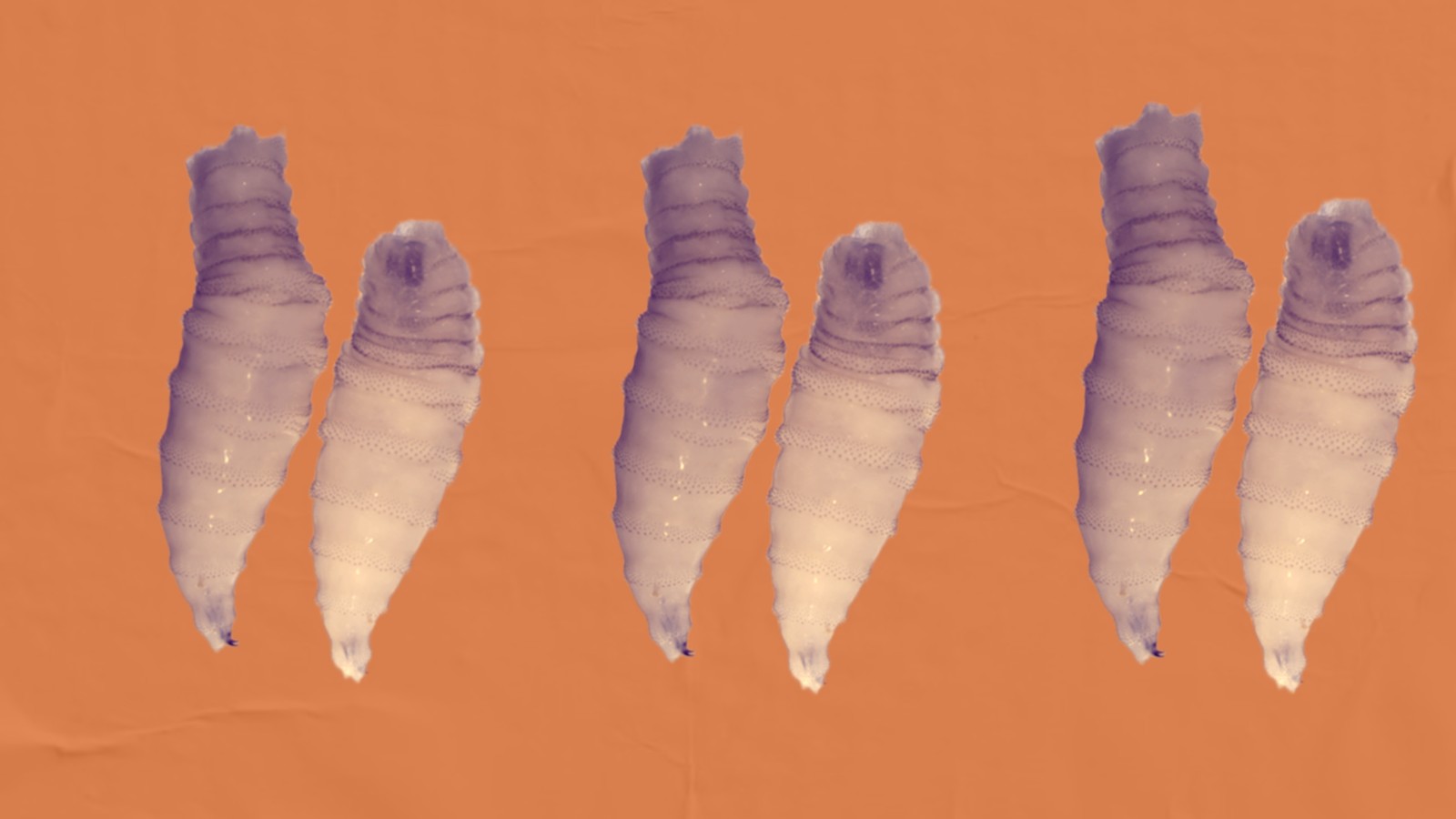
The life cycle of a screwworm, to borrow a phrase from Hobbes, is nasty, brutish, and short. The insect begins life as an egg laid in the living flesh of an animal, usually inside an open wound or mucous membrane. The larvae hatch and latch onto their host with hooklike mouthparts, supping voraciously for 14 days or so before metamorphosizing into adult flies, reproducing, and finding a new animal to afflict. Female flies can lay 300 eggs at a time, and larvae can feed so vigorously as to cause the death of their host within one week. The worm’s scientific name, Cochliomyia hominivorax, is Latin for “man eater,” though infestations in humans are relatively uncommon. Mostly the worms are interested in parasitizing livestock, wildlife, and, yes, even your beloved pets.
Get the newsletter
Sign up for The Lede
Get the stories you need to know about each week. Delivered every Sunday.
Sign Up Now
The screwworm’s reentry into Texas had been portended since 2023, but it wasn’t until two weeks ago that the insect was caught breaching our southern border. Two specimens were found in newborn calves in Zavala County, just a few miles from Mexico. Days later it was discovered that they’d spread ever farther—screwworms were detected dining on another calf in La Salle County, a goat in Gillespie County, and a dog in Andrews County, which is some 400 miles north of the first reported case.
Now state and federal officials are scrambling to swat the bugs like pests at a picnic. Governor Greg Abbott has made a disaster declaration due to the risk posed to Texas’ $15 billion cattle industry. John Bellinger, a regent of Texas A&M University, has been tapped by the feds to lead the charge against screwworms. A 12-mile quarantine zone has been charted in Zavala County, and a wider “surveillance zone” has been created around it. Meanwhile, the U.S. Department of Agriculture (USDA) is effectively trying to create a no-fly zone in South Texas. The agency is building a factory in the border city of Edinburg to produce sterile male screwworms that are incapable of reproduction, but the facility is not expected to be online for another year.
Despite the surge of state and federal resources, the screwworm problem may prove difficult to squash. The insect was first purged from Texas in 1966, but one decade later the worms were back for their pound of flesh. Once again the wriggling masses of flesh-eating larvae were nightmare fuel for ranchers, who were bled of $728 million in today’s dollars. The Texas economy suffered to the tune of $2 billion. In 1986, through a plentitude of political wrangling and inventive new eradication efforts, the worms were forced to mount another retreat back to Mexico with their wings tucked between their legs. The moral of the story: Give a screwworm an inch, and it’ll take a mile.
It’s evident that the Trump administration hasn’t given much credence to the cautionary tale. The president lowered the drawbridge for screwworms last year when Elon Musk’s Department of Government Efficiency (DOGE) slashed federal contributions to a robust U.S. Agency for International Development partner program with Panama, where the insects were confined to a remote isthmus for many decades. His DOGE initiative made deep staffing cuts to the USDA, under which the Animal and Plant Health Inspection Service (APHIS) is housed. APHIS employees represent the first line of defense against incoming parasites, inspecting the cattle awaiting import from Mexico to ensure no screwworms are hitching a ride. In one year under Trump, APHIS staffing has been drained of 1,885 employees, a 23 percent reduction. Screwworms specialize in exploiting these sort of free-bleeding cuts.
At the same time the federal government was being systemically gutted, screwworms were spreading through Central America and Mexico with sickening speed and dogged persistence. They marched north toward Texas as resolutely as Moses and the Chosen People forged a path through the desert for the promised land. Except in this case, manna from heaven tends to walk on four hooves.
Predictably, the Trump administration has claimed no culpability in the developing crisis. Brooke Rollins, the Texas conservative activist-turned-agriculture secretary, placed the blame on cartels trafficking in illicit cattle and Democrats’ “open border policies.” No matter that Trump has allocated tens of billions of dollars to build a wall across our southern border, which ostensibly would hem up any holes. Or that Abbott and the State of Texas spent north of $10 billion to “lock down” the border during the length of the Biden presidency. Or that, in 2024, the Biden administration placed a months-long hold on Mexican cattle imports to hedge against the risk of a full-blown screwworm invasion. Back then, Sid Miller, the now-lame duck Texas agriculture commissioner, decried the border blockade as federal interventionism; he called the $165 million in emergency funding allocated for stemming the tide of screwworms “typical Washington behavior—prematurely spending first and asking questions later.” He told me in an interview at the time that the feds shouldn’t “do a damn thing until we have a problem.” Well, Houston, now we have a problem.
Or do we? Trump’s administration has downplayed the risk posed by screwwormkind at every turn. Earlier this month, Don McLaughlin, a Republican state representative from Uvalde, warned that the insects were a mere mile away from Texas, virtually on the windowscreen of the United States. Rollins disputed the veracity of the lawmaker’s tipoff, characterizing McLaughlin as the boy who cried worm.
She chided McLaughlin for causing a public panic and said the screwworm was, instead, 25 miles distant. The pest was confirmed in Texas only one day after her onstensible clapback. Rollins has also minimized the nearly $2 billion economic impact figure—calculated by her own agency—that would devastate ranchers if a new infestation should grip Texas. She has assured Americans that their food supply is “not at risk,” despite the fact that beef prices are up 75 percent since 2020 and are considered to rise to new levels of unaffordability under the specter of reinfestation. “It’s just a little pest, and it can be treated,” Rollins told CNBC.
A little pest, sure, but one with a big appetite. And now that it has reared its ugly eyeless head for the first time in 40 years, can the powers that be shoo it away before it sinks its hooks in us all over again? Or are we Texans in for another protracted war of the worms? If history is any indication, the fight will be hard-fought. It will be nasty and brutish. And if we’re lucky, it’ll be short.