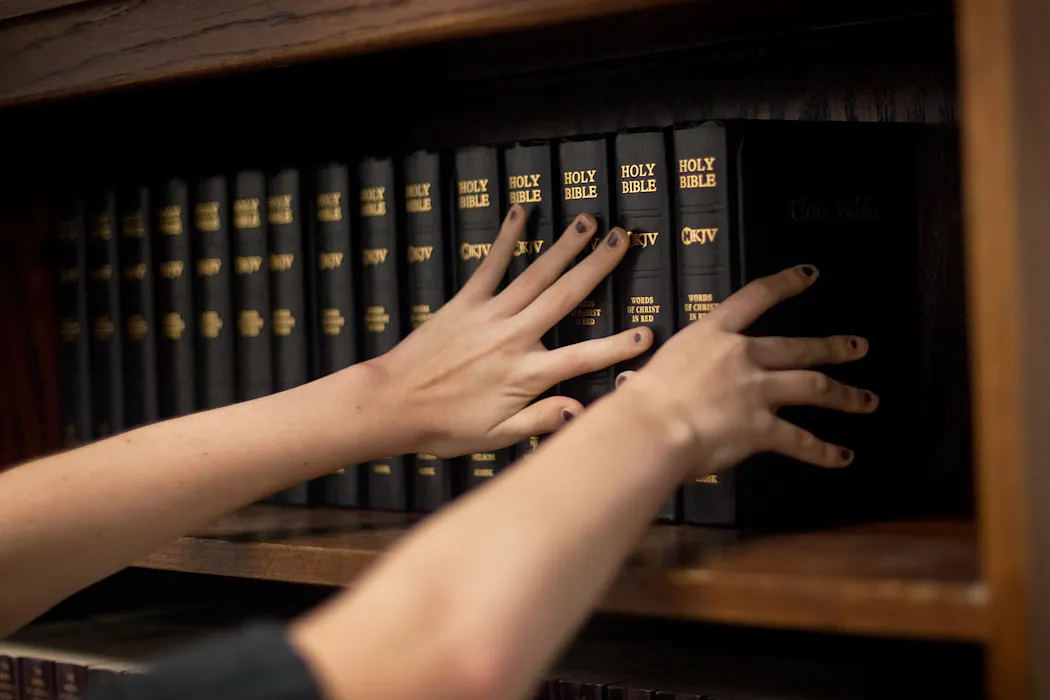
On June 26, 2026, the Texas State Board of Education approved a required reading list for public schools, including selections from the Bible. The 9-5 vote, split along Republican and Democrat party lines, stems from a 2023 state law that required Texas to create a list with at least one mandatory reading per grade level.
Ultimately, the board produced a list of more than 200 readings, which include about a dozen biblical texts. It also requires material from literary and public figures such as Charles Dickens, William Shakespeare, Martin Luther King Jr. and Margaret Thatcher.
Critics argue that mandatory Bible readings in public schools violate the First Amendment of the U.S. Constitution, which bars the government from “an establishment of religion.” These opponents maintain that the readings impermissibly promote religion, particularly Christianity, while violating the free exercise rights of students who belong to other religions, or none.
Litigation over the use of the Bible in American public schools began over 150 years ago – with the outcome often depending on a lesson’s purpose.
Courts, Bible and public schools
The first reported case on the Bible in U.S. public schools was in 1872, when the Supreme Court of Ohio affirmed a ban against religious instruction in public classrooms. Conversely, 50 years later, the Supreme Court of Georgia upheld an ordinance to start school days with readings from the King James Version of the Bible.
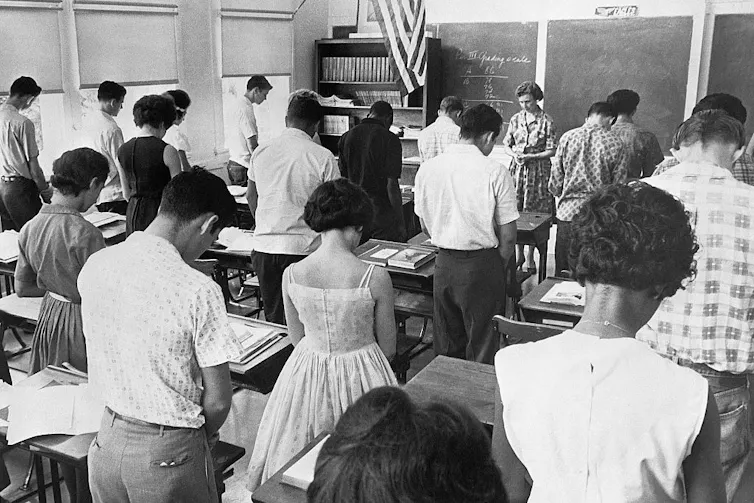
Bible reading first reached the U.S. Supreme Court in 1963, in School District of Abington Township v. Schempp. This case, from Pennsylvania, was consolidated with a similar dispute from Maryland, Murray v. Curlett.
Opponents in both cases challenged mandatory Bible readings and prayer at the start of school days. The plaintiffs argued that these activities violated the establishment clause of the First Amendment: that “Congress shall make no law respecting an establishment of religion.”
The justices struck down both practices, finding that they did not have a secular purpose and that their main effect was to advance religion.
Attempting to allay concerns they were anti-religious, the justices declared, “It certainly may be said that the Bible is worthy of study for its literary and historic qualities. Nothing we have said here indicates that such study of the Bible or of religion, when presented objectively as part of a secular program of education, may not be effected consistently with the First Amendment.”
Justice William Brennan’s concurrence added, “The holding of the Court today plainly does not foreclose teaching about the Holy Scriptures or about the differences between religious sects in classes in literature or history.”
In the following decades, lower courts invalidated classes as violating the establishment clause if the subject matter promoted Christianity – teaching it as religious truth rather than discussing the Bible’s literary and historical qualities. In 1981, for instance, the 5th U.S. Circuit Court of Appeals banned an elective Bible course in Alabama.
Two years later, the 8th Circuit summarily affirmed an order invalidating a program in Arkansas that allowed students to take voluntary Bible classes during school hours.
In 1996, a federal trial court in Mississippi invalidated Bible study classes taught in a rotation with music, physical education and library courses, plus another called A Biblical History of the Middle East.
In these three cases, the courts agreed that the classes were unacceptable because they advanced Christianity.
Lone Star State
Returning to Texas, the board’s new reading list is far from inclusive. Proposed passages mostly come from translations of the Bible that Protestant Christians use, as well as one from a Jewish publisher. The list does not include translations used by Catholics or sacred texts from non-Jewish and non-Christian faiths.
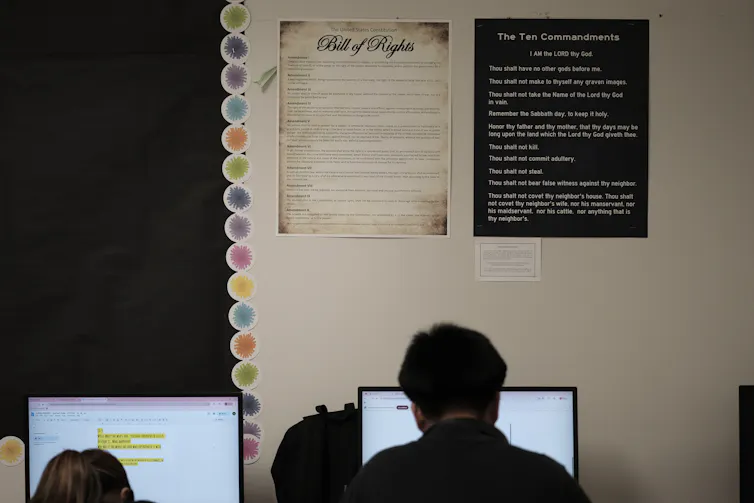
Biblical texts on the list include a picture-book adaptation of the David and Goliath story for elementary students and passages about Adam and Eve for older students. The required readings also include excerpts from multiple books of the Bible – Jonah, Psalms, Lamentations and Genesis – for students in middle and high school.
As of now, parents who object to their kids reading these texts may opt their children out of specific readings if they conflict with their religious or moral beliefs.
2 types of teaching
As Brennan noted in Abington, the Supreme Court “plainly does not foreclose teaching about the Holy Scriptures or about the differences between religious sects in classes in literature or history.” Still, there is a significant difference between objectively teaching about religion and teaching of religion from a faith perspective.
This difference has been important throughout my own career. For 36 years, I have taught education law with a special interest in the relationships between religion, law and education. But in addition to my education and law degrees, I earned a master’s of divinity degree. I previously taught religion, social studies and law to high school students, while teaching college theology part time.
Teaching religion at two Catholic high schools before and after law school, my job was to inculcate Roman Catholic values in my students. Conversely, teaching theology to adult students, I emphasized 11th-century theologian Anselm of Canterbury’s dictum that theology represents “faith seeking understanding.” In other words, my goal was to enable them to make their own judgments about whether to follow religious teachings.
Many times, I have reasoned that increasing religious practices in public life is constitutional. My concern about Texas, though, is that the readings fail to distinguish between teaching about and of religion in public schools by failing to discuss matters of faith objectively.
Expanding students’ horizons and advancing tolerance by exposing them to religious perspectives is a good intention. Yet the breadth of selections is hardly inclusive, given its focus primarily on Christianity, to the exclusion of other faiths. With 67% of adults in Texas identifying as Christians, 26% as unaffiliated and 6% belonging to other faiths, I believe the board could have developed a list that represents the state’s religious variety.
Implementation of the program will be staggered, starting in elementary schools in 2030, for Texas’ more than 5 million students – about 10% of the national total. I expect the Bible readings will face legal challenges, likely sooner rather than later.
This is an updated version of an article originally published on April 27, 2026.
This article was originally published on The Conversation. Read the original article.