The Federal Aviation Administration prohibited flights in a Texas region near the border with Mexico after the Defense Department accidentally shot down a border patrol drone on Thursday, an administration official told Axios.
The big picture: Per an FAA notice, the agency issued airspace restrictions "for Special Security Reasons" after the Pentagon shot down the drone in the area around Fort Hancock, just over 50 miles southeast of El Paso — the scene of a similar airspace closure earlier this month.
Driving the news: Reuters first reported on congressional aides' reports that the Pentagon was believed to have used a "military laser-based anti-drone system" to shoot down the drone.
- The latest incident happened because CBP didn't coordinate with the department, an administration official told Axios.
- Neither coordinated with the FAA, according to the official.
What they're saying: The incident happened when the Department of Defense "employed counter-unmanned aircraft system authorities to mitigate a seemingly threatening unmanned aerial system operating within military airspace," per a joint statement from the DOD, U.S. Customs and Border Protection and the FAA emailed early Friday.
- "The engagement took place far away from populated areas and there were no commercial aircraft in the vicinity," it continued.
- The departments are "working together in an unprecedented fashion" at President Trump's direction "to mitigate drone threats by Mexican cartels and foreign terrorist organizations at the U.S.-Mexico Border," according to the statement.
- "These agencies will continue to work on increased cooperation and communication to prevent such incidents in the future."
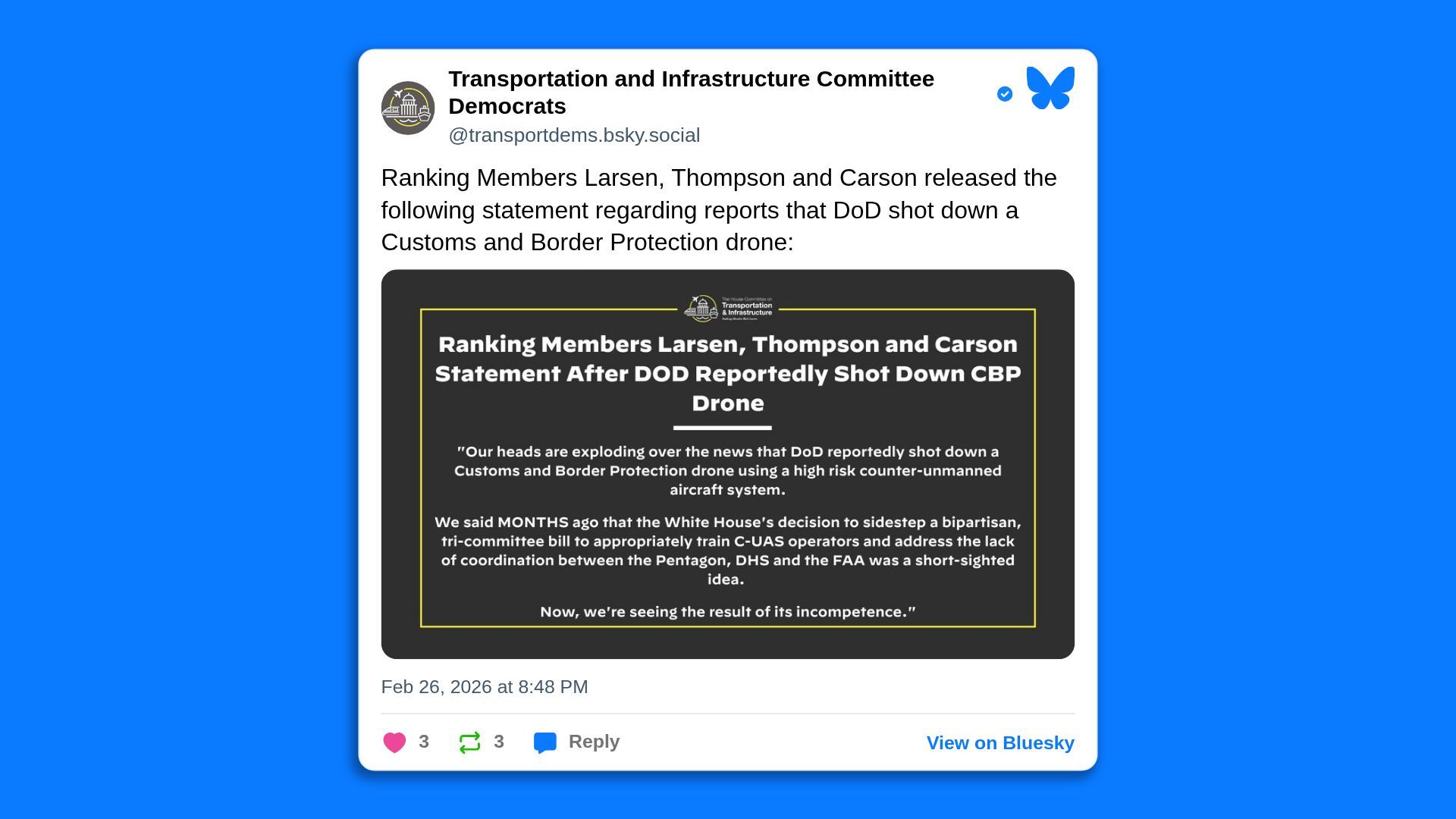
The other side: Reps. Rick Larsen (D-Wash.), Bennie Thompson (D-Miss.) and André Carson (D-Ind.), ranking members on committees that oversee aviation and Homeland Security matters, in a joint statement denounced the Trump administration over the incident:
State of play: "A temporary flight restriction (TFR) was already in place around the Fort Hancock area," an FAA spokesperson said in a Thursday night statement.
- "The TFR has been expanded to include a greater radius to ensure safety," the spokesperson added. "Because of the location of the TFR, it does not impact commercial flights."
- The spokesperson did not immediately respond to Axios' requests for comment on details of the drone incident and the Pentagon referred Axios to the FAA for comment.
- Representatives for the White House and U.S. CBP did not immediately respond to Axios' Thursday night requests for comment.
Of note: Senators demanded a classified briefing following the last airspace closure, which a source told Axios stemmed from a dispute between the FAA and the Pentagon on the safety of testing anti-drone technology.
- The Trump administration's official line, via Transportation Secretary Sean Duffy, was that it happened after the FAA and Defense Department "acted swiftly to address a cartel drone incursion."
What's next: Airspace restrictions that went into effect around 6:30pm Thursday local time are due to last through June 24, though air ambulance and search and rescue flights can be exempted, per the FAA notice.
Go deeper: Laser weapon that shut down El Paso's skies was LOCUST system
Editor's note: This article has been updated with additional details throughout.