Reproductive rights campaigners heralded the US supreme court’s Tuesday ruling to bar parts of Texas’ restrictive abortion law from going into effect, but say the ricochet effect of competing court decisions has created a hostile environment for providers hoping to connect women in Texas with abortion services.
An appeals court on 2 October had ordered the enforcement of two standards from Texas’ House Bill 2 (HB2) – leading to the closure of all but seven of the state’s abortion clinics. Advocates estimated that after the supreme court’s ruling on Tuesday, 13 more would be allowed to reopen.
But the nearly two weeks between those two rulings meant that many of the shuttered clinics had lost the leases to their buildings or fired most of their staff.
Whole Women’s Health, one of the plaintiffs in the lawsuit, operated five clinics in the state, four of which had to close or stop providing abortion services because of the rollout of HB2, which began in July 2013.
Amy Hagstrom Miller, the CEO and founder of Whole Women’s Health said that her organization, which also has clinics and offices in other states, incurred more than half a million dollars in debt in the last six months while trying to keep the clinics open.
She said participating in the lawsuit “was not a good business decision, but it was a good decision on behalf of women in the state and standing on the right side of history”.
Hagstrom Miller said she has had to lay off nearly half Whole Woman’s Health staff since HB2 passed. “It has been excruciating that I can’t provide for them the stability they deserve and answers about what the future is going to look like,” Hagstrom Miller said.
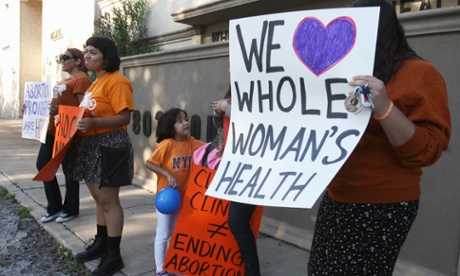
She is happy with the supreme court’s decision, however, especially because it has paved the way to reopen the Whole Women’s Health clinic in McAllen, Texas. That facility is the only in-state abortion provider in southern Texas. Hagstrom Miller said it had appointments scheduled for Friday and Saturday.
The McAllen facility also benefited from a legal exception to a rule that requires doctors that perform abortion to have admitting privileges at nearby hospitals. A clinic in El Paso, the only one serving the western part of the state, is also exempt from this rule.
Before governor Rick Perry enacted HB2 in July 2013, there were 41 abortion providers in Texas. Less than half of those clinics will remain open even with the supreme court’s Tuesday decision.
“Had the supreme court not taken the step it did … the decision for women’s health would have been catastrophic in Texas,” said Stephanie Toti, an attorney at the Center for Reproductive Rights who is involved with the group’s second lawsuit against HB2.
The supreme court’s announcement is an interim ruling, and the case will now head back to the fifth circuit court of appeals. Once that court issues a decision, which is expected in the early part of next year, the losing side of the case will likely petition the supreme court.
As the law goes back and forth, reproductive rights advocates are also working to alert women in Texas to their abortion rights.
Elizabeth Nash, senior state issues associate at Guttmacher Institute, said that it is difficult to keep people informed about changes to state laws, and especially to let them know that clinics have reopened.
“The status of abortion and access to abortion is changing so frequently that it is really hard to communicate to a woman whether her clinic is open or closed,” said Nash.
And while the supreme court’s decision may receive considerable attention in certain corners of the news and social media, descriptions of complicated and restrictive laws can sound like an all-out ban for someone only catching a glimpse of the news.
Nash said this is exacerbated because the population of women who obtain abortions are often poorer and might be less engaged with the constantly changing news. “Because they are working two jobs, they may not be able to read the newspaper every day,” said Nash.