More food delivery means more plastic
Test Yourself is where you can improve your reading skills. Whether it’s for tests like University Entrance Exams or IELTS and TOEFL, or even just for fun, these stories help you to read, understand and improve your English.
You can download a PDF of this story to be used in class or at home. Click the link below.
Read the following story by Suwitcha Chaiyong from the Bangkok Post. Then, answer the questions that follow.
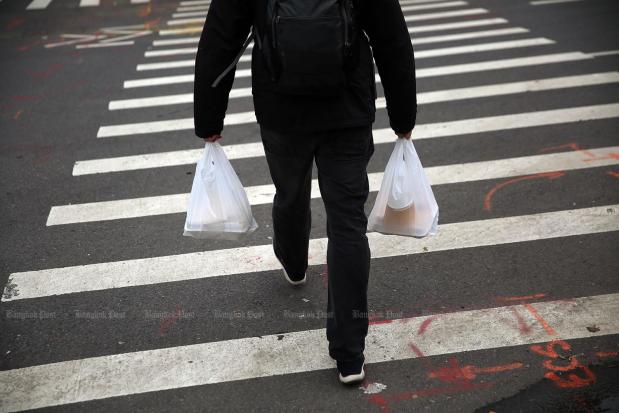
The Covid-19 outbreak has forced a large number of people to turn to food delivery services. The business surge, unfortunately, comes with a huge problem -- plastic waste. The Thailand Environment Institute (TEI) reported the amount of plastic waste has risen significantly -- from 5,500 tonnes recorded before the outbreak to 6,300 tonnes per day during the pandemic.
PLASTIC DELIVERY
"Food delivery is a part of plastic increase. When a person orders chicken and rice, there will be seven to eight pieces of plastic such as bags for rice, chicken, soup, vegetables, sauce and utensils," said TEI president Wijarn Simachaya.
Containers can be made of several kinds of plastic. Most of them are rated as recyclable. However, in Thailand, mismanaged plastic waste causes environmental problems.
"Most plastics used for food containers are made of three kinds of plastic which can be recycled, but with our insufficient waste management, this plastic waste can leak into the environment, which can be harmful to animals," said Pichmol Rugrod, Plastic Free Future Team Leader at Greenpeace Thailand.
"Some containers are conventional plastics, which take a century to decompose," added Wijarn.
After a two-month lockdown, food delivery has become a new norm. Yet Pichmol doesn't believe this trend will last forever.
"Recently, people have shown more concern about the environment. A food delivery platform called Indy Dish, for example, provides reusable containers and customers need to pay a deposit for borrowing containers. Other companies can do the same by changing from single-use plastic to reusable ones. Some food applications also ask whether customers want utensils. And it can be a new normal too," said Pichmol.
PLASTIC LAW
Developed countries are also in a battle against increased plastic waste from the food delivery industry, but they have better ways to handle plastics. More restaurants in the United States and South Korea, for instance, provide more reusable containers than those in Thailand. Efficient waste sorting and waste management in those countries also help prevent plastics leaking into the environment.
"In Sweden, people are required to sort their waste into more than 20 categories and dispose of them separately. Then, the local government will pick up each kind of waste on different days. In order to get rid of their household waste, Swedish people have to first sort their waste properly," Pichmol said.
"Malaysia has efficient waste management both in terms of landfill and incineration. If we want to solve our waste management problems, we should allow the private sector to invest under the control of local governments," Wijarn suggested.
Both experts agree that Thailand needs an environmental law, although the country has a long-term roadmap to reduce plastic waste until 2027. As a TEI representative, Wijarn said that while there were discussions in the past about the possibility of an environmental law and reuse, reduce and recycle policies, there was no progress.
"The no-plastic-bag campaign, which started on January 1, has worked well. The country's plastic reduction roadmap should, however, lead to a clear law," said Pichmol. "And there should be a campaign to educate people on how plastics affect the environment.”
As there is still no such law, Pichmol suggested people solve plastic problems by depending as little on food delivery as possible and not opting for any plastic containers and utensils.
"We should cook ourselves by using ingredients in local areas. Most foods in supermarkets or convenience stores are packed in containers -- most of which are plastic. I encourage people to purchase food ingredients from people in the community or at a neighbourhood market or try to find vendors or shops that accept reusable containers. I believe if there is more demand from customers, more businesses will adjust their products and services to serve them," Pichmol concluded.

Section 1: Answer the following questions in the space provided.
1. How many kinds of plastic are used in most food containers? .…………….
2. How many years do conventional plastics take to decompose? …………….
3. Indy Dish asks customers to buy reusable containers. True or false? ……………..
4. The Swedish government sorts people’s waste. True or false? …………….
5. Malaysia has efficiency in which two waste management methods? …………….
6. When did Thailand introduce a plastic reduction campaign? …………..
7. Pichmol suggests shopping less in supermarkets. True or false? …………….
8. Pichmol said businesses can demand that customers change their behaviour. True or false? …………….
.
Section 2: Write the noun form of the following words in the space provided.
9. mismanaged ……… 10. believe ……… 11. developed ………. 12. solve ………. 13. adjust ……….
.
Section 3: Read the following passage. Then, fill in the blanks with the correct words from the choices given.
Last year, a restaurant chain …14… that they provided wasteless delivery services by …15… containers made from bagasse (from sugarcane), polylactic acid (PLA) and bioplastic. They said bagasse containers can decompose in 45 days, …16… PLA and bioplastic packages take …17… a year. However, Pichmol disagrees. She said PLA and bioplastic …18… environmentally friendly.
“These kinds of plastics …19… pollute the environment.”
14. A. claims B. claimed C. claim
15. A. use B. usage C. using
16. A. so B. while C. before
17 A. almost B. more C. less
18. A. isn’t B. aren’t C. can’t
19. A. still B. however C. meanwhile
.
Section 4: Find words that match the following definitions.
20. a sudden large increase ……………
21. objects or tools used in a kitchen ……………
22. regular or normal ……………
23. the process of burning something completely ……………
24. a plan for how to achieve something …………
.
.
Answers: 1. three. 2. 100. 3. false. 4. false. 5. landfill, incineration. 6. January 1. 7. true. 8. false.
9. mismanagement. 10. believer/belief. 11. developer/development. 12. solution. 13. adjustment.
14. b. 15. c. 16. b. 17. a. 18. b. 19. a.
20. surge. 21. utensils. 22. conventional. 23. incineration. 24. roadmap.
SCORE 21-24: Excellent! 17-20: Good. 13-16: Fair. 12 or fewer: You'll do better next time!