Are e-scooters the future for commuters?
Test Yourself is where you can improve your reading skills. Whether it’s for tests like University Entrance Exams or IELTS and TOEFL, or even just for fun, these stories help you to read, understand and improve your English.
You can download a PDF of this story to be used in class or at home. Click the link below.
Read the following story by Melalin Mahavongtrakul from the Bangkok Post. Then, answer the questions that follow.
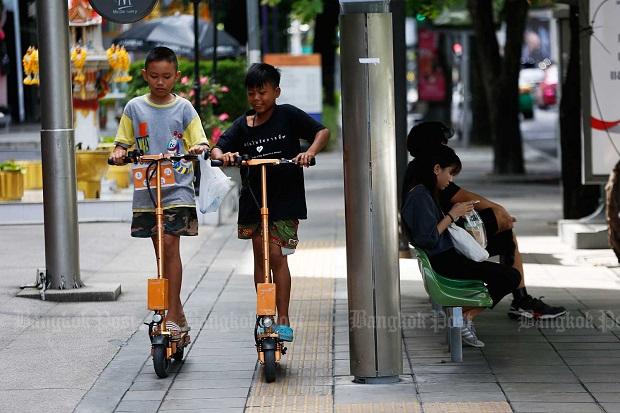
Are e-scooters the future for commuters? Recently, scooter-sharing systems have been introduced in Bangkok. Wander around Thong Lor and Ekamai today, and you'll see electric scooters (e-scooters) outside BTS stations and in front of cafes and restaurants.
IN THE ZONE
Neuron, a scooter-sharing company based in Singapore, introduced its line of orange e-scooters in Chiang Mai late last year. In the capital, the service area started out in Thong Lor before expanding from Asok to On Nut BTS stations, and Phetchaburi to Queen Sirikit National Convention Centre MRT stations. Neuron provides around 200 e-scooters in this area. It is reported that users take approximately 500-600 trips daily within the zone.
The service comes with an app and GPS tracking in each scooter. Designated parking spots can be located using the in-app map. Neuron also employs staff to go around the area collecting scooters, replacing batteries and ensuring abandoned scooters don't end up dumped together.
"It's not about simply buying scooters and placing them on the street. We look at it in terms of city planning too, as well as incorporating technology to keep things safe while helping with the smart city initiative," said Nate Chanchareon, Neuron Mobility's head of business development.
To use the service, users have to download the app then scan a QR code on the scooter. Then they just hop on and ride. The pay-per-ride rates start from 20 baht, with an additional 3 baht per minute. Daily, weekly and monthly rates are available. The scooters can reach speeds of 20-25km/h. Basic insurance is provided, helmets are not.
GOOD FEEDBACK
Nate said feedback from commuters has been positive. In Chiang Mai, many use it for tourism and leisure purposes. In Bangkok, the scooters are mainly being used for commuting purposes, connecting from the BTS/MRT to the home or workplace, providing a solution to the first-mile/last-mile (FMLM) connection problem, an attractive alternative to motorcycle taxis, taxis or walking.
"Consider any given Friday. The traffic is heavy. Some people may not want to ride on a motorcycle. Scooters can then be a faster option than cars and cheaper than a taxi for the first-mile/last-mile connection. They're suitable for commuting short distances. The more options there are, the better they help ease the traffic," said Nate. As they run on electricity, the scooters are also more eco-friendly.
However, despite the benefits, there are concerns over safety. According to Nate, some minor injuries have been reported from people falling over while using the scooters. There still is risk, of course, which Nate describes as "similar to riding a bicycle".
RULES AND REGULATIONS
Assoc Prof Pawinee Iamtrakul, from the Faculty of Architecture and Planning at Thammasat University, says the use of scooters can be safe as long as regulations are in place. She believes it's up to different sectors to come together and manage the sharing of space.
"People have different limitations. Scooters are one option that can help them travel longer distances. It'll be helpful to improve basic infrastructure to accommodate a diversity of users for greater connectivity, accessibility and safety," she said.
Additionally, she argues, e-scooters can be used to promote tourism and help local economies. Despite the controversies and uncertainties that surround scooter-sharing, both Nate and Pawinee are confident that they have the potential to grow.
"As long as Thailand continues to have road traffic problems, people will seek alternatives," said Nate. "If there's a more reliable, faster, maybe even cheaper option, people will use it. In Bangkok, the infrastructure isn't bad in all areas. There are places that may be good for using scooters."
Section 1: Read through the story and answer the following questions.
1. Where is the scooter company based? …………….
2. How many scooters are in the downtown Bangkok area? …………….
3. Users must scan a QR code then download an app. True or false? …………….
4. How much would a 5-minute scooter ride cost? …………….
5. Bangkok scooters are mainly used by tourists. True or false? …………….
6. What does FMLM mean? …………….
7. Riding a scooter is more dangerous than riding a bicycle. True or false? …………….
8. All of Bangkok has bad infrastructure. True or false? …………….
Section 2: Write the noun form of the following words.
9. introduced .…..…10. expanding ……..…11. employs …….…12. safe .……13. suitable .…………
Section 3: Read the following passage. Then, fill in the blanks with the correct words from the choices given.
…14… for a first-timer, the scooter was easy to ride. The real challenge was to …15… all obstacles and get to my destination in one piece. Sure enough, it …16… to be difficult. I spent half the time riding and the other half pulling and lifting the heavy scooter. I was drenched with …17… by the time I got to my …18…, almost half an hour later, a distance of 3.4km. I paid 45 baht. …19…, the same trip using the Grab motorcycle taxi service is 48 baht and over 75 baht for a Grab taxi.
14. a. Except b. Even c. Only
15. a. avoid b. encounter c. enjoy
16. a. was b. proved c. is
17. a. rain b. sweat c. water
18. a. destiny b. destination c. destitute
19. a. Compared b. Comparing c. Comparatively
Section 4: Find words that match the following definitions.
20. left and no longer wanted, used or needed ……………
21. an arrangement with a company in which where they agree to pay the costs if you are injured……………
22. people who travel into a city to work each day ……………
23. the possibility of something bad happening ……………
24. the basic systems and services that are necessary for a country, for example buildings, transport and power supplies ……………
Answers: 1. Singapore. 2. Around 200. 3. False. 4. 35 baht. 5. False. 6. First-mile/last-mile. 7. False. 8. False. 9. introduction 10. expansion 11. employment 12. safety 13. suitability 14. b. 15. a. 16. b. 17. b. 18. b. 19. c. 20. abandoned. 21. insurance. 22. commuters. 23. risk. 24. infrastructure.
SCORE
21-24: Excellent! 17-20: Good. 13-16: Fair. 12 or fewer: You'll do better next time!