Hiroshi Fuji transforms unwanted children's toys into magnificent works of art
Test Yourself is where you can improve your reading skills. Whether it’s for tests like University Entrance Exams or IELTS and TOEFL, or even just for fun, these stories help you to read, understand and improve your English.
You can download a PDF of this story to be used in class or at home. Click the link below.
Read the following story by Melalin Mahavongtrakul from the Bangkok Post. Then, answer the questions that follow.
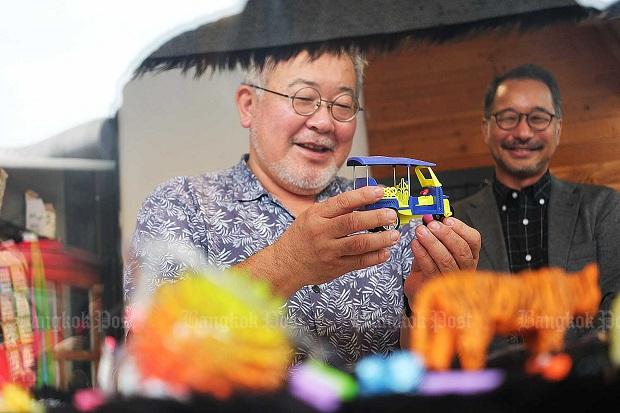
Hiroshi Fuji turns a toy in his hand from side to side. His eyes gleam with childlike curiosity as he inspects the colourful plastic that will be part of his upcoming exhibition, Jurassic Plastic at ChangChui Creative Park. Fuji's creation of vibrant dinosaur sculptures made from plastic toys have made appearances in different countries and will come to Bangkok at the end of this month.
PLASTIC FOREVER
Born in 1960 in Japan, Fuji witnessed the days when plastics weren't so common to their steady rise over the years. Now, plastic is everywhere.
"At first, I thought that in 10-20 years, plastic would be gone. But as I grow older, I found that they never go anywhere. And until the day I die, I will probably have to live with plastic," said Fuji via an interpreter during his recent visit to Bangkok.
As an adult, he learned that plastic originated from the fossil fuel crude oil — formed from the decomposition of buried organisms — and thus connected the idea of Jurassic with plastics as they're used today.
Twenty years ago, he had his first child. Despite the intention to stay clear of plastic toys, his nursery was eventually filled with them. He then came up with the idea to trade unused plastic toys so they don't end up as trash, and eventually the amount of toys continued to build up at his house.
"I began asking why there are so many of them and then collecting them to be turned into something useful. And I didn't realise at all I would be able to collect so many. I started turning these pieces into birds and dinosaurs. Soon, I had toys coming to me from all over Japan," said Fuji.
WORLDWIDE EXHIBITION
Fuji's exhibition has travelled from Japan to Sydney, Australia, and now to Bangkok. In each venue, he accepted donations of unwanted toys from the locals. Coming to Bangkok, he's looking forward to seeing the toys that Thai kids and families will be bringing.
From his inspection at ChangChui, Fuji noted different colours and motifs used in Thai toys. He also found a tuk-tuk model among the pile.
In working with plastic materials, Fuji admitted he felt uncomfortable at times. But if one does nothing with them, then these unwanted toys will just end up as trash.
"There are times I wish I could use materials like wood, fabric, and even soil in my works. But today, plastic is much more available. We have to admit we live in a world full of plastic. Some of the toys are 20-30 years old and they are still around. Years from now, they will be out of production and that will make the toys even more interesting.
"Today, plastic is viewed as trash and the evil of nature. But if someone were to turn it into something shining for those in the future, maybe people will view it differently from today," he said.
Raising society's awareness on such a topic through fun, colourful toys is deliberately done to draw people's attention to the problem, Fuji added.
"It's a tough issue. And if I choose to tell it with a difficult theme, people wouldn't want to come," he said. "What I want to see is the activity that will be happening with the kids and adults that will be coming in here, and how they would connect to the problems in the environment that we need to fix. We can't fix anything if people don't want to get involved.
"An art exhibition often creates an inspiration or even passes on certain influences. We are getting materials from Thai kids, and if Japanese kids see them, they may want to have these toys too. In a sense, it's also about passing on the fun to one another," Fuji added.
Hiroshi Fuji's exhibition "Jurassic Plastic" will be held from Aug 26 to Oct 14 at ChangChui Creative Park. Admission is free. Plastic toy donations will be accepted until Aug 16 at the park. For more information, visit changchuibangkok.com.
Section 1: Read through the story and answer the following questions.
1. What are Fuji’s dinosaur sculptures made of? …………….
2. When Fuji was born, plastic was everywhere. True or false?
3. How old is Fuji’s first child? …………….
4. Fuji always enjoys working with plastic. True or false? …………….
5. Where is the exhibition being held before Bangkok? …………….
6. Fuji sometimes works with wood and soil. True or false? …………….
7. The exhibition has a difficult theme. True or false? …………….
8. How much does it cost to visit the exhibition? …………….
Section 2: Decide whether the following words are a noun, adjective, adverb or verb.
9. common .…..…10. interpreter ……..…11. eventually …….…12. realise .……13. uncomfortable .…………
Section 3: Read the following passage. Then, fill in the blanks with the correct words from the choices given.
"But …14… some differences, the …15… thing is the plastic problem. Microplastics, …16…, are a global issue for the environment. This pollution is a problem shared by all, whether you're in Japan, Australia or Thailand. How did our society turn into that of …17… that …18… such a large amount of plastics? How will they carry on into the future? It's an issue that we have to …19… together,” he said.
14. a. because b. however c. despite
15. a. commons b. common c. commoner
16. a. finally b. especially c. extremely
17. a. consumes b. consumer c. consumerism
18. a. consumes b. consumer c. consumerism
19. a. cover b. tackle c. ignore
Section 4: Find words that match the following definitions.
20. a strong desire to know about something ……………
21. works of art that are made by carving ……………
22. living things, especially ones that are extremely small ……………
23. things that are given to a person or an organisation in order to help them …………
24. designs or patterns ……………
Answers: 1. Plastic toys. 2. False. 3. 20 4. False. 5. Sydney. 6. False. 7. False. 8. Nothing. 9. adjective. 10. noun. 11. adverb. 12. verb. 13. adjective. 14. c. 15. b. 16. b. 17. c. 18. a. 19. b. 20. curiosity. 21. sculptures. 22. organisms. 23. donations. 24. motifs.
SCORE: 21-24: Excellent! 17-20: Good. 13-16: Fair. 12 or fewer: You'll do better next time!