/Tesla%20charging%20station%20black%20background%20by%20Blomst%20via%20Pixabay.jpg)
With Tesla's (TSLA) core auto business continuing to post underwhelming results and its nascent robotaxi initiative having trouble getting off the ground, TSLA stock, with its forward price-to-earnings ratio of 335.83 times, appears to be dramatically overvalued. Consequently, investors should avoid buying Tesla's shares.
Meanwhile, Congress is considering imposing an annual fee of $130 on electric vehicles. While this fee, if implemented, is unlikely to deter the vast majority of consumers interested in Tesla's EVs from buying them, it could slightly reduce the demand for the firm's automobiles, adding another negative catalyst for TSLA stock.
About TSLA Stock
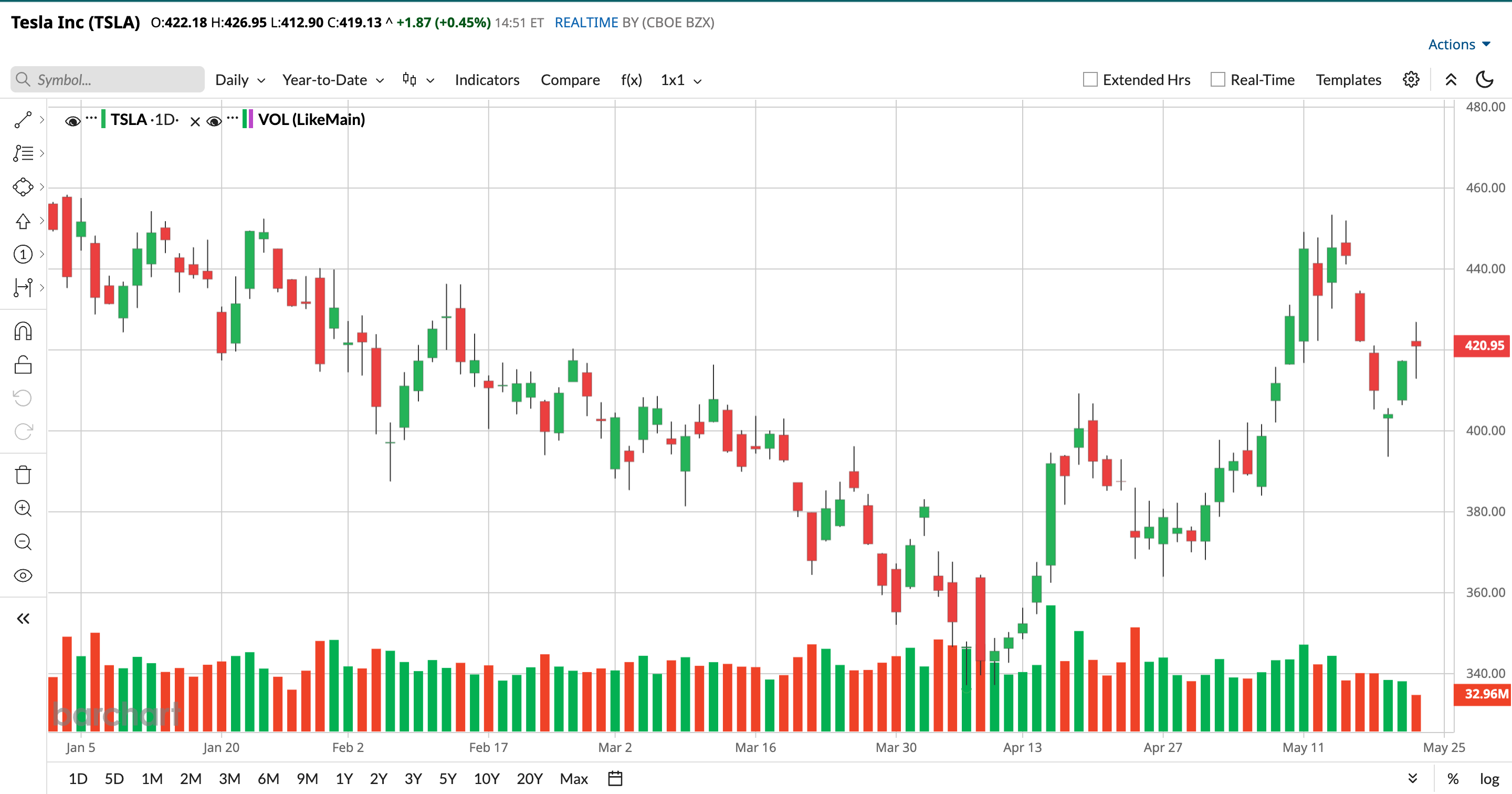
The largest seller of EVs in the U.S. by a wide margin, Tesla has not performed well for its investors so far in 2026, as its shares had fallen 6.27% so far this year.
Tesla has an extremely high market capitalization of $1.57 trillion.
The Auto Business and the Robotaxi Initiative Continue To Be Unimpressive
Tesla delivered 358,023 EVs in the first quarter, well below the 408,386 vehicles that it produced. Further, analysts, on average, were expecting the company to deliver 370,000 EVs. And the automaker handed over 14% fewer EVs than in the previous quarter, although its deliveries did increase 6% versus Q1 of 2025. Still, the Q1 total was not superb overall.
Turning to robotaxis, Reuters recently reported that the service has been plagued by “long wait times, canceled rides, limited availability and problems with drop-offs .” Additionally, Elektrek, a news website focusing on EVs, has asserted that the robotaxis have a relatively high accident rate. Finally, while Tesla CEO Elon Musk predicted in the summer of 2025 that the service would be available to 150 million Americans, it hasn't expanded beyond Texas yet.
The $130 Surcharge Could Be a Mild, Negative Catalyst for Tesla
A bipartisan proposal in the House of Representatives would impose an annual fee of $130 on all EVs. Beginning in 2029, the surcharge would rise $5 annually until it reaches $150.
Most of the buyers of new Tesla EVs, which cost at least roughly $40,000, are likely upper middle class or wealthy. As a result, most of the potential buyers of the EVs are unlikely to be deterred by a fee that, if imposed, eventually would amount to less than $13 per month. However, a small percentage of very budget-conscious consumers who decided to buy EVs in order to save money on fuel could view the $130 fee as undermining the case for EVs. Consequently, these buyers could decide to purchase a plug-in hybrid (the fee for such vehicles under the proposed legislation would be just $35 annually), a regular hybrid, or a gasoline-powered vehicle. The owners of the two latter types of vehicles would not be assessed any fees under the proposed legislation.
Other Negative Catalysts Facing Tesla
Musk's political activism likely continues to alienate many consumers. And the huge supply of previously leased EVs, along with the expiration of the EV tax credit, probably continue to weigh on the company's EV deliveries in the U.S. Finally, the automaker's Cybertruck is widely viewed as a failure, as its sales reportedly have come in “at barely 8%” of Musk's outlook.