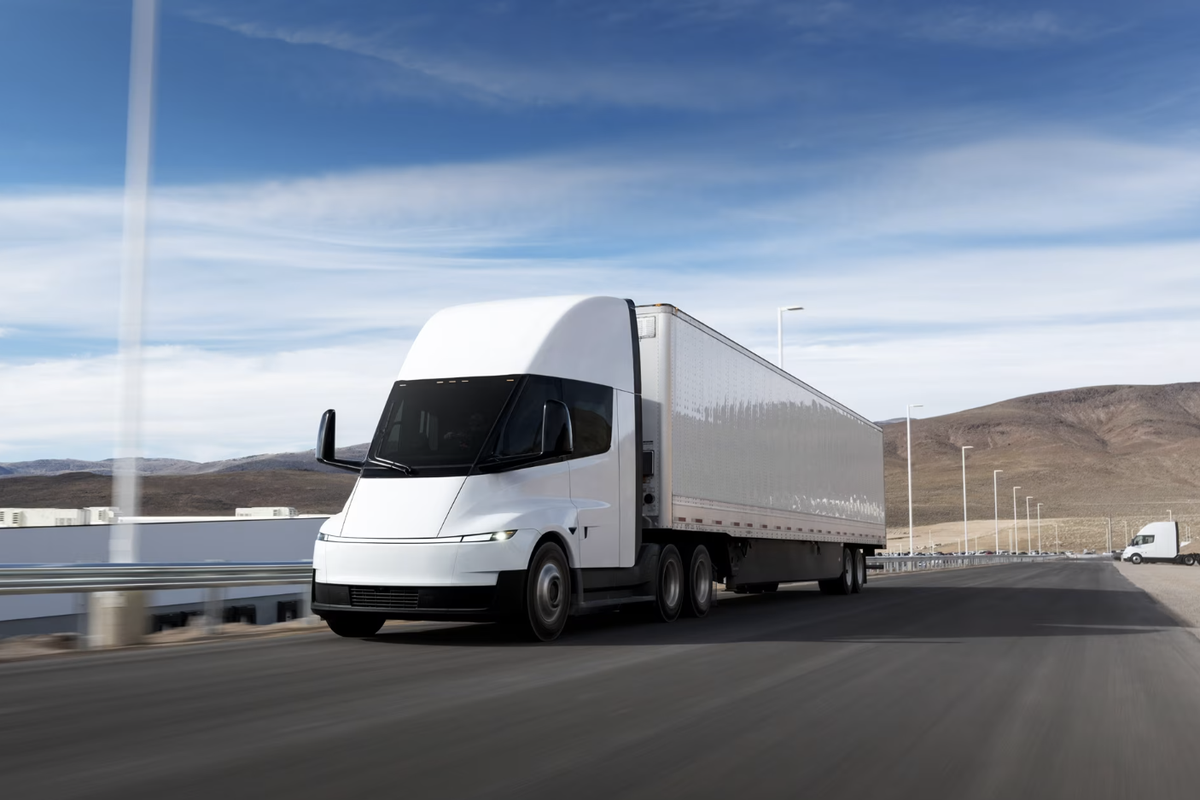
Tesla’s Semi truck has finally entered high-volume production, seven years later than planned.
The electric truck was first unveiled in 2017, with Tesla CEO Elon Musk pledging at the time that production would begin in 2019.
That target was pushed back to 2020, then 2021, then 2022, before a limited launch on a low-volume “pilot” line saw a few early units delivered to PepsiCo.
In 2023, a $3.6 billion expansion of Tesla’s Gigafactory in Nevada included a dedicated high-volume Semi factory, however by 2024 the mass production target deadline was once again pushed back to 2026.
By contrast, Volvo’s electric truck was announced the year after the Tesla Semi was unveiled, and entered volume production just a year later.
The Swedish automaker is now the global leader in electric truck manufacturing.
First Semi off high volume line pic.twitter.com/fI1AdQrJFH
— Tesla Semi (@tesla_semi) April 29, 2026
Tesla’s missed deadlines follow a pattern of overly optimistic timelines set by Musk at his various companies.
The second generation Tesla Roadster, which was unveiled alongside the Semi in 2017, was meant to enter production in 2020 but is now scheduled for 2027.
There have been similar delays with the company’s Full Self-Driving (FSD) technology, as well as production bottlenecks that pushed back the release of the Model 3.
At SpaceX, Musk has been forced to push back his timeline for sending rockets to Mars, which he originally claimed would take place in 2022 with the firm’s massive Starship rocket.
As of 2026, the Starship rocket is still undergoing testing, with any Mars missions still years away.
Tesla Semi feels like a sports car to drive https://t.co/an2KiEh5wG
— Elon Musk (@elonmusk) April 12, 2026
Despite the missed production targets for the Semi, Tesla says it expects to produce up to 50,000 trucks per year at its 1.7-million-square-foot facility in Texas.
When the Tesla Semi truck was first unveiled nearly a decade ago, Musk claimed it could deliver over 1,000 horsepower, and would be “the safest, most comfortable truck ever”.
It boasted an acceleration time from 0 to 100km/h of just 20 seconds – three-times faster than the average fuel-powered semi.
He also said it would have a range of around 500 miles (800km) for the Long Range version, and 325 miles for the Standard Range version.
After personally testing the truck, he said it “feels like a sports car to drive”.
tk
Musk accuses Altman of betraying promise to keep OpenAI as nonprofit during trial
Musk testifies in high-stakes trial against Altman over OpenAI
Musk v Altman: The court showdown that could shape the future of AI
Robot dogs with Musk and Zuckerberg heads roam gallery for new exhibit
The people building AI think it might be conscious. That’s not the most alarming part
What is Palantir? The US analytics firm behind the £330m NHS data platform