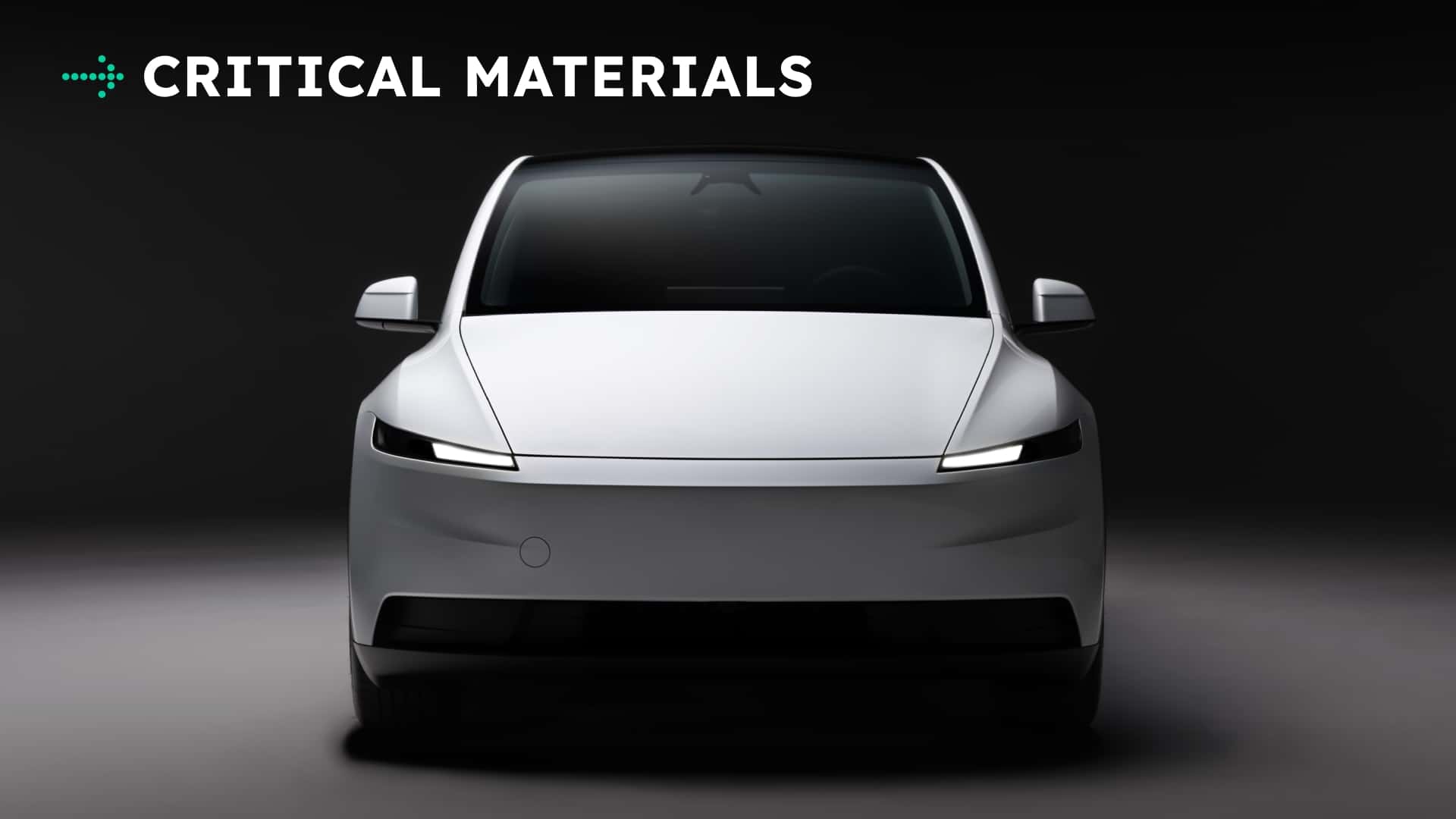
With the EV tax credit officially gone, sales of electrified vehicles are projected to take a beating this quarter. Even Tesla—which has proven itself to be fairly resilient to pressure from competition and sales kerfuffles—isn't coming out of this without a few scrapes.
Get Critical Materials in your inbox.
The must-read auto and tech briefing, every weekday.
Welcome back to Critical Materials, your daily roundup for all things electric and tech in the automotive space. Also on deck: China's war on pop-out door handles takes shape and Tesla says not to worry about threats of a sales ban in California. Let's jump in.
25%: Tesla Sales Down 8.9% For 2025, Says Cox

With more competition than ever, an aging lineup and buyers who feel politically betrayed, Tesla entered 2025 with a disadvantage. That fight has continued throughout the year and has placed Tesla well below the market average for year-over-year sales growth.
According to sales estimates posted by Cox Automotive on Wednesday, Tesla's U.S. sales for 2025 are on track do be down 8.9% year-over-year—from around 634,000 vehicles in 2024 to roughly 577,000 in 2025. And if you zoom in to check quarter-over-quarter performance, it's pretty apparent that things likely won't improve before January.
The whole picture points to a bleak 2025 as a whole, with Tesla's sales in Q4 down a staggering 29.8% compared to Q3, and 22.4% compared to Q4 of last year. This isn't necessarily indicative of Tesla's overall performance compared to its competition, but rather it's a broader snapshot of how the EV market as a whole is reacting to the loss of government incentives.
Tesla looked to combat this slide by rolling out more affordable versions of the Model 3 and Model Y earlier this year; however, these stripped-down versions failed to attract the sales that Tesla hoped for.
Cox points out that the EV market artificially stepped on the gas in Q3, with buyers looking to take advantage of the EV tax credit pulling the trigger while they still could. Demand has since fallen off a cliff, and EV inventory tripled from just 40 days of market supply at the end of the third quarter to 149 days in November (that's up more than 42% year-over-year).
One huge reason is affordability, says Cox. It specifically points out that most EVs fall into the premium segment and that only 9 EV models on the market are available for under $40,000, versus 56 ICE models. Cox says that this represents a "fundamental affordability gap." It says only 3.7% of total EV sales were for under $40,000 since October versus 38.7% across powertrains.
50%: Cruise's Scars Are Building GM's Future In Personal Autonomy
GM has decided that if you're going to learn the hard, expensive lessons, you might as well reuse them wherever possible. After shuttering its Cruise robotaxi efforts last year, GM decided to redirect those resources toward bringing autonomous features to cars regular people can actually own.
Automotive News has the scoop on how GM's new fleet of test cars, plus Cruise employees' experience, is paving the way for eyes-off driving. The automaker has equipped 48 Cadillac Escalade IQ EVs and 90 GMC Yukons to gather driving data across the country. The outlet explains what these test cars are out there doing:
Beyond Cruise’s technical expertise, scaling an eyes-off driver-assistance system requires GM’s manufacturing know-how. The test fleet will provide insights on where to position the cameras, how to scale assembly and how to make the vehicles practical for everyday use at a price customers can afford.
Unlike a robotaxi fleet, personally owned vehicles don’t return to a central depot where they can be maintained and refueled each night, said [Jason Ekelmann, manager of the advanced vehicle integration team at General Motors], who has a background in robotics and whose GM career includes work on autonomy and advanced driver-assistance systems.
They also must have exterior sensors packaged in a way that will keep them safe from rain or snow when parked outdoors.
GM hopes to deploy eyes-off Super Cruise for the Cadillac Escalade IQ by 2028 and eventually scale that system across multiple GM brands, platforms and vehicle segments. GM is betting that using Cruise's experience in the field will allow it to meet that goal, so it's ramping up its testing efforts.
That's the real shift—to figure out exactly what fits (and what doesn't) in personal autonomy versus Cruise's commercial-level robotaxi past. Building something boring enough to appease regulators and exciting enough for consumers to jump at the opportunity to buy.
75%: China's Door Handle Safety Mandates Take Shape
China has declared war on electronic pop-out door handles after high-profile crashes in the country brought this futuristic hardware into question. Reports of potential regulation have been swirling for months, and now regulators have issued draft legislation that would seriously crack down on how car companies can implement the tech in future models.
The proposed rules were published on Wednesday and would mandate that cars come with easily accessible mechanical door releases both inside and out. This would make it so that any techno-centric car company doing business in China that has deployed the tech—think Tesla, Xiaomi and others—would need to implement a fix before the final version of the ruling takes effect.
Car News China sums up what to expect:
According to the ministry, the draft standard titled Automotive Door Handle Safety Technical Requirements mandates that each side door, excluding tailgates, be equipped with a mechanically released exterior door handle.
The design must allow occupants or rescuers to open the door without tools after irreversible restraint system deployment or battery thermal propagation events. Vehicles with electronically controlled or automatically activated door-locking systems must still permit mechanical release even when the locking system remains engaged during such events.
The draft specifies that exterior door handles must be positioned within defined accessible areas on the door or adjacent door frame, depending on door opening type. Sufficient hand-operating space must always be maintained to ensure mechanical release, even in the event of power loss or system failures.
Exterior door handles aren't the only focus. Beijing is also taking aim at interior handles by setting the stage to mandate mechanical latches that are both easy to spot and easy to access.
The issue of electronic door handles without mechanical backups isn't confined to China. Tesla has come under fire in the U.S. for similar tech, which may fail to operate in a crash or a no-power scenario. A Bloomberg investigation and subsequent government probe put that under the microscope.
100%: Who Will Win The Race To Personal Eyes-Off Autonomy?
Automakers are refocusing their efforts on autonomy, and the first company to bring widespread, eyes-off autonomy to market will reap immense rewards. At first glance, you might assume Tesla is the closest, but I'm not so sure about that. Which car company do you think will win the race?