European markets mixed with Tesco leading London shares lower
Another uncertain day for stock markets, with the seemingly never ending attempts at fixing Greece’s financial problems no nearer to a solution, jitters over the UK election and hints of rate rises in the UK and US after, respectively, more hawkish that expected Bank of England minutes and higher than forecast US house sales. Tesco ended the day down more than 5% after its record £6.4bn loss, the biggest faller in the FTSE 100. The final scores showed:
- The FTSE 100 finished down 34.69 points or 0.49% at 7028.24
- Germany’s Dax dropped 0.6% to 11,867.37
- France’s Cac closed up 0.36% at 5211.09
- Italy’s FTSE MIB added 0.32% to 23,315.40
- Spain’s Ibex ended down 0.2% at 11,399.2
- The Athens market added 2.08% to 719.43 on reports the ECB had raised the cap again on emergency liquidity assistance to the country’s banks
On Wall Street, the Dow Jones Industrial Average is currently 50 points or 0.27% higher.
On that note, it’s time to close up for the evening. Thanks for all your comments, and we’ll be back tomorrow.
Over in Athens growing numbers of government MPs are giving voice to concerns that Greece’s escalating standoff with creditors may ultimately only be solved if the country holds fresh elections or a referendum. Helena Smith reports:
In a sign of just how perilous Greece’s position is, ever more MPs from the governing Syriza party say fresh elections, or a referendum, may be the only way of solving the conundrum the country now faces. Two leading Syriza officials, including the prominent Euro parliamentarian Kostas Chrysogonos, raised the prospect today of a plebiscite being put before Greeks in the event of both sides failing to reach an “honourable compromise.
Chrysogonos said if creditors continued making “outlandish demands” of Greece, a referendum could be organized within a matter of weeks and the dilemma solved by democratic process. “Syriza does not have a popular mandate for a rupture with Europe, nor does it have a popular mandate for blind submission,” he said adding that it was impossible for an anti-austerity government to do what even the previous pro-bailout government had found impossible to achieve.
“What this government was given was a mandate to be tough in negotiations and the hope is we end up at an honourable compromise,” he said speaking from Brussels. “But at some point those negotiations have to end, time is running out. If lenders continue to make outlandish demands, then the people can decide. I am sure a referendum could be organized in two weeks.”
Asked what the referendum would ask, the MEP said: “Do you agree to the austerity measures being asked of Greece.”
Back with Greece, and regional officials are calling for a meeting with prime minister Alexis Tsipras in return for backing the government’s call to effectively lend money to the central bank, Bloomberg reports:
Officials from Greece’s biggest cities and regions demanded an audience with the prime minister in exchange for their support after they were told to hand over their cash reserves to help keep the country afloat.
Running out of options, Greece’s anti-bailout coalition ordered municipalities on Monday to shift their cash balances to the central bank. Without the move, the government may have struggled to pay salaries and pensions.
The country’s two biggest umbrella groups for local governments, which represent mayors and governors from a myriad of parties, said they would hand over their money on the condition that Prime Minister Alexis Tsipras briefs them on the “the true state” of the economy.
“If the country is in danger of bankruptcy, we will give everything we have,” the Central Union of Municipalities said on its website on Wednesday. “They just have to tell us” and we’ll contribute to the national effort.
Full story:
Greek Mayors Demand Audience With Tsipras in Exchange for Help
Updated
And here’s a video of new Tesco chief executive Dave Lewis, explaining his thoughts on the future of the beleaguered supermarket:
Updated
A successful sale of assets could ease pressure on Tesco’s credit rating, according to Moody’s. Sven Reinke, Moody’s Vice President and Senior Analyst, said:
We see early signs of improvement in Tesco’s operating performance, driven by growing sales volumes resulting from its measures around service, availability and price. However, we do not expect a material increase in Tesco’s underlying operating profitability in the 2015/16 fiscal year.
Tesco seeks to monetise assets over the next 12 months. If that happens, it could ease the pressure exerted by the company’s high leverage and deteriorated financial profile on its Ba1 ratings.
A chart on Greek payments from Open Europe:
Chart on #Greece payments drives home that even if it gets€7.2bn tranche doesn't get it far http://t.co/vmgOVkZOoU pic.twitter.com/OiT1hpekGe
— Open Europe (@OpenEurope) April 22, 2015
German bond yields, which have been heading towards zero, have jumped sharply today, with the 10 year yield up from 0.1% to 0.16%.
The bonds have been in demand recently - pushing down the yield - thanks to the European Central Bank’s QE bond buying programme, as well as worries over Greece leaving the eurozone.
But with Germany raising its growth forecast for this year from 1.5% to 1.8%, the yields have started to rise again.
Could Greece default on a payment and still remain in the eurozone? Open Europe has been looking at the options, and concludes:
In any scenario, a default or missed payment by Greece would increase animosity between the two sides and put the country’s position in the Euro in jeopardy since it needs further cash from the Eurozone to secure it. That being said, a missed payment to the IMF would probably be manageable from an economic/financial standpoint, though the politics may be different. However, a missed payment to the ECB could well trigger a downward spiral towards Grexit. In all scenarios, the response of the ECB is likely to constitute a key turning point, once again highlighting just how important and political its position has become (intentionally or not).
Ultimately, a temporary missed payment is something which in most scenarios could be managed at a political level (assuming the willingness exists). However, the same cannot be said of a decision to unilaterally write off a large amount of the loans. We have to remember that this remains a fundamental goal of the Syriza government and, as we have long argued, it seems likely that Greece will need some debt restructuring for its position to be sustainable. As we warned in 2012... this has been made all the more difficult by the fact the large majority of debt is now held by official creditors.
In the end, this is the elephant in the room amongst all the short term negotiations to keep Greece afloat for the next month or two. This is all just a precursor to the bigger negotiations over how Greece will fund itself once the bailout expires at the end of June. Will such an agreement involve a debt write-down? Will it be another bailout? Will a Syriza-led government agree to the necessary conditions and be able to sell them at home sufficiently to maintain their power? These questions seem gargantuan given that the two sides can’t currently agree on a short term reform list.
The full commentary is here.
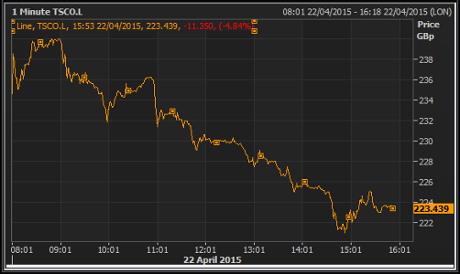
Back with Tesco, and the early rise in the share price is now long gone.
The supermarket is down nearly 5% at 223.5p, meaning it is the biggest faller in the FTSE 100 at the moment, in the wake of its hefty £6.4bn loss and concerns about the outlook.
Eurozone consumer confidence slips
Back with the eurozone, and consumer confidence dipped in April against expectations of an increase.
An early estimate showed a fall to -4.6 this month compared to 3.7 in March, after three consecutive monthly increases. Teunis Brosens at ING said:
The slight dip in sentiment may be partly explained by the fact that the perceived beneficial effect of low oil prices is wearing off: fuel prices at the pump have edged up 3 cents in April, compared to March.
But even after this gentle correction, Eurozone consumers remain upbeat, with sentiment running well above its long-term average. Sentiment has also been running ahead of actual consumer spending. Retail sales suggest consumer spending was solid in the first quarter, and today’s flash consumer sentiment shows that the second quarter also started quite well – just maybe not as stellar as some had hoped.
Updated
Any market expectation that the strong existing homes data could lead to a policy change by the Federal Reserve is likely to be short lived, according to Rob Carnell at ING Bank. He said:
With housing transactions a slow moving part of the economy, it is probably not wise to declare the US soft-patch over just yet, though there were also some encouraging increases in median house prices, which should help to support consumer confidence and spending in the coming months.
That said, with next week’s [Federal Reserve] meeting closing in, and limited additional data in advance of this, we see little likelihood that this result is enough to warrant a hint at a policy change in June from the accompanying April Federal Reserve text. The market response to this data should be a stronger US dollar and higher bond yields and implied Fed rates. But with this result fairly marginal for the Fed decision, we don’t think any market response will be substantial, or necessarily long-lived.
US homes sales rose more sharply than expected in March, suggesting an earlier than expected interest rate rise by the Federal Reserve could still be in prospect despite recent weak data.
Existing home sales jumped by 6.1% to an annual rate of 5.19m units, the highest since September 2013. Analysts had been expecting a 3% increase.
The figures have pushed the Dow Jones Industrial Average into the red after an early rise, down around 17 points.
German finance minister spokesman Martin Jaeger has been talking about when Greece has to deliver its reform programmes, and it throws a few more dates into the pot:
*APRIL 30 GREEK REFORM LIST DEADLINE A ‘POLITICAL’ DATE; JUNE 30 IS RELEVANT LEGAL DEADLINE FOR #GREEK PROGRAM - JAEGER
— liuk (@liuk__) April 22, 2015
Time for some refreshments, US-style.
And it looks like consumers are turning back to Coke but still shunning McDonald’s.
Coca-Cola has reported a 1% rise in first quarter revenues to $5.1bn, the rise in nine quarters. The company has been hit by sluggish demand for carbonated drinks, partly because of health concerns, but it has been diversifying its business by taking stakes in businesses in faster growing markets.
But McDonald’s is still struggling after tough competition in the US and food scandals in China and Japan. First quarter like for like sales fell 2.3%, and much will now rest on a turnaround plan from new chief executive Stever Easterbrook, which will be revealed on May 4.
Updated
The Hounslow man accused of contributing to the 2010 flash crash on the US market - when the Dow Jones Industrial Average plunged 5% in five minutes - has vowed to fight extradition when he appeared in court earlier.
A full hearing on extradition will now be heard in August.
Here’s our latest report:
Tesco has wiped the slate clean with these figures (a £6.4bn loss let’s not forget).
That’s the view of HSBC analyst David McCarthy, who says:
Ultimately, there is encouragement in this update: UK volume growth is the best in many years, increased cost savings have been identified and the portfolio review continues to progress.
As such, this represents another step in the right direction and a sign that there is a clear plan. This will be led by the UK business where improving sales trends and better margins are encouraging. We continue to believe that Tesco can return to a sustainable UK operating margin of over 4%, given its scale advantages.
Tesco is now following the right strategy, in our view, and has the right management in place to achieve this. This drives our positive view on the stock and we retain our buy rating and 295p fair value target price.
Greece hopes to get €2.5bn from its plan to get state entities and local governments to effectively lend to the state, according to deputy finance minister Dimitris Mardas.
According to Reuters, Mardas told Greece’s Star TV:
My target is €2.5bn. I want this €2.5bn to cover any needs that may occur, I repeat, taking into account the worst case scenarios and the needs for May.
Meanwhile the World Economic Forum has published a piece on whether Greece will indeed run out of cash.
Will #Greece run out of cash? http://t.co/kymiwdU0Cd #Eurozone #economics pic.twitter.com/00AZ5siOUf
— World Economic Forum (@wef) April 22, 2015
The conclusion is a relatively positive one, in the short term at least:
Greece has looming repayment deadlines....[It] has to repay €6.7 billion to the ECB and €9.8 billion to the IMF in 2015. (There are also maturing treasury bills, but these are rolled over by the largely state-owned Greek banks). Greece also has to pay some interest on its liabilities, though not that much, because interest payments on EFSF loans (the largest creditor of the country) are deferred.
The question is therefore whether the primary budget surplus and the possible liquidation of some financial assets would be sufficient for the Greek government to carry on paying financial obligations until an agreement is reached with the creditors in the coming weeks or months. My guess is yes, at least perhaps till the summer, when large repayment will become due.
If the report is correct that the ECB has raised the cap on emergency liquidity assistance (ELA) that Greek banks can draw by €1.5bn, this follows an €800m increase last week. The ECB has been raising the cap gradually to keep the pressure on Greece to come to a deal with its creditors.
Handelsblatt Reporting That Greek #ELA Cap Has Been Raised By About EUR1.5 Bln To EUR75.5 Bln - #BBG
— Live Squawk (@livesquawk) April 22, 2015
Back with Greece, and state minister and Syriza MP Nikos Pappas has indicated the government is unlikely to back down on pension cuts and tax hikes, adding more uncertainty to the chances of a deal with its lenders.
Pappas told a parliamentary committee (quotes from Reuters):
The negotiations have their difficulties and the lenders have tabled requests which have not been accepted so far. And they will not be accepted because they are the red lines of the government - accepting VAT hikes on islands and pension cuts.
The government seeks...and will achieve a solution. Not just any agreement.
Lunchtime summary
Time for a recap:
Tesco has reported losses of £6.4bn, the worst result in its 96-year history and Britain’s biggest-ever retail loss, after huge writedowns on the value of its property portfolio.
The annual result was worse than the City’s most dire predictions that the group would fall £5bn into the red. Chief executive Dave Lewis said he had tried to make a break with Tesco’s recent history by accounting for all likely events.
But Lewis warned that the food retail market remained “challenging” and that, despite signs of improving sales, Tesco’s performance would be volatile for some time to come.
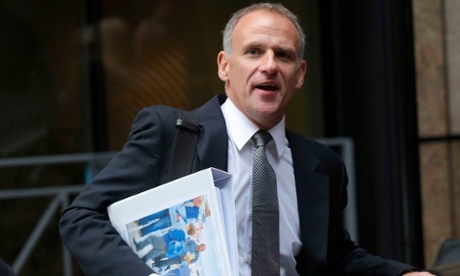
Lewis, who joined Tesco in September, said: “We’ve got a long, long way to go and I don’t think it will be smooth as we move through the changes we want to make. We have sought to draw a line under the past and to rebuild from here. Everything we know [about] we have dealt with.”
The former Unilever executive was drafted in to turn around the fortunes of Britain’s biggest retailer following a series of profit warnings amid a ferocious price war with rivals.....
Here’s the full story:
On a conference call, Lewis refused to pledge that trading profits wouldn’t continue to fall this year, but insisted the the company is getting stronger. Highlights start here
One analyst have called on Tesco to consider shutting up to 200 stores. Other, though, believe the company’s underying performance is improving.
Shares in Tesco have been volatile today, and are now down 1.8% at 230p.
Speaking of Greece... EU officials have said Athens won’t present a concrete list of reforms when eurozone finance minister meet on Friday.
Thomas Wieser, who heads the Eurogroup Working Group, said:
The clock is ticking. There won’t be a new list in Riga, but over the course of May it must finally be reached.”
Despite that, Greek bond yields have recovered some value this morning after being pounded by default fears in recent days.
Regular eurozone crisis followers may find this chart interesting too, showing how Greece could arrive safely at a third bailout, or find itself plunged into capital controls.....
Greece: How events could unfold over the next few weeks http://t.co/tRYg7Ecs2e #Greece #euro #ECB #IMF #grexit pic.twitter.com/DmVY7tmWsJ
— MacroPolis (@MacroPolis_gr) April 22, 2015
Updated
Six point four billion pounds is a lot of money in anyone’s book. Enough to run a small government department for a year, or cover 10% of Britain’s education budget.
It’s also slightly more than the amount of money (€7.2bn) that Greece needs from its creditors soon to avoid a default:
For no good reason I am obsessing about Tesco losing £6bn & still being formidable & Greece needing roughly that sum to stay afloat
— Robert Peston (@Peston) April 22, 2015
Analyst: Tesco faces a long slog
Fund manager Rahul Sharma has tweeted some interesting analysis of Tesco’s results this morning:
Messy is the best way to describe Tesco results. No big new shocks & some quick fixes are in place but now for the long, slow hard stuff
— Rahul Sharma (@Retail_Guru) April 22, 2015
Tesco reveals big property losses. Largely reflecting past mistakes but also a big slug of large stores not working that well any more.
— Rahul Sharma (@Retail_Guru) April 22, 2015
Tesco UK Q4 sales down 1%, down from -0.5% pace during Xmas (or near -1.5% in recent weeks). Asia, Europe both unpretty.
— Rahul Sharma (@Retail_Guru) April 22, 2015
Very clear from todays #s. Tesco International has the same problems as UK - thriving discounters, too-big stores & a price image problem.
— Rahul Sharma (@Retail_Guru) April 22, 2015
Alongside Tesco's property write-downs is a huge £600m inventory write-off. Stuff they couldn't flog off to anyone. Really a one-off?
— Rahul Sharma (@Retail_Guru) April 22, 2015
As if Tesco didn’t have enough problems, its pension deficit has swelled from £2.6bn to £3.9bn.
The company is also consulting staff about replacing its final salary (‘defined benefit) pension scheme with a new “defined contribution scheme”, as another way of strengthening its balance sheet.
Matthew Harrison, managing director of Lincoln Pension, says this is part of a wider trend, given the massive rally in bonds (which push down the rate of return, or yield, that investors get)
Although the pension deficit numbers in the Tesco situation are unusually large, the general theme is not an uncommon one for UK pension schemes. It provides a timely reminder that even in this phase of increasing consumer and business confidence, defined benefit pension benefits are not necessarily secure.
With gilt yields persisting at historically low levels, deficits remain high. Where this is coupled with challenging trading conditions for the employer the, sometimes delicate, balance between the financial position of an employer and the scale of its Defined Benefit pension obligations can easily be disrupted.
Tesco’s CEO is ruling out duplicating Aldi and Lidl’s strategy of carrying much fewer products.
Lewis says Tesco will not become a discounter. "One of our great advantages is that depth of range."
— Luke Tugby (@LukeTugby) April 22, 2015
Back in January, we reported that Tesco was looking to cut its range of 90,000 products by a third. That would still dwarf the discounters.
For example, Tesco offers 28 types of ketchup to dip one’s chips into, compared to Aldi’s lone own-brand offering.
More than 20 million Tesco shares have changed hands in the City today, as many as on a trading day normally.
2hrs into trading and #Tesco volume is already the same as its 30 daily moving average. Big interest.
— Joshua Raymond (@Josh_CityIndex) April 22, 2015

Struggling to understand how the value of Tesco’s store has slumped by almost £5bn?
Brewin Dolphin equity analyst Nicla Di Palma has the answer:
Every year Tesco reviews the carrying value of its stores to ensure that they are supported by either their value in use or their fair value less the cost of disposal.
Due to difficult industry conditions the value of property has declined: basically, as the food retail industry faces difficult conditions and cuts its store opening programmes, the value of supermarkets declines.
The early rally in Tesco’s is petering out; they’re now down 0.5% (in line with the FTSE 100 this morning)
Lewis Sturdy, dealer at London Capital Group, explains why traders are still nervous about piling into Tesco shares:
‘Investors have the double edged sword of what looks like a clear line being drawn under this annus horribilis, while the dividend is cut and uncertainty about is resumption will keep many yield seekers lukewarm.’
The decline of Tesco’s biggest stores continues:
Only Tesco's Express stores seeing like for like sales growth. Extra stores down 2.2%, superstores worse at -2.5%
— Sarah Butler (@whatbutlersaw) April 22, 2015
My colleague Sarah Butler has taken a tour of a Tesco store with retail expert Clive Black. Their verdict - prices were keen and staff were plentiful, but you couldn’t say the same about the customers....
Full story: Tesco’s troubles - it’s easy to keep a quiet store clean
Updated
In other news... the minutes of the Bank of England’s most recent meeting were just released, showing that policymakers voted 9-0 to leave interest rates unchanged (again) a fortnight ago.
They also predicted that UK inflation will probably turn negative in the next couple of months - having been zero in February and March.
#BoE minutes shows no change in voting. 2 members said decision was finely balanced. GBP strength may be lowering inflation faster #GBP
— Joshua Raymond (@Josh_CityIndex) April 22, 2015
Dave Lewis is now speaking to City analysts:
'We're starting to see some very early encouraging first steps' says Dave Lewis of Tesco to analysts..
— Sarah Butler (@whatbutlersaw) April 22, 2015
Lewis arrived at Tesco last summer with the nickname “Drastic Dave”, due to his reputation for reviving struggling brands at Unilever.
He’s living up to the moniker, as Michael Hewson of CMC Markets explains:
On a trading basis profits came in at £1.4bn with the most recent quarter seeing the supermarkets first improvement in like for like sales in over four years, which would appear to suggest that some of the recent changes that were announced at the end of last year are starting to bear fruit.
Today’s record losses of £5.7bn may well have been more than markets expected but in a way they are also encouraging, as they signal a determination by management to clean the slate and get on with turning the business around, and drawing a line under a pretty awful last couple of years.
Updated
We shouldn’t forget that Tesco has already cut thousands of jobs as part of Lewis’s turnaround strategy.
Roughly 7,000 jobs already gone at Tesco as Dave Lewis cuts costs, more to come...
— Graham Ruddick (@GrahamtRuddick) April 22, 2015
Dave Lewis denied this morning that he has ‘kitchen-sinked’ the problems at Tesco, by throwing as much bad news as possible into the mix today.
But Professor Crawford Spence of Warwick Business School is convinced that the Tesco CEO is trying to make life a little easier in future years:
Spence says:
“These figures are absolutely huge - nearly the biggest loss in UK corporate history. However, they need to be understood in context. They relate mostly to asset write-downs rather than poor trading performance.
Underlying trading performance for Tesco has actually not been too bad in recent months. In many ways Tesco has decided to make these losses now rather than later. It all needs to be understood within CEO Dave Lewis’s strategy of ‘taking a bath’ in his first couple of years in the job - basically, if he gets all the skeletons out of the closet early on then Tesco will look bad initially, but he will give himself a set of benchmarks that are relatively easy to surpass in the coming years.”
Tesco’s problems do put life’s little indignities into perspective:
Feel a bit bad about complaining about the lack of those sprinkles in my Muller Yoghurt now http://t.co/so0bueGfZv
— Ben Hatch Novelist (@BenHatch) April 22, 2015
This isn’t only Tesco’s biggest ever pre-tax loss. It’s also the biggest ever suffered by a UK retailer. By some distance.
Tesco's £6.4bn loss dwarfs other retailers' past losses. Here's why it happened: http://t.co/J17MTxB6wv pic.twitter.com/vdglYMySu6
— fastFT (@fastFT) April 22, 2015
We reckon it’s also the sixth-largest in UK corporate history, but someway shy of the £27bn loss suffered by Royal Bank of Scotland in 2009 when the empire built by Fred Goodwin spectacularly collapsed.
Updated
It's the end of the Tesco era
Today marks the “the official end of the Tesco era”, says John Ibbotson of Retail Vision.
But he also believes Dave Lewis has taken the right decisions since being lured from Unilever last year to tackle one of the biggest, and toughest,
“The irony is that Tesco is on the right path. Amid the extensive wreckage left by his predecessors, Dave Lewis has done all the right things, and made all the tough decisions, to put Tesco back on track.
“Lewis has delivered direction, reduced prices, cut costs, closed the Cheshunt head office and put more staff into stores. Most fundamentally, he has changed the retailer’s entire corporate philosophy.
But Tesco will never be “the force it once was”
“With this huge loss, the decadent retail dynasty of Tesco has come to an end.”
But is that a bad thing for the UK? Independent high street stores won’t miss the days when Tesco was racking up record profits and expanding into virtually every postcode in the land.
Investors seem to believe CEO Dave Lewis’s line that Tesco is getting better (slowly).
Tesco shares up 1.5% after writedown of property assets masks improved sales 239.40 last
— Steve Collins (@TradeDesk_Steve) April 22, 2015
Tesco rreported that like-for-like sales volumes in the UK rose for the first time in over four years. And sales turnover improved in the last three months, to a drop of only 1.0%.
This will reassure Dave Lewis – Tesco’s shares are continuing to rise....
Tesco $TSCO now third biggest riser in FTSE, +2%....
— David Jones (@JonesTheMarkets) April 22, 2015
Analyst: Tesco should consider shutting another 200 stores

Tesco chief Dave Lewis needs to keep shutting stores, slash staff numbers and drop less popular products, reckons Mike Dennis, retail analyst at City firm Cantor FitzGerald.
In a research note, Dennis makes five recommendations:
- We believe Tesco should consider closing 200 underperforming supermarkets/superstores and focus on growing the more profitable remaining 700 stores (excluding Express), in addition, this should also allow for £40m of cost savings from the closure of a distribution centre
- Tesco should not only reduce its slowest selling product range, but also reduce credit days to secure a much lower net cost of goods to invest and recapture its customer base and squeeze Sainsbury’s who we believe have been the main net beneficiary of Tesco’s poor trading
- Matt Davies, Tesco’s UK CEO as of 1st June, should consider a further reduction in staff and a significant simplification of central functions and category management. Aldi UK today generates twice the sales per full-time employee compared to Tesco UK and is expected to report higher trading profits
- In our research note, entitled “Box Cutter” dated 11th July 2014, we stated that Tesco needed to address the 2.67m sq ft of uneconomic superstore and hypermarket retail space. We believe this space could be used for profitable destination leisure facilities, concessions in various related home categories and other healthcare services.
- Tesco needs to work with suppliers to reduce excess capacity in certain categories in the European supply chain to allow it to squeeze the discounters’ cost of goods.
Updated
Ken Odeluga of City Index reckons that Dave Lewis is “clearing the decks” by announcing the biggest loss in Tesco’s history today:
Tesco’s final results for 2014 are a fitting way for the company to cap its most challenging year for decades.
In a move long anticipated by investors, the firm has written down the value of its stores by £4.7bn, pushing its bottom line into the red by £6.38bn, its worst-ever annual loss.
Tesco shares rise despite record loss
The stock market is open and Tesco shares are .... up slightly.
They’ve risen by 1.35p to 236p, as traders digest today’s results.
That suggests the City still has faith in Dave Lewis.
Tesco $TSCO shares up a tad in early trading +0.5%. Every little helps etc..
— David Jones (@JonesTheMarkets) April 22, 2015
Updated
My colleague Sean Farrell has tweeted the key points from the conference call:
Tesco CEO Lewis says all options still on table but looking at what to do with existing business before raising new equity (rights issue).
— Sean Farrell (@farrell_s) April 22, 2015
Tesco CEO Lewis says everything they know about they have dealt with. Sought to draw a line under the past.
— Sean Farrell (@farrell_s) April 22, 2015
Tesco CEO Lewis says will "bang on today" about how more people are coming to Tesco. Fundamental core of business is still very strong.
— Sean Farrell (@farrell_s) April 22, 2015
Tesco CEO Lewis says: "We've got a long, long way to go and I don't think it will be smooth as we move through the changes we want to make."
— Sean Farrell (@farrell_s) April 22, 2015
Tesco has heard enough from the press pack for the moment.
Dave Lewis wraps up the call, reminding us that today’s £6.38bn loss is mainly due to one-off writedowns [see 7.28am for details].
And he repeats his thanks to Tesco’s staff. They’ve been “nothing short of brilliant’, he says.
Dave Lewis won’t give any guarantees about future dividend payments.
Tesco: 'Future dividends will be considered within context of group performance, free cash flow generation and the level of indebtedness.'
— Daniel Coatsworth (@SharesMagDan) April 22, 2015
Could trading profits this year actually be lower than in the last 12 months?
Our aspiration is maintain our profit level at this year’s level (£1.4bn), but if we need to make investments to improve our offering, then we’ll do it, Lewis replies.
So yes, in other words.
Updated
Alex Ralph of the Times nails it -- are you shocked by the scale of the decline at Tesco?
Dave Lewis concedes that “It’s a very significant day” for Tesco, given the size of today’s large statutory loss.
We think it’s right that we face into these changes, and create the platform to “build a great business”.
And Lewis insists that he’s turning Tesco around.
More people are coming into stores, transactions are increasing, and volumes are growing again.
Updated
#Tesco's Lewis: "We sought to draw a line & put the past behind us but it would be a hostage to fortune to say nothing bad will ever emerge"
— Adam Parsons (@AdamParsons1) April 22, 2015
Reuters is reporting that Tesco shares could fall by up to 3% when trading begins in a few minutes....
Have you done enough to put the problems of the past behind you and reassure the City?
Lewis: We have sought to draw a line and put the past behind us... but it would be a “hostage to fortune” to say that nothing bad will ever emerge.

This is a real kitchen-sinking job, isn’t it? asks the BBC.
Lewis says he doesn’t recognise the term - today’s results accurately reflect the situation.
Updated
On those £4.7bn property writedowns... Tesco explains that it’s cut £3.8bn off the value of its operational stores (due to cash flow and property values).
The remaining £925m is the value of sites it is exiting (not being build, as I wrongly wrote earlier, sorry)
Bloomberg next -- will Tesco have to implement deeper price cuts?
Lewis replies that he believes customers want “stable, low, simple prices that they can rely on”. He’s committed to delivering it for customers wherever possible.
So, he’s not announcing a new price war this morning.
First question goes to Reuters. Can you give more details about Tesco’s portfolio review?
The review is still in place, Lewis adds. Dunnhumby (Tesco’s customer data arm) is the main item on the table.
Nothing else to announce, but a whole lot of work is going on.
And is Tesco still planning to sell assets before considering issuing equity -- (ie, tapping shareholders for funds through a rights issue)?
We will look at all funding strategies... continue to keep all options on the table.
But Lewis adds that he believes the firm should look at its assets first, before going to investors for cash.
Updated
Today’s headlines will undoubtedly focus on our loss and one-off writedowns (‘fraid so, Dave), but the underlying picture is improving, Lewis concludes.
Onto questions......
Lewis says there has been very intense activity in Tesco, especially since January.
We couldn’t have achieved a fraction of what we’ve done without the positivity and enthusiasm of our staff, he adds.
Updated
It will take 18 months to fully reset Tesco’s relationship with its suppliers, Lewis says.
Tesco press conference

Dave Lewis is holding a press call with reporters now.
He’s confirming that shareholders won’t get a dividend this year.
43 underperforming stores have now been closed, and Tesco is talking to developers about sites where it will no longer build a store.
Updated
The City will give its verdict in 30 minutes, when the London stock market opens. Traders had expected a big loss - just not this big - so the reaction could be muted....
Tesco $TSCO had been flat this week on expectation of £5bn loss. Interesting to see where shares open at 8. Chart: pic.twitter.com/uzclgfOKIN
— David Jones (@JonesTheMarkets) April 22, 2015
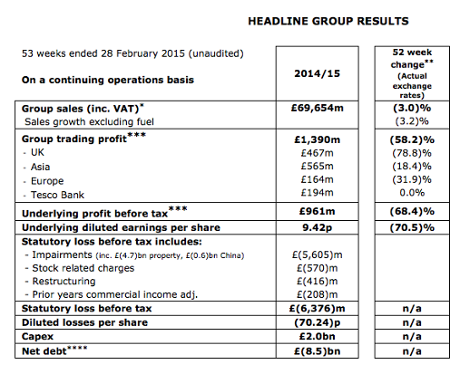
Tesco’s results are online here, including this chart showing how the company slumped into its record loss in the 2014-15 financial year:
Tesco takes £7bn writedown - the details
Tesco’s huge loss is due to a series of one-off writedowns totalling £7bn.
It has taken an impairment charge of £3.8bn again the value of the stores it operates, blamed on “challenging industry conditions and the decline in profit over the last year”
It has also slashed the value of “work-in-progress” (ie, stores being built) (stores being closed) by £925m.
Tesco has also taken written off £570m in stock-related charges, which follows the adoption of a forward-looking provisioning methodology.
That follows the scandal last year, when Tesco admitted that it had overstated its profits and vowed to change the way it booked revenue from suppliers.
There are various other write-downs too, including £630m relating to its investment with China Resources Enterprise.
Updated
The drop in food prices in the UK has hit Tesco.
It says:
The UK grocery market remains highly competitive with macro-economic deflationary pressure and significant price investment across the industry. For the year as a whole, UK like-for-like sales excluding fuel declined by (3.6)% but we saw an improving trend into the second half driven by investments across the offer.
Tesco CEO admits market is "still challenging"
Dave Lewis, the executive parachuted into Tesco last summer to rebuilt its fortunes, admits that it has been “a very difficult year for Tesco”.
The results we have published today reflect a deterioration in the market and, more significantly, an erosion of our competitiveness over recent years. We have faced into this reality, sought to draw a line under the past and begun to rebuild, and already we are beginning to see early encouraging signs from what we’ve done so far.
Lewis says that his turnaround plan is working, with “a steady increase in footfall, transactions and, most significantly, volumes.... More customers are buying more things at Tesco.”
But ha also admits that:
“The market is still challenging and we are not expecting any let up in the months ahead.”
Trading profits, which strip out one-off factors, have also tumbled. Tesco posted a trading profit of £1.4bn for the last financial year, down 58.2% year-on-year.
Today’s results show that Tesco is struggling in the increasingly competitive supermarket sector.
Like-for-like sales, excluding fuel and VAT, fell by 1.7% in the last quarter.
The City was braced for something nasty, after Sky reported last night that the loss could reach £5bn. But still -- a loss of this scale simply wasn’t expected.
Quite obvious why #Tesco leaked the loss story. Imagine if they hadn't, the shock that would have come. £6.38bn loss is huge #kitchensink
— Joshua Raymond (@Josh_CityIndex) April 22, 2015
It’s a truly stunning loss.
Six point three seven billion. Imagine.
— Mike Bird (@Birdyword) April 22, 2015
TESCO POSTS £6.38BN LOSS
Breaking: Britain’s largest supermarket has just stunned the City with the biggest loss in its history.
Tesco has posted a pre-tax loss of almost £6.4bn for 2014, even worse than the most pessimistic analysts had expected.
That includes a £7bn of one-off charges, which have driven the company deep into the red.
More to follow....
Updated
The Agenda: Tesco's loss, and Greece
Good morning, and welcome to our rolling coverage of the world economy, the financial markets, the eurozone and business.
Today we’ll be watching Greece, as usual. Deputy finance ministers from across the eurozone are meeting later to discuss the progress towards locking some aid.
Time continues to tick away, with Athens facing public sector wage bills next week
#Greece AltFinMin Mardas says gov't is €400ml short in cash needed for end of April payments of wages & pensions. /via @koinoniaoramega
— Yannis Koutsomitis (@YanniKouts) April 22, 2015
The other big story today is Tesco, which is reporting its 2014 results in a few minutes time. The City is braced for the biggest loss in its history; as new CEO Dave Lewis gets to grips with the company:
Britain’s biggest supermarket will post its first yearly figures since Mr Lewis was drafted in to turn around its fortunes following a series of profit warnings amid a ferocious price war with rivals.
They are expected to show trading profits falling by 58% to £1.4bn, their lowest level for more than a decade.
Analysts also foresee billions more being subtracted from the group’s bottom line as it writes down the value of its properties by around £3bn as well as facing up to a pension fund deficit swelling to as much as £5bn.
Experts at Barclays have pencilled in a statutory pre-tax loss at around £2.9bn with Shore Capital estimating around £3bn while some reports suggest losses could be as high as £5bn.
Shore’s Clive Black said: “At a statutory level, it’s going to be a horror show. But, for shareholders, it is about Dave Lewis and the future.”
We’ll also be watching out for the minutes of the Bank of England’s latest monetary policy committee meeting, at 930am BST, and other key developments through the day.....