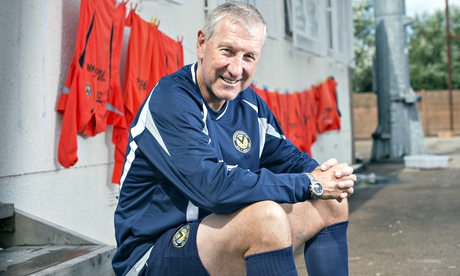
I arrive ludicrously early for my appointment with Terry Butcher, so I spend a while in the players’ lounge at Newport County’s training ground. Once the blood-soaked, lion-hearted stalwart of England’s backline, Butcher wipes my table clean, offers to make me a hot drink and then helps the cook put away some plates. Around him players, filling time between the day’s two training sessions, play darts and table tennis or sit around and chat. Russell Osman, Butcher’s former team-mate with Ipswich Town and England and now his assistant, sidles over. “Don’t worry, they’re better at football than they are at darts,” he says, as the well-peppered wall around the dartboard gains another hole. “Trouble is, some of them are better at table tennis than they are at football.”
With one point from their first five league games – plus instant elimination from the Capital One Cup and Johnstone’s Paint Trophy – Newport’s start to the season has been considerably more pong than ping. But there is mitigation: if the bookmakers are any guide they have played three of the six best sides in the division, two of them away; only once have they been beaten by more than one goal; in the cups they tested a strong Wolverhampton Wanderers side at Molineux before falling 2-1, and started their decisive shoot-out against Swindon on Tuesday night with six unstoppable penalties only to lose on the seventh.
Some early-season stumbling was anyway to be expected following a chaotic summer when the chairman, lottery millionaire Les Scadding, left the club, the squad was reshaped – Butcher’s first official day’s work in May involved releasing 13 players – and the club’s board collectively stepped down, handing control to the supporters’ trust.
“It’s been a whirlwind, it’s been everything I thought it would be and more,” Butcher says. “I expected a lot of change. I knew a lot of players had to go, because the budget has been cut by half a million and the wage ceiling has come right down. Now Les has gone it’s a much different scenario. We had to make some hard decisions, particularly early on. There’s a lot more hard decisions to come I feel.”
Butcher is one of three former England players who will spend this international weekend in a League Two dug-out, with Keith Curle now at Carlisle and Teddy Sheringham taking the first steps of his managerial career at Stevenage, against whom Newport won their only point . “Teddy was part of the Premier League and with all the money that goes with that, you don’t expect someone of his earning potential to be managing a League Two side, that’s for sure,” says Butcher. “It shows that he’s prepared to work and to roll his sleeves up and get stuck in, so you have to admire him for that. The old route for a manager, many years ago, was to manage a lower league team and then progress through the ranks and the divisions and end up at the top. I seem to have gone the reverse of that: started at the top and ended up down in League Two.”
Butcher’s 25-year managerial career is certainly atypical. It started at top-flight Coventry, where he was signed as player-manager in 1990 at the age of 31 – “There were players who were older than me and I think half of them had been offered the job before I’d got there” – and has meandered chaotically ever since, most of it spent in Scotland and including spells in charge of Raith Rovers’ reserves, Dundee United’s youth team, and – during a spell out of the game in the mid-90s – the Old Manor Hotel in Bridge of Allan. Situated just off the Fife Coastal Path, the hotel allowed Butcher to indulge his passions for walking and coastal scenery (he owns a house in Bawdsey in Suffolk, near his childhood home, where he plans to spend his retirement engaged in similar pursuits).
The team’s early-season form has wounded the pride of a man best remembered for another injury. Sunday marks the 26th anniversary of the match that made Butcher’s legend, a World Cup qualifier against Sweden in Stockholm that he ended drenched in blood after a clash of heads. “It’s a bit embarrassing,” he says of that image. “There was a bit more to my game than a bloody shirt but there you go.”
It could be worse, I suggest. Some people’s England careers are summed up by pictures of them being outjumped by handballing cheats, or holding a brolly. “Yeah, I wouldn’t want that in a million years,” he says. “Mine is a favourable one. I’ve been called the hardest Englishman ever, which is quite flattering, and I suppose that it is nice in a way that there is an image of me that people remember. And it sums me up well. That’s me to a T, that is. Bloody but unbowed.”
Bloody, unbowed and enjoying a delightful coastal walk, Butcher seems to be a mess of contradictions. “I’m everywhere. I’m difficult to be labelled,” he says. “I think people would like me to be labelled and pigeon-holed, but I’m still changing. I’m uncomplicated, quite simple. I like the good things in life, the family life.”
Born in Singapore, raised in Lowestoft and employed in Scotland for most of the past quarter-century, Butcher is commuting to Newport from Bristol and finds himself forgotten in the country for whom he won 77 caps, seven of them as captain. “It’s quite nice coming down to England because I don’t get recognised down here,” he says. “I’d been in Scotland so long I’d get recognised everywhere, so you don’t get as much peace and quiet. When you come down to Bristol, people don’t know you and in a way that’s quite nice. I know a lot of people want to be noticed but I’d rather not be noticed at all. And I’m 6ft 4in so I’m quite noticeable. I just like the simple things. I like to walk my dog and a nice glass of wine – or several glasses of wine – and some good company.”
In short, he seems now to have little in common with the Iron Maiden-loving (he says he still listens to them, but “I like Simon Mayo on Radio 2. I think he’s tremendous. We listen to him while we’re having our tea”) centre-half who once said that pulling on a Rangers shirt was “like being pumped full of cocaine”. “Did I really say that?” he says now. “I wouldn’t know because I’ve never been pumped full of cocaine. I’ve never touched the stuff.”
Butcher’s greatest successes as a manager have come at Motherwell, whom he guided through administration and to a League Cup final during four seasons in the early noughties, and at perennial underdogs Inverness Caledonian Thistle. Meanwhile, he failed at Coventry, Sunderland and, most recently, Hibernian. His CV suggests that he thrives when he should struggle and struggles when expected to thrive. This, if nothing else, should offer some encouragement to Newport supporters.
“I love the underdog mentality. I like to roll my sleeves up and get stuck in. I can’t do it physically now but I can do it in terms of the work rate and togetherness and how you bond as a team. I’m sort of suited to that role. I love that,” he says. “Motherwell were in administration when I was their manager and Inverness were relegated, so I think, ‘Yeah, here we go again.’ It’s the most enjoyable rollercoaster you’ll ever go on.
“As much as I don’t like being pigeon-holed as a warrior, I do like to lead a band of men. A gutsy, strong, determined gang that punches miles above its weight. Getting success against all the odds, that’s me. If we do well this year, it’ll be one of those. It’ll be my biggest achievement in football.”
With that England’s erstwhile blood-stained warrior is off, to fetch a plate of sandwiches for a local radio reporter.