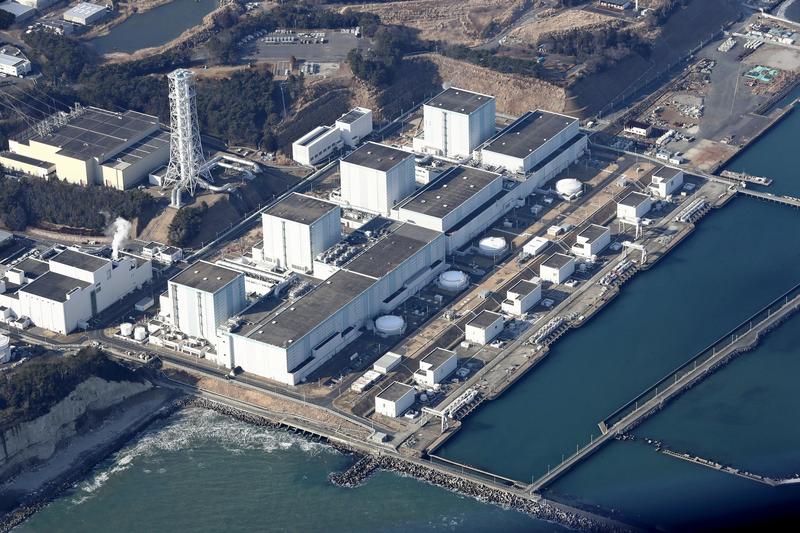
Tokyo Electric Power Company Holdings Inc. has notified the Fukushima governor that the utility will decommission all four reactors at its Fukushima No. 2 nuclear power plant, a decision that means all 10 reactors that TEPCO operated in the prefecture before the 2011 Great East Japan Earthquake will be scrapped.
TEPCO President Tomoaki Kobayakawa met with Fukushima Gov. Masao Uchibori at the prefectural government office Wednesday to convey the utility's decision to scrap the plant, located in the towns of Naraha and Tomioka. TEPCO plans to officially approve the decommissioning of the reactors at a board meeting scheduled to be held on July 31. TEPCO expects the process of scrapping the four reactors to take at least 40 years.
TEPCO had previously decided to decommission the six reactors at its Fukushima No. 1 nuclear power plant, which suffered damage in the March 11, 2011, earthquake and ensuing tsunami.
Key milestone
"There was no precedent for decommissioning four reactors, so we needed some time, but we have a pretty clear idea now," Kobayakawa said to Uchibori on Wednesday evening. "The region's understanding and cooperation will be more important than anything else."
Uchibori replied: "I take your decision very seriously. This is an important step toward the decommissioning of all reactors at nuclear power plants in this prefecture."
TEPCO had put off making a decision on whether to scrap the No. 2 plant's reactors following the 2011 catastrophe. If these reactors could be restarted, TEPCO had intended to use the resulting profits for compensation payments, decontamination work, decommissioning the reactors at the No. 1 plant and other projects. The utility also wished to give priority to decommissioning work at the No. 1 plant, which is expected to take 30 to 40 years.
However, the Fukushima prefectural government and local authorities passed a string of resolutions calling on TEPCO to bring the curtain down on the No. 2 plant's reactors. The realization that restarting the reactors was impossible spread through the utility and the Economy, Trade and Industry Ministry, which oversees energy policy.
It took more than one year from the time TEPCO announced in June 2018 that it planned to decommission the reactors to actually making the decision to scrap them. This was due to concerns that decommissioning the reactors would increase TEPCO's burden of costs and squeeze the company's business.
TEPCO's decision marks a key milestone for local governments with jurisdiction over the No. 2 plant, which is about 12 kilometers south of the No. 1 plant.
Naraha Mayor Yukiei Matsumoto welcomed TEPCO's decision, saying, "This will send a positive message to the town's residents living in Naraha and residents who evacuated and are living elsewhere."
The mayor of Tomioka, Koichi Miyamoto, also expressed expectation that the decision would be good for his town. The decommissioning work "will create jobs and the effect on the regional economy will be a strong tailwind for this area's reconstruction," Miyamoto said.
TEPCO plans to store the No. 2 plant's about 10,000 spent fuel assemblies at a storage facility that will be built on the plant's premises. Government subsidies will be paid to local authorities hosting such a facility, with the funds to be devoted to regional development work and other projects.
The central and local governments will likely discuss the amount and other details of these subsidies in upcoming talks.
Read more from The Japan News at https://japannews.yomiuri.co.jp/