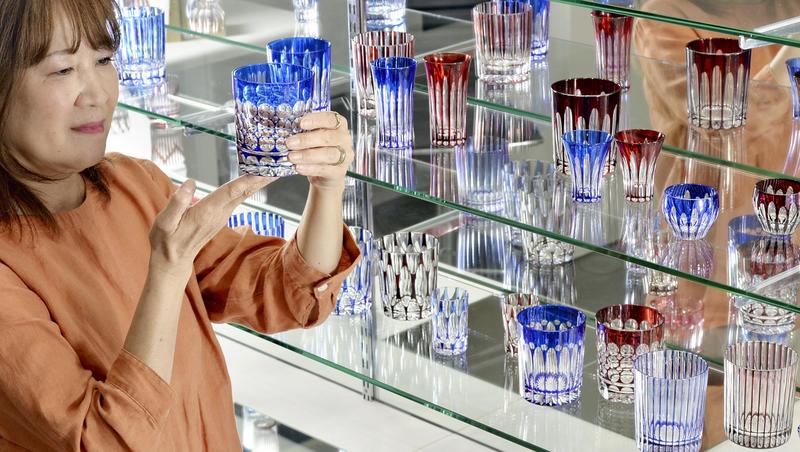
OSAKA -- The Tenma district in Osaka city once prospered as a major glass production center in Japan. Visitors today may find it difficult to locate signs of how Tenma bustled when it was home to rows of factories and wholesalers, but the district still maintains some of its glass culture. A local workshop crafts Tenma kiriko cut glasses, which shine like jewels.
Presented to world leaders
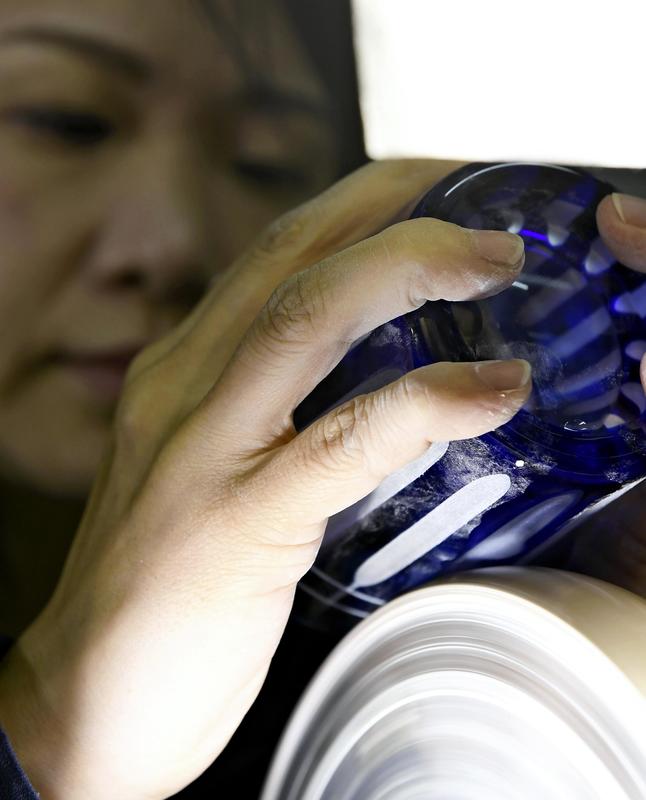
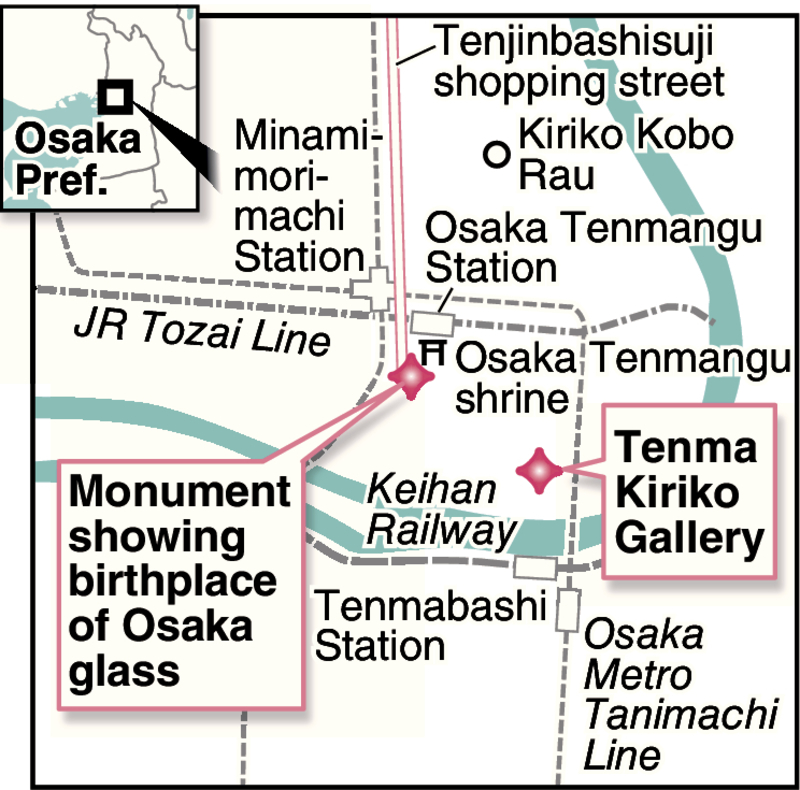
The Kiriko Kobo Rau workshop is a 10-minute walk from Osaka Tenmangu shrine in Kita Ward. When I visited the workshop, I heared a high tone like a bell echo through the facility when a glass surface was placed over the round blade of a polisher.
Tenma kiriko items are produced by covering transparent glass with red or indigo-colored glass before carving patterns. All the products are handmade.
The cut-glass technique was established about 20 years ago by Takeichi Ura, an uncle of Koji Ura, 58, who currently runs the workshop. While similar products in Tokyo, called Edo kiriko, feature fine and regular lines because they are cut using a V-shaped blade, Tenma kiriko products get round, simple patterns created by a U-shaped blade.
"Let's put water in a glass," Ura said after we arrived at the nearby Tenma Kiriko Gallery shop. When I followed his suggestion, I found that the pattern reflected on the surface looked like the inside of a kaleidoscope, thanks to light refraction. This is why Tenma kiriko products are described as being beautiful both as subjects for admiration and as practical items.
When the summit of the Group of 20 major economies was held in Osaka in June, a pair of Tenma kiriko glasses were presented to U.S. President Donald Trump and other state guests, putting the city's glass culture in the global spotlight.
Dating back to 18th century
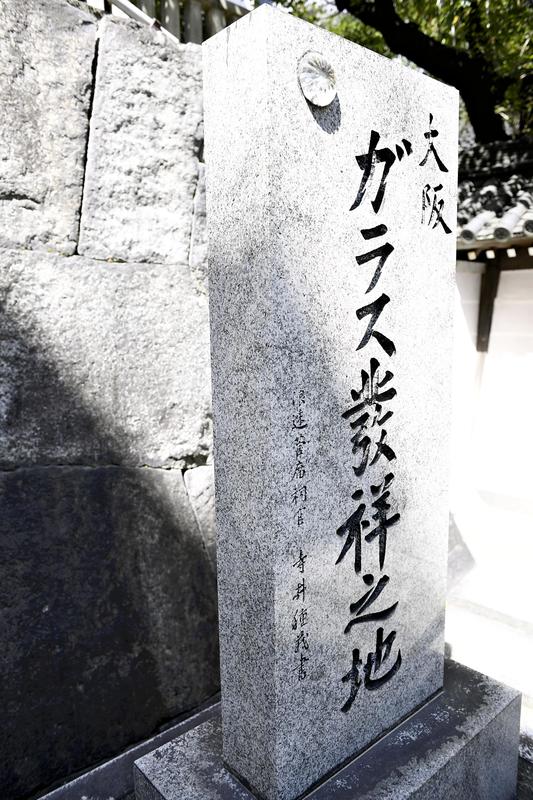
On the south side of Osaka Tenmangu shrine stands a stone monument that bears the phrase "The birthplace of Osaka glass," indicating the area's history of close ties to the material.
According to the inscriptions on the monument, Harimaya Seibei, a merchant from Nagasaki who learned glass production techniques from the Dutch, started producing the material near the shrine in the mid-18th century during the Edo period (1603-1867). It is said that by the beginning of the 19th century, a glass factory had opened nearby.
In 1871 during the early Meiji era (1868-1912), the Tenma area had another major development: the establishment of the government's Mint Bureau. Soda ash, one of the materials necessary for producing glass, is also used to mint coins.
The bureau sold surplus soda ash to the private sector at low prices, which was then used to produce glass. After the opening of the Mint Bureau, the surrounding neighborhoods became a major glass production area in Japan, along with Nagasaki and Tokyo.
The Tenma area was home to many factories and wholesalers, where various glass items were produced such as thermos bottles, ashtrays and marbles.
"These neighborhoods used to buzz with many factories and lots of people working there," said Yasutaka Kinbara, 70, the president of Osakaya Shoten shop, which deals with materials for glass.
The area was later urbanized, and the Osaka Glass Manufacturers Association has seen its members decrease from about 50 to 29 over the past 30 years.
The glass industry in general is facing challenges such as the influx of imported products and competition with resin and other materials. But domestic glass containers are under a fresh spotlight for their high quality and air-tightness, as Japanese cosmetics have become popular among foreign visitors to the country.
"By identifying consumer needs and constantly creating new products, we should be able to find a way forward," said association chairman Kiyoshi Maruyama, 54.
-- How to get there
Railway and Osaka Metro lines. Its shelves contain more than 50 items such as rock glasses and tumblers. Many rock glass items are priced at 16,000 yen to 21,000 yen before tax. The shop is open from 1 p.m. to 7 p.m. on weekdays, but starts at 11 a.m. on weekends and national holidays. Closed on Mondays. For more information, call the gallery at (06) 6926-4443.
Read more from The Japan News at https://japannews.yomiuri.co.jp/