Welcome to the Thursday, Aug. 20, 2026, Brew.
By: Lara Bonatesta
Here’s what’s in store for you as you start your day:
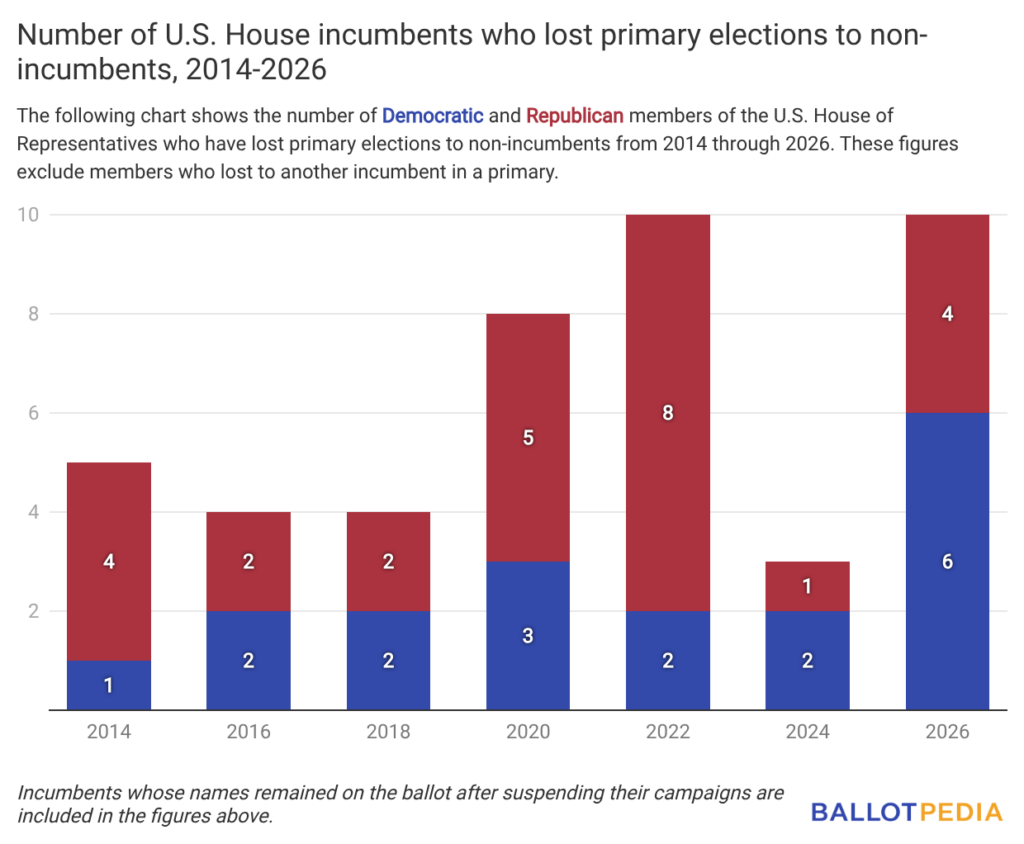
- Ten U.S. House incumbents have lost primaries to non-incumbents this year, tying 2022 for the most since at least 2014
- North Carolina Gov. Josh Stein vetoes election omnibus bill
- Age and policy differences at the center of Massachusetts’ 8th Congressional District Democratic primary
Ten U.S. House incumbents have lost primaries to non-incumbents this year, tying 2022 for the most since at least 2014
U.S. Rep. Cory Mills (R) became the 10th U.S. House incumbent to lose a primary to a non-incumbent this year, which ties 2026 with 2022 for the most incumbent primary losses to a non-incumbent since at least 2014. Mills lost to Ryan Elijah (R) in the primary for Florida's 7th Congressional District. An 11th incumbent, Rep. Al Green (D-Texas), lost to Rep. Christian Menefee (D) in the primary runoff for Texas’ 18th Congressional District on May 26, which featured two incumbents due to redistricting.
More Democratic incumbents (six) have lost to non-incumbents this year than in any other year in that same period.
Two Trump-backed U.S. House candidates lose primaries, 17 win
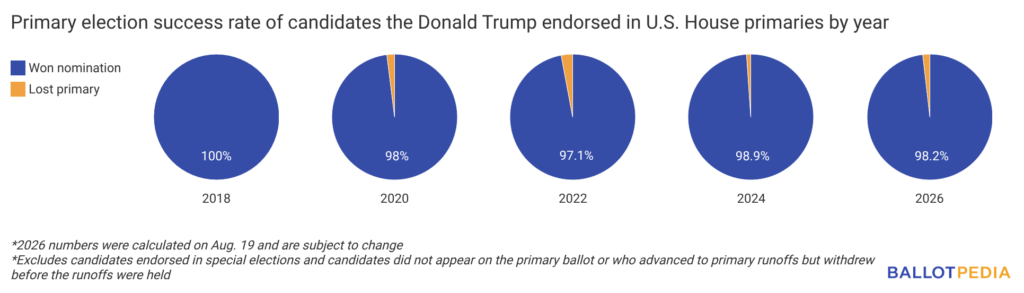
Mills was one of two U.S. House candidates who President Donald Trump (R) endorsed to lose primaries on Aug. 18. Trump also endorsed Catalina Lauf (R) in Florida's 19th Congressional District, who lost to Jim Schwartzel (R). Mills and Lauf are the third and fourth Trump-backed U.S. House candidates to lose a primary this year. They join Amir Hassan (R), who lost his primary in Michigan's 8th Congressional District on Aug. 4, and incumbent Andy Ogles (R), who lost his primary in Tennessee’s 5th Congressional District on Aug. 6.
Trump endorsed an additional 17 U.S. House candidates who won their primaries. Excluding special elections, Trump has endorsed 238 U.S. House candidates in primaries this year. So far, 215 won, four lost, and elections have not taken place for six of them. (Note: Eleven candidates did not appear on the primary ballot, and two advanced to primary runoffs but withdrew before the runoffs were held.) So far, the success rate for Trump’s U.S. House endorsees this year is 98.2%.
The candidate that Trump endorsed for governor of Wyoming – Megan Degenfelder, the state Superintendent of Public Instruction – also lost her primary to state Sen. Eric Barlow.
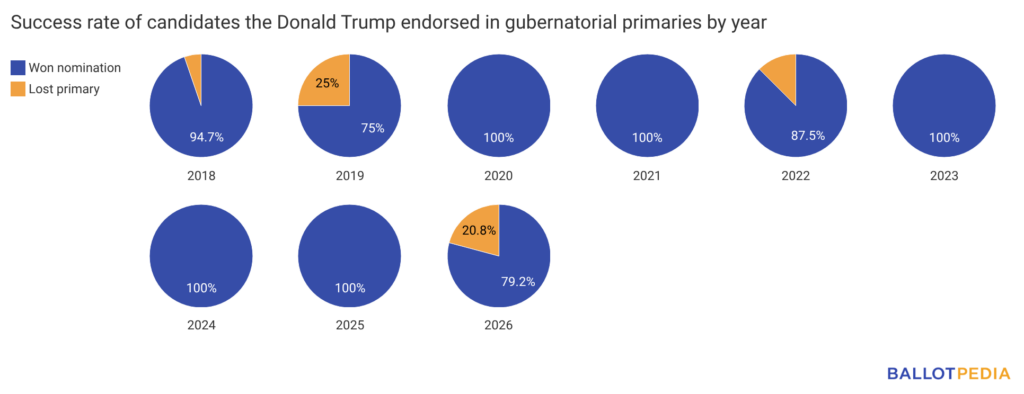
Trump has endorsed 24 gubernatorial candidates this year. Of those 19 won their primaries or primary runoffs and five lost their primaries or primary runoffs – a success rate of 79.2%.
Four former U.S. House members lose Florida primary bids to return to the House
Jim Schwartzel won the Republican primary in Florida's 19th Congressional District, topping a candidate field that included Lauf, who we mentioned above, and former House members Madison Cawthorn and Chris Collins, who previously represented North Carolina's 11th Congressional District and New York's 27th Congressional District, respectively.
Including Cawthorn and Collins, four former U.S. House members lost primaries, all in Florida.
The two other former members are Alan Grayson (D), who ran in Florida’s 7th Congressional District, and Sheila Cherfilus-McCormick (D), who ran in Florida's 20th Congressional District.
DSA-member wins Democratic U.S. Senate nomination in Florida, while both DSA-endorsed congressional candidates lost their primaries
Angie Nixon (D), who is a member of the Democratic Socialists of America (DSA), defeated Alex Vindman (D) in the Special Democratic primary for U.S. Senate in Florida. Nixon will face incumbent Ashley B. Moody (R) in November. Governor Ron DeSantis (R) appointed Moody to replace Marco Rubio (R) when he became U.S. Secretary of State. The winner of the November general election will serve the final two years of the term Rubio was elected to in 2022. Nixon is not included in our count of DSA-endorsed candidates because, according to the DSA website, neither the national nor a local chapter endorsed her.
Both U.S. House candidates that the national DSA or its local chapters endorsed — Oliver Larkin in Florida’s 25th Congressional District and Brittney Robinson in Florida’s 4th Congressional District — lost their respective Democratic primaries.
Special election for Pennsylvania state House seat Republicans have held since 1999 is too close to call
As of 2 p.m., the special election for Pennsylvania House of Representatives District 12 in Butler County was still too close to call. Based on unofficial returns, Brandon Dukes (D) led Scott Timko (R) 50.29% to 49.71%, or 8,469 to 8,372 votes. Former incumbent Stephenie Scialabba (R), who resigned in March, won the seat 64.7% to 35.1% in 2024. The Democratic vote total was 56% of the party's vote total in the district's 2024 regular election. For Republicans, that number was 30%.
If Dukes wins, this would be the 13th state legislative seat to change party hands in a special election since January 2025, all from Republican to Democratic control. It would be the second seat to change party hands in Pennsylvania in that period, joining one in Lancaster County. Republicans have held the seat since 1999. Heading into the election, Democrats hold a 102-100 majority in the Pennsylvania House of Representatives with one vacancy.
In Tuesday night’s state legislative primaries, 13 incumbent Wyoming state legislators, all Republicans, lost their bids for re-election. Twelve of those primaries were for seats in the House and one was for a seat in the Senate. As of this writing, six House races featuring incumbents, both Republicans, were still uncalled. According to Cowboy State Daily, multiple of the members who lost their seats were either members or allies of the state legislature’s Freedom Caucus.
This is the third election cycle in a row in which more than 10 incumbents lost their bids for re-election in the primaries in Wyoming. In 2024, 14 incumbents, all Republican House members, lost their primaries. In 2022, 10 incumbents – three Republican Senators and seven Republican state representatives – lost in the primaries.
Alaska voters approve ballot measure establishing campaign contribution limits for state and local elections, ending unlimited individual contributions
Alaska voters approved Ballot Measure 1, establishing campaign contribution limits for state and local elections for the first time since the U.S. Court of Appeals for the Ninth Circuit struck down the previous limits in 2021.
The measure makes Alaska the 39th state with contribution limits on how much an individual may contribute to a state-level candidate, with limits varying by state, office, and election cycle. Eleven states — Alabama, Indiana, Iowa, Mississippi, Nebraska, North Dakota, Oregon, Pennsylvania, Texas, Utah, and Virginia — allow unlimited individual contributions to state-level candidates.
Miami voters approve ballot measure to move elections from odd to even years
Voters in Miami, Florida, approved a charter amendment to move city elections from odd-numbered years to even-numbered years, aligning them with state elections. The transition will be staggered, beginning in 2034 and 2036. Click here to learn more.
The change will make Miami the 44th of the 100 most populous U.S. cities to hold even-year elections, and the 50th that holds even-year elections specifically for mayor. It is currently one of 36 of the 100 largest cities that hold odd-year elections. Twenty-one cities hold elections in both even and odd years.
Here's what happened in six other elections that we were watching:
- Byron Donalds (R) defeated 10 other candidates in Florida’s Republican gubernatorial primary. He will face Democratic nominee David Jolly in November. Donalds, who currently represents Florida’s 19th Congressional District, is one of 10 U.S. House incumbents — all Republicans — who did not seek re-election this year to run for governor in their respective states. Of those, four won their primaries and six lost.
- Incumbent Debbie Wasserman Schultz (D) won the Democratic primary in Florida's 20th Congressional District, defeating four other candidates. Ahead of the 2026 elections, Florida adopted a new congressional map that changed the boundaries of the 20th District from those used in 2024. In 2024, Wasserman Schultz was elected to the 25th District, and Cherfilus-McCormick was elected to the 20th District. Wasserman Schultz ran for re-election in the 20th District after redistricting shifted the 25th District towards Republicans.
- Jonathan Kreiss-Tomkins (D) and Tom Begich (D) advanced from Alaska’s top-four gubernatorial primary. As of 2 p.m. on Aug. 19, the two other candidates who will advance had not yet been determined. Incumbent Gov. Mike Dunleavy (R) is term-limited. Alaska's last Democratic governor, Tony Knowles, left office in 2002.
- Incumbent Dan S. Sullivan (R) and former U.S. Rep. Mary Peltola (D) advanced from the top-four primary for U.S.Senate in Alaska. As of 2 p.m. on Aug. 19, the two other candidates who will advance had not yet been determined. Fourteen other candidates ran, including a man named Dan J. Sullivan , who had received the third most votes as of this writing.
- Incumbent St. Petersburg, Florida, Mayor Kenneth Welch and former Florida Gov. Charlie Crist advanced to the Nov. 3 general election. While the office is officially nonpartisan, both candidates were previously elected to other offices as Democrats.
- As of 2 p.m. on Aug. 19, the special election in California's 14th Congressional District was still too close to call. Aisha Wahab (D) led with 51% to Melissa Hernandez’s 49%. The winner will fill the vacancy that was created when Eric Swalwell (D) resigned, following allegations of sexual misconduct. This is the 10th special election to be held to fill a vacancy in the 119th Congress.
Click here to see more election results from Aug. 18.
North Carolina Gov. Josh Stein vetoes election omnibus bill
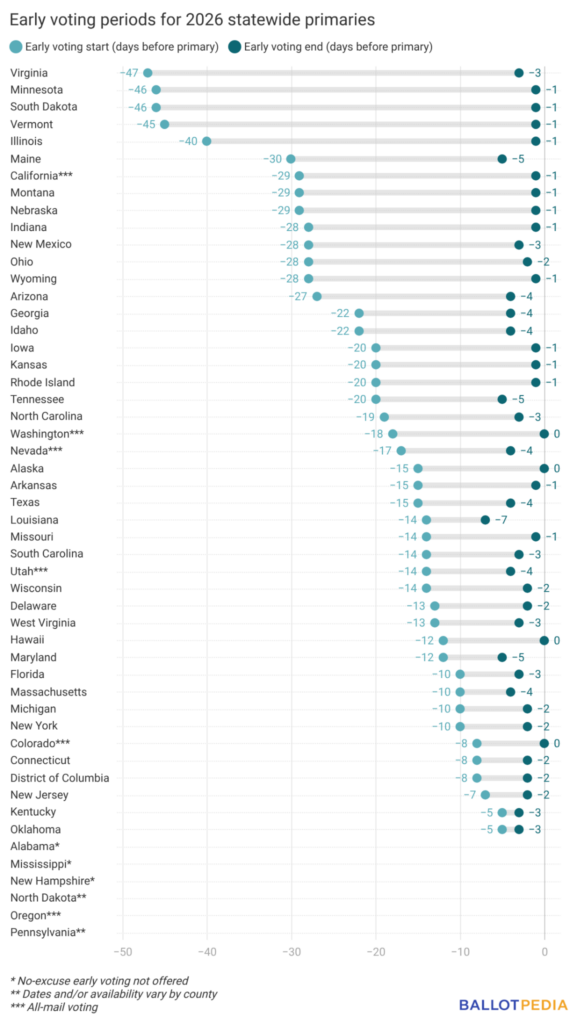
On Aug. 17, North Carolina Gov. Josh Stein (D) vetoed House Bill 958, an omnibus elections bill that would have made a variety of changes to North Carolina's election laws, including shortening the early voting period for primary elections.
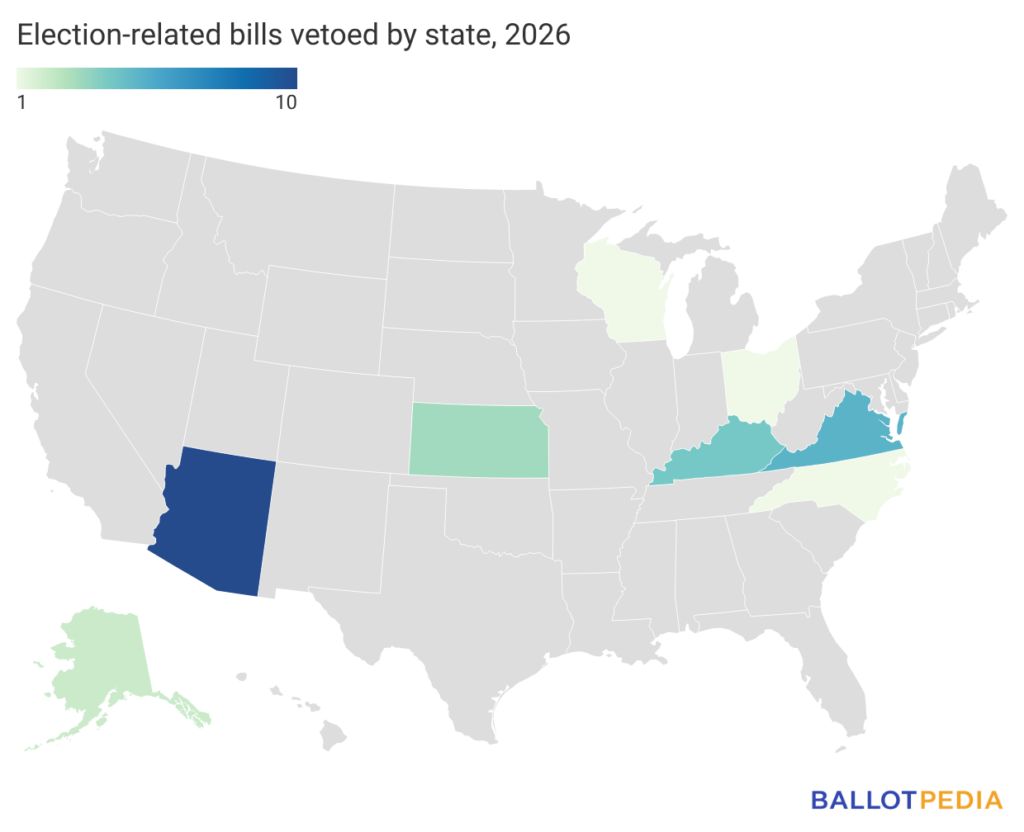
Nationally, this was the 27th gubernatorial veto of an election-related bill in 2026. Nineteen of those vetoes came from a Democratic governor in a divided government state, including Stein’s. Two vetoes came from a Republican governor in a state with a divided government. Five vetoes came from a Democratic governor in a Democratic trifecta. One veto came from a Republican governor in a Republican trifecta.
HB 958 would have required early voting for non-municipal primary or runoff elections to take place in the 10-day period between the second Thursday before the election and the Saturday before the election. It also would have set a 10-day limit on early voting for special and municipal elections. Currently, early voting for non-municipal elections is held in the 17-day period beginning on the third Thursday before the election. H958 would not have changed the early voting period for general elections.
The bill also would have established a post-election audit of county election systems and controls, increased the reporting threshold for certain campaign contributions, and required election officials to receive more frequent reports on individuals who have died and must be removed from the voter registration list.
According to reporting from the Raleigh News & Observer, legislative leaders have said they will not attempt to override any vetoes until after the November midterm elections.
The state Senate passed the final version of the bill 28-13 on July 28, with 28 Republicans voting in favor and 13 Democrats voting against. The state House approved the bill 62-47 on Aug. 4, with 62 Republicans voting in favor and 46 Democrats and one unaffiliated member voting against.
North Carolina is one of 26 states that require weekend early voting hours, as well as one of 14 states to require early voting to be available during evening hours. Colorado, Connecticut, Massachusetts, New Jersey, and Oklahoma have statutes that set different early voting requirements for statewide primary and general elections.
Stein signed a different omnibus elections bill on Aug. 11. House Bill 834 extends the cure period for absentee ballots to 12 p.m. on the fifth business day following the election, rather than the third business day, among other changes to election laws. It was the first election-related bill enacted in North Carolina this year.
Heading into the 2026 elections, North Carolina is one of 11 states with a divided government. Republicans would need to gain one seat in the House to be able to override the governor’s vetoes without help from Democrats. Democrats would need to retain all their seats or gain seats in either chamber to prevent a Republican supermajority. In North Carolina, three-fifths of members present in both chambers must vote to override a veto. Assuming all members are present and there are no vacancies, this amounts to 72 of the 120 members in the state House and 30 of the 50 members in the state Senate. Currently, Republicans hold a 30-20 supermajority in the Senate and a 71-47 majority in the state House.
Click here to learn more about early voting.
Age and policy differences at the center of Massachusetts’ 8th Congressional District Democratic primary
Incumbent Stephen Lynch (D) and Patrick Roath (D) are running in the Democratic primary for Massachusetts' 8th Congressional District on Sept. 1.
WBUR's Anthony Brooks wrote, "The race is one of many primary contests across the country pitting the power of incumbency against a call for generational change."
As we mentioned earlier this week in our Aug. 18 edition of Daily Brew, five of Massachusetts' congressional incumbents face primary challengers this year, tied with 2018 for the most since at least 2014. Nationally, there are more contested Democratic primaries for U.S. House than in any year in that same period.
Roath has criticized Lynch's record, saying he was not in touch with the Democratic base. Lynch says that his experience has given him an understanding of how Congress works.
Lynch was first elected to Congress in a 2001 special election. He is campaigning on his record and background as a former ironworker. The Professional Firefighters of Massachusetts and the Iron Workers Local 7 endorsed Lynch.
Roath is a lawyer and aide to former Gov. Deval Patrick (D). He is campaigning on supporting a federal paid leave plan based on Massachusetts' state program. Roath is also campaigning on building more housing units. Patrick and the Boston Teachers' Union endorsed Roath. Roath completed Ballotpedia’s Candidate Connection survey, click here to see his response.
According to Boston.com’s Ross Cristantiello, at a debate hosted by the League of Women Voters of Hingham on Aug. 13, Roath criticized Lynch for voting against the Affordable Care Act in 2010 and for voting in favor of the Laken Riley Act in 2025. Roath also said he would cosponsor legislation to pass Medicare for All and would support lowering the standard age for Medicare.
On these issues, Cristantiello wrote that Lynch “said that he had antitrust concerns with the ACA at the time and called for lawmakers to ‘revisit’ the landmark legislation now” and “called for ‘comprehensive’ immigration reform and spoke about his support for the DREAM Act, a longstanding proposal to protect immigrants who came to the country as children from deportation.”
Click here to learn more about the Democratic primary in Massachusetts' 8th Congressional District.