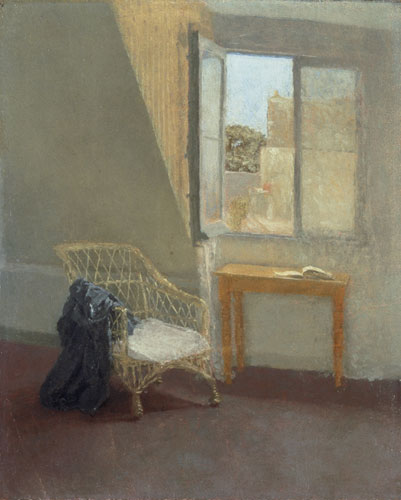
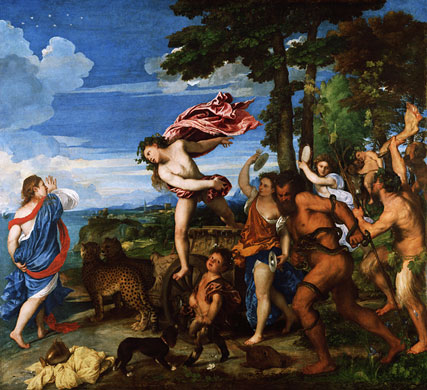
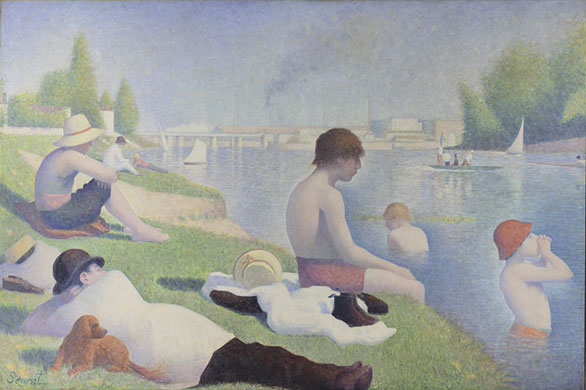
A Corner of the Artist’s Room in Paris (with Open Window), Gwen John. National Museum & Gallery of Wales, Cardiff. "'I am not myself except in my room,' wrote Gwen John to her erstwhile lover, Rodin, and her room has its own personality. The soft sunshine, the wicker chair, the open book, the window opening on to Paris: perfect silence, simplicity, restraint. The coat on the chair speaks of the possibility of going out, but also the peace of staying in. Some see it as an absent self, along with the chair over which it is draped, but the beautiful room is not empty. The artist is present, creating the atmosphere as she paints. And what a beautiful reverie: partly achieved by using chalk in the primer and a lot of white to get those misty, pearly tones, partly with brushstrokes that are never put on to bear the impression of the artist’s ego, each half concealing the next"Photograph: National Museum CardiffBacchus and Ariadne, 1520-3, Titian. National Gallery, London. "There are some paintings, and even just details of paintings, that you want to see all the time – a small corner, for instance, of Titian’s Bacchus and Ariadne. This shows an expanse of deep blue sky illuminated by eight glimmering stars, or possibly a very faint glow from the east that gives a silver lining to the motionless clouds. It is a beautiful image of sustained expectation, seconds before the Sun lifts above the horizon and the stars disappear from the heavens. Even if you didn’t know the scene below represented the moment of love at first sight, you would still have a sense of something amazing in the air Titian paints, the exact transition between darkness and dawning light. This fraction of the painting would make a show in itself, quite apart from all the rest of his astounding originality" Photograph: CorbisBathers at Asnières, 1884, Georges Seurat. National Gallery, London. "Vast, serene, luxuriously light, soft as the summer’s day it portrays, you would hardly think that Seurat’s first masterpiece, painted in his mid-20s, was executed in small, tight, criss-cross brushstrokes. Its pleasures are hazily narcotic – the figures dreaming on the bank, the boy submerged in the water, the drifting yachts and motionless smoke – so that first impressions are not of a radical formal experiment. Each figure is isolated in thought and pictorial space. Bare backs are haloed, shadow, sky and water iridescent with colour, the scene bleached by sunlight. It speaks so much of a stillness that commentators fill it up with explanations. It’s political (workers’ day off) or gay (no women) or art history updated (bathers in Chelsea boots and bowlers) and it is partly the latter. Overall, it is a moment of joyfully unforced thought (or no thought at all) made permanent"Photograph: The National Gallery, London
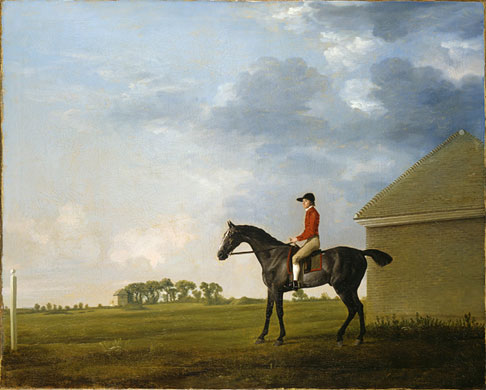
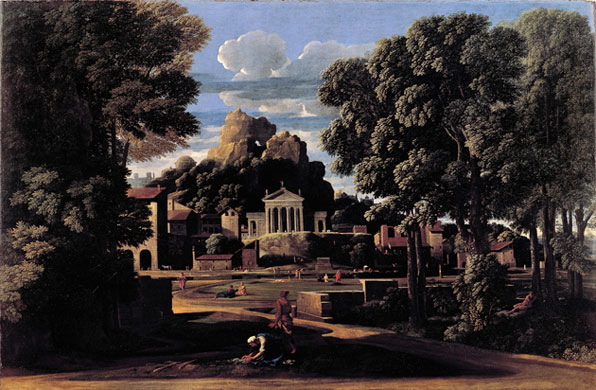
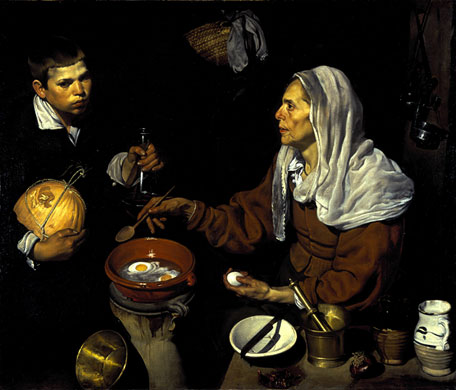
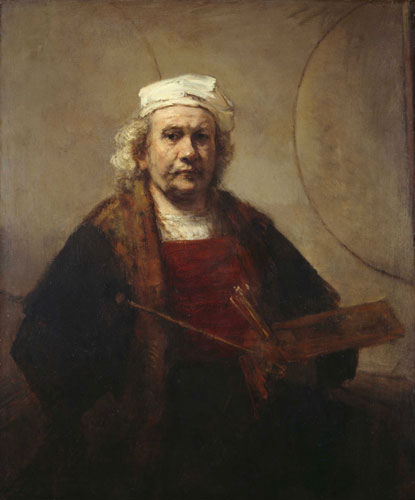
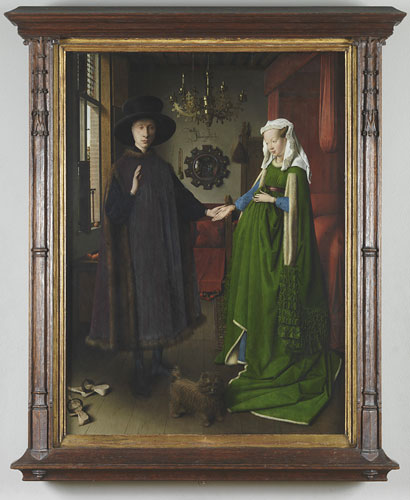
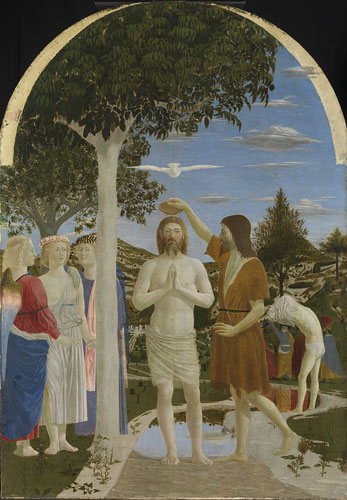
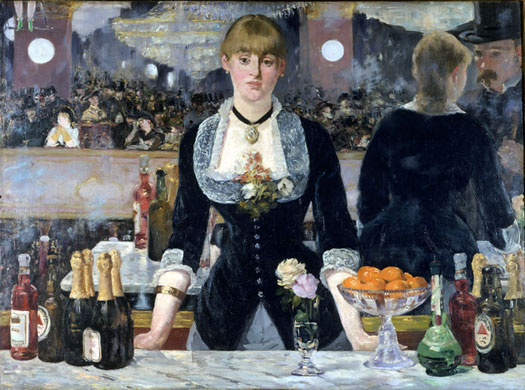
Gimcrack, with John Pratt up, on Newmarket Heath, c1765, George Stubbs. Fitzwilliam Museum, Cambridge. "Look at that title: the horse comes first. This is a portrait of Gimcrack, from which you feel you could recognise this noble creature just as much, if not more, than the jockey John Pratt. The future looks good, a new sun is rising high, but the present is still a little stormy; more than half of the painting is sky, against which the dark horse presents a trenchant cut-out. No British painter can match Stubbs for his sense of outline and tense, nervous design and this work embodies both"Photograph: The Fitzwilliam Museum CambridgeLandscape with the Ashes of Phocion, 1648, Nicolas Poussin. Walker Art Gallery, Liverpool. "Imagine gathering up the strewn ashes of your husband with your bare hands. This is what Poussin evokes in this astonishing painting. Phocion was a great Athenian general in the 4th century BC, executed on trumped-up charges for trying to prevent corruption and excess. His body was ignominiously burnt outside the city walls, his widow forced to retrieve the remains in secret. It’s a sinister scene – the dark trees, the furtive companion, the spy lurking on the right – made more horrifying by the perfect composition: the massed trees, the serene gardens, the temple rising up behind and others carrying on regardless in a passage of daylight. It is a classical subject painted with classical elegance, to a moral purpose. This is life: the best man murdered and civilisation, with its manicured lawns, continuing as normal. A new tradition of narrative landscape"Photograph: Walker Art GalleryOld Woman Frying Eggs, 1618, Velázquez. National Gallery of Scotland, Edinburgh. "What Velázquez could achieve with the tip of his brush remains astonishing and his genius was there from the start. You can see it in the frying pan of eggs coalescing from translucent liquid to white flux in this tavern scene painted before he was 20. The red onion, bowl and knife, all lying like sacraments on an altar. The old woman and the boy are portraits of workers in Velázquez's native Seville. Everything remains still, a tableau made to bewitch and each object a feat of gleaming illusion in darkness. But at the quick of the picture is this moment in which liquid becomes solid, acquires form, like the alchemy of oil paint itself"Photograph: National Gallery of ScotlandSelf-portrait, c1663, Rembrandt (detail) Kenwood House, London. "Rembrandt, insolvent, isolated, not many years from death, is dressed like a king, his presence commanding. Holding court in the kingdom of his studio, he summarises all he could do with his art, from the huge variation of accents in that ambiguous face to the lightly scratched moustache, cloudy hair and his cap’s white streaks. A flurry of marks sketches in the palette, brushes and hand, the triumvirate of tools. The famous circles behind him have made a Mona Lisa of the self-portrait for historians, but the man himself makes the enigma. The black eyes are withdrawn in a face strong as the Ancient of Days yet painted in the softest strokes. What is the expression – stern yet sympathetic, undeceived but forgiving? And to whom is this mercy directed? The familiar face is truthfully inconclusive, for no man can be summarised in a single work of art"Photograph: English Heritage Photo LibraryThe Arnolfini Portrait, 1434, Jan van Eyck. National Gallery, London. "The familiar Arnolfini – the rich couple with dog, shoes and oranges. But what are they doing in a bedroom, an intimacy unheard of in Flemish portraiture? Is this the engagement, the marriage, the party afterwards? Even if one knew what Giovanni was testifying with his right hand, he would still be a disturbing presence with his reptilian mask and cauldron of a hat. He touches, but does not look at his companion. “Jan van Eyck was here” is written on the wall above the mirror in which the artist slips himself into the scene, tinkering with the picture’s tense. Without it, you would simply be looking at an image of the past; in it, things are still happening, life continues on our side – the painter’s side – of this room. Van Eyck invented not just the whole tradition of painting in oil, but the idea of an open-ended picture that extends into our world"Photograph: The National Gallery, LondonThe Baptism of Christ, 1450, Piero della Francesca. The National Gallery, London. "The Archbishop of Westminster once said that Piero’s sublime Baptism ought to hang in a cathedral, not a gallery, and it is easy to understand why. Few works of art convey or embody the uplift of faith more than this transcendently beautiful image. Everything aspires upwards from those pale feet, the legs, the tree, the bodies, Christ’s hands, the line of water linking head to shell right up to the bird itself, shaped like the clouds beside it, a hovering UFO. Much has been made of the artist’s mathematical precision, but none of it explains the meditative calm famously experienced by those who stand before this picture"Photograph: The National Gallery, LondonBar at the Folies-Bergère, 1881-2, Manet. Courtauld Institute, London. "The barmaid leans on the counter at the end of her tether, impassive, absorbed, hiding her inner self in broad, twinkling light. This triggers the famous question – why does the mirror behind her not reflect what is actually in front of it, as if she were separate from her reflection? As if there were two similar women, or just one in some before-and-after sequence with a customer, a man who ought to be standing where you stand, except that he is part of a scene possibly in a dream, or in the past, or in some other room. We know the barmaid was called Suzon, but this is not quite a portrait, nor a snapshot of a bar, for the scene is conspicuously manufactured. She stands apart, unreachable, dreaming. Our public and private selves are separated and Manet finds a new way of painting this truth, altering the concept of realist painting in the process"Photograph: The Courtauld Gallery, London
Sign up to read this article
Read news from 100’s of titles, curated specifically for you.