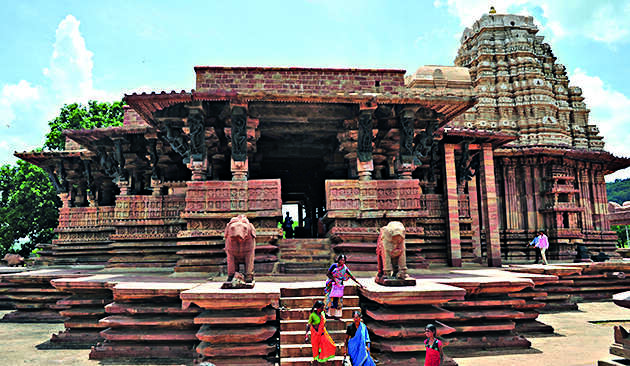
HYDERABAD: World heritage site Rudreshwara (Ramappa) Temple has significant threats of damage, natural spoilage and other defects. In the management plan submitted to Unesco, the state said that the Archaeological Survey of India is working to rectify the defects at the temple complex.
The structural analysis, conducted by a team from National Institute of Technology, Warangal, has found that floor beams resting on the sand have been subjected to tensile strength which is far less than stress developed due to the superstructure.
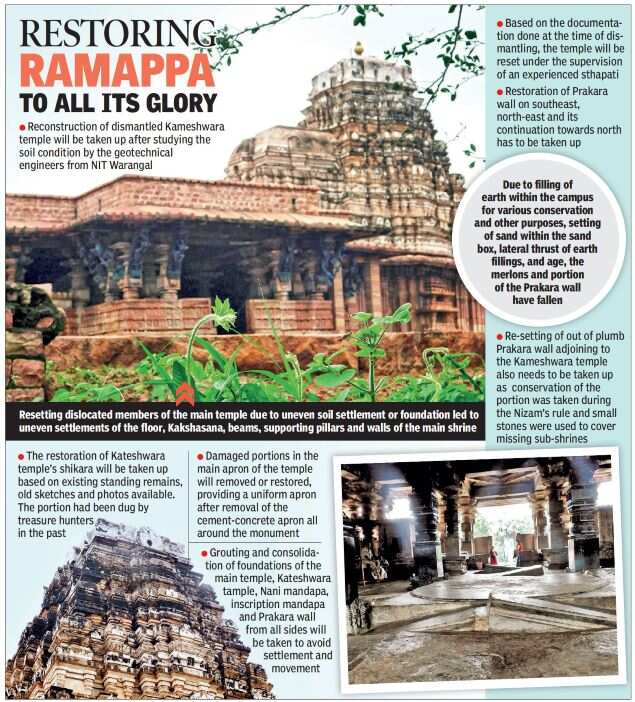
“This is the primary reason for all broken floor beams that have been observed. The floor beams, having large cross-sections made up of sandstones, have failed severely, resulting in settlement of all four major load-bearing dolerite pillars,” archaeologist Dr E Siva Nagi Reddy said. “Kameswara Temple is being restored using the same building elements with little modified structural stability and quality control adopting the ancient construction procedure,” he added.
The sikhara — upper part of the main temple — is made up of floating bricks, overlaid with stucco. Nagi Reddy said that the deposition of dried moss and other micro-vegetation caused an unpleasant appearance and weakening of the stucco surface. “The probable cause is due to the impact of humidity and rainfall, thick micro-vegetation growth occurred, which caused deterioration of stucco surface,” the heritage department said.
Hard lichen growth on the stone surface of temple’s exterior vertical wall was causing deterioration due to the secretion of acids. Nandi mandapa, kitchen, Kateswara temple were made up of red sandstone with white bands, probably procured from nearby hills. The exterior wall of the main temple has been impacted due to humidity and rainfall, and thick micro-vegetation growth. The exterior wall of Nandi Mandap has the presence of remnants of previously applied lime patches. Lime marks and the presence of lime remnants were seen.
The ceiling of antechamber has soot deposits in the interior of the temple.“Burning of oil lamps, camphor, incense sticks etc., led to deposition of soot on the interior walls and ceiling. Disfiguring of the sculptures was found at the exterior wall of the temple and sub-shrines, it has occurred due to the impact of the atmospheric vagaries, and inherent nature of building material, stone sculptures eroded causing disfigurement,” the heritage department said in the management plan.