There’s still room for firsts in art. For Elizabeth Ann Macgregor, director of Sydney’s Museum of Contemporary Art, that first was opening a collaboration between an artist and his dog. The work in question is Teena’s Bathtime , an installation video by Sydney-based artist David Capra, commissioned for the museum’s Jackson Bella room.
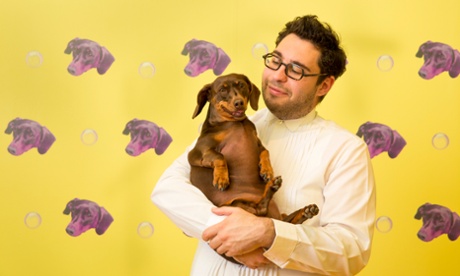
The artist was there, dressed in his habitual performance outfit of a white shirt buttoned to the neck, white shorts, tights and sandshoes, contrasting with an unshaven face and shock of black, curly hair. And Teena was there too, a plump sausage dog who spent most of her time in Capra’s arms, surveying the crowd with a mixture of fear and indifference behind baleful brown eyes.
Capra describes himself as an “intercessory artist” which is to say his work – performance, video, sculpture – exists in the social spaces created by communities such as religious groups, people with disabilities and the various interlocking circles of the art world itself.
In 2013, he won the Blake emerging artist award for Year of Jubilee, a video work about the ritual of banner waving. Capra is considered a leading artist of his generation, a view certainly held by his peers who showed up for the launch of Teena’s Bathtime – artists including Tom Polo, Heath Franco and Phoebe Rathmell, all young and most of them employed by the MCA, including the sometimes emotional MC, performance artist Liam Benson.
But all eyes were on the video of Teena having a bath in one of those mobile dog wash vans you see roaming the suburbs. The video itself is in a room wallpapered with a pattern of purple-blue Teena heads and soap bubbles against a shocking yellow background, a reference to Andy Warhol’s cow wallpaper. A giant soft sculpture of a sausage dog body frames a video screen on which you see Teena tended by Brett, a giggle-hatted dog washer dispensing canine wisdom. Brushing a dog, he says, is the most meaningful contact a human can have with their pet.
The video continues on as Capra meets Dawn, a woman with autism, and her service greyhound, Lucy, then later wheelchair-user Charlene and her two miniature collies. A seat in the installation enables Capra to sit with Teena and meet visitors who enter via the adjoining room, a space designed for people with specific physical, emotional or behavioural needs.
Capra describes his work as being about overcoming anxieties, both his own and those of the people he meets, and it’s a great example of the recent push to make contemporary art relevant to communities beyond the confines of the traditional gallery space.
Although this work is exhibited in a traditional gallery, the usual white cube formalities have been dispensed with in favour of a more causal environment: a room of cushions and pinboards featuring flat felt sausage dogs, Capra’s performance flags, knitting projects and an interactive video room. And while Capra’s installation and the Bella room are usually reserved for its intended audience, the public can gain access on periodic open days, the next on 20 June.
It’s rare to attend any kind of art opening or launch where there’s such a positive vibe – the sheer optimism and good-natured fun of Capra’s project won over the 100 people in the room. As the crowd oohed and ahhed over Teena (who could frankly afford to lose a few kilos)– the magical suspension of disbelief that’s required to appreciate art was transferred to a dog. She seemed to love the attention.