Nine years have passed since the Great East Japan Earthquake and tsunami that caused unprecedented damage. Recently, with the help of science, more projects have been conducted to examine historical materials that recorded natural disasters and had long been kept in local communities. I spoke to researchers involved in such projects about their efforts to pass the disaster prevention lessons of the past onto the future.
Driving along a winding path toward the Pacific coast on the eastern tip of the Omoe Peninsula, Iwate Prefecture, I saw an old stela by the side of the road. I stopped the car and got out, approaching the shoulder-high stone slab facing the Pacific Ocean.
Among the words inscribed on it was the following phrase: "Don't build a house below this point."
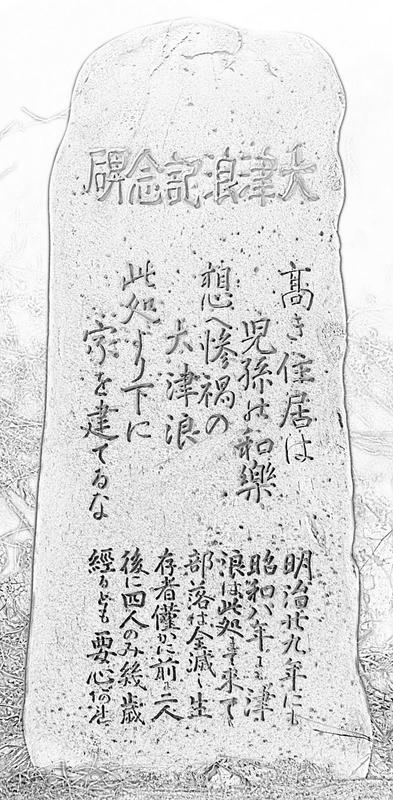
The message written on the Otsunami Kinenhi stela in the Aneyoshi district in the city of Miyako conveys to the local people the damage and the lessons from the 1896 Meiji Sanriku Earthquake and the 1933 Showa Sanriku Earthquake that devastated the district.
Both sides of the road were surrounded by mountains and forests, so I could not see the sea from where the stela stands. However, I found out the tsunami during the 2011 Great East Japan Earthquake reached a point just 50 meters in front of the stela.
The message on the stela from the past reflects what actually happened in the present. As I realized this, I got a shiver.
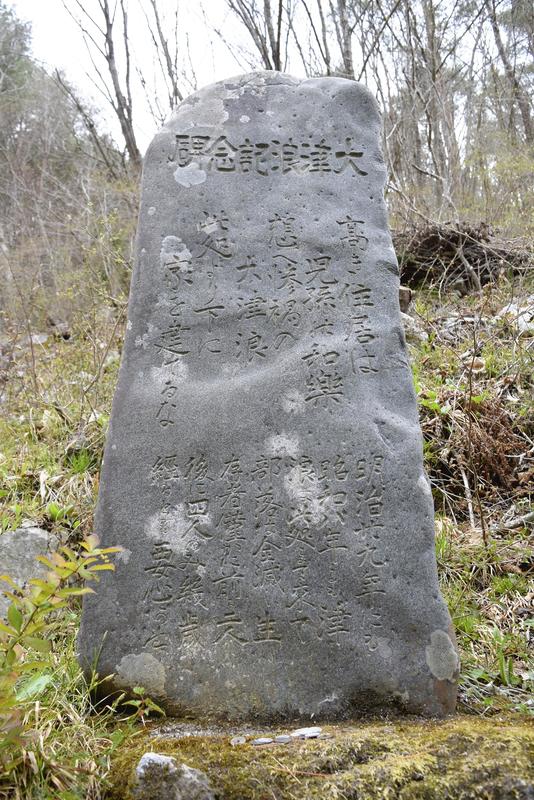
"The stela served as a landmark for us in case of emergency," said Tamishige Kimura, 73, who heads the residents' association of the district. There are no houses seen along the slope coming up to the stela from the nearby fishing port. About 30 people who own houses in an area above the stela evaded the tsunami and still live in the area.
"The teachings of our ancestors saved our lives," Kimura said.
"If you just run far away, you will only be caught by the tsunami. Make sure you always know a high place nearby for evacuation."
"Tsunami come after massive earthquakes. Gather here in the event of an earthquake."
Stelae with such messages can be found in many parts of Miyako.
They were erected following the occurrence of each major tsunami, including the one after the 1960 Chile earthquake, and always played an important role of informing residents of the actual circumstances of the damage in past disasters.
However, these stelae that convey valuable lessons from the past for the present are in danger. As the surfaces of the stelae have long been exposed to the elements, the inscriptions have gradually faded, making it difficult to read. Meanwhile, the number of residents who pass down to others in the area the existence of such stelae is decreasing.
With this in mind, Hideyuki Uesugi, 44, an associate fellow at the Nara National Research Institute for Cultural Properties, started the Hikari Takuhon research project. Uesugi is jointly working with Tohoku University and other entities to restore and preserve such stelae inscribed with lessons of past disasters.
"Some were destroyed by the earthquake, while others are in danger of being discarded," he said. "If we don't preserve them now, the information will be lost forever."
For the project, researchers take multiple photos of the inscribed characters on a stela using a fixed camera as flashlights illuminate the text at various angles. Special image processing software is used to synthesize the photos into a single image, revealing the faded inscriptions clearly.
It takes a few minutes to illuminate the inscriptions and only about 10 seconds to synthesize the images. Without touching the precious historical materials, the whole procedure, including the final confirmation of the images, can be done on-site in a short period of time with portable equipment. Therefore, if there are any failures in the process, it can immediately be done again. Project researchers have so far conducted this process at about 200 locations nationwide and begun making the images available in an online database.
Some local high school students are cooperating in the research.
"Through such activities, the lessons of past disasters will be passed on to the younger generations and eventually lead to disaster prevention and mitigation," Uesugi said.
The magnitude and seismic intensity of earthquakes became scientifically measurable only in the past 100 years. How can we find out about historical major earthquakes that occurred once every few hundreds years to thousand years? Clues can be found in old documents.
In the wake of the 1891 Nobi earthquake, which measured magnitude 8 and is believed to be the largest inland quake in Japan, the compilation of a history of earthquakes began. This history is now 30,000 pages long, but it contains many undeciphered materials, while there are not enough researchers who can read old documents.
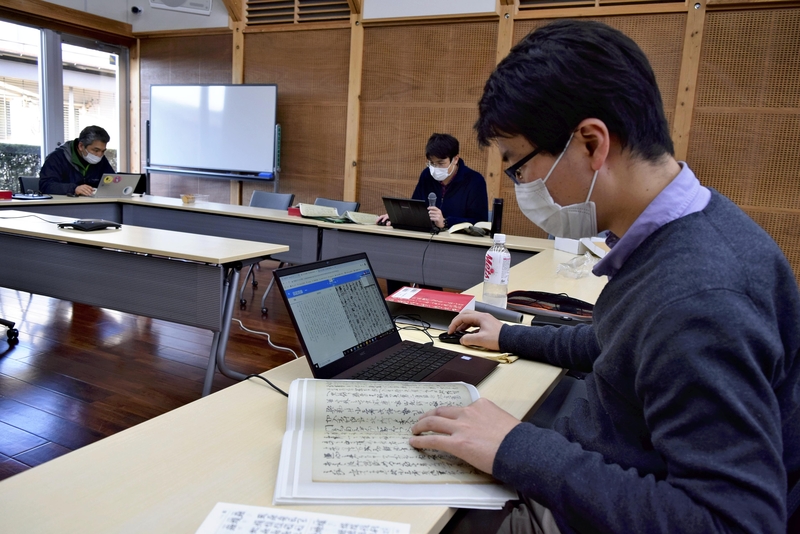
For that reason, seismologists and others at Kyoto University launched the Minna de Honkoku project in 2017 and developed an app that helps decipher old cursive writing using artificial intelligence.
With the help of members of the public who are interested in old documents, participants in the project proceeded with work to decipher more than 500 historical materials mainly from the Edo period (1603-1867).
Project member Yasuyuki Kano, 45, an associate professor at the University of Tokyo's Earthquake Research Institute, said, "The advantage of historical materials is that we can learn the details of past earthquakes, such as the time they occurred, the process of aftershocks and the areas jolted."
Another member, Akihito Nishiyama, 48, a specially appointed researcher of the Historiographical Institute at the University of Tokyo, took particular note of old diaries. He did so because diaries are kept by the same person for a long period of time so they can provide information on small tremors of which details were not abundant available.
Project members deciphered diaries written mainly around the time of the Ansei Tokai and the Ansei Nankai earthquakes in 1854 in the late Edo period, when magnitude-8-class massive earthquakes occurred in a series. They classified about 3,400 jolts into three intensity levels of high, middle and low, before recording their locations on a map of Japan. These efforts led to the discovery of a new fact that the stone walls of Tottori Castle were destroyed in an earthquake in 1849.
"If we can learn more about small tremors before and after a massive earthquake, we will be able to grasp the whole picture of the earthquake's mechanism and use it for quake predictions," Nishiyama said. "I hope such efforts will play a role in linking history and seismology."
Read more from The Japan News at https://japannews.yomiuri.co.jp/