Artificial intelligence and the new 5G communication standard are being used for competitions, event management and viewing. The Games offer great opportunities for Japan's tech companies to demonstrate their prowess to the world.
--Beamed-in badminton
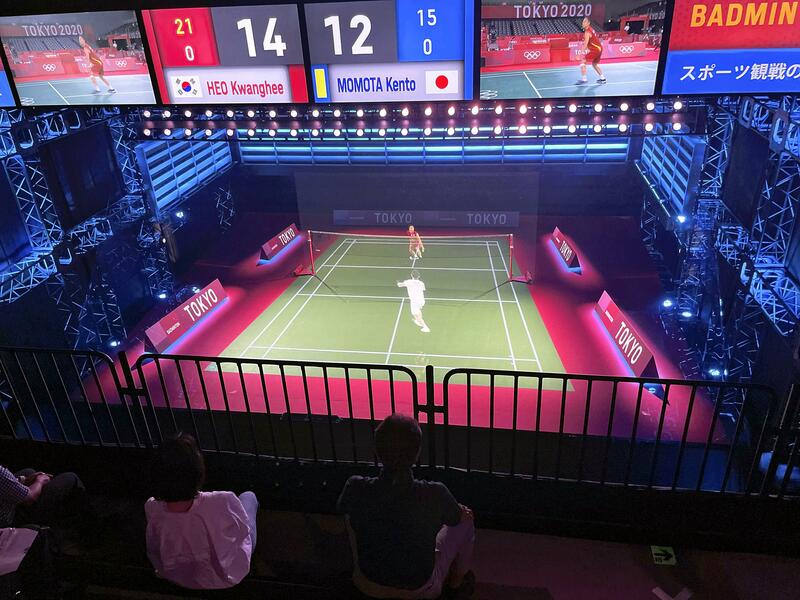
On July 30, two Olympic athletes were seen hitting a shuttlecock to each other on a badminton court specially built in the National Museum of Emerging Science and Innovation (Miraikan) in Koto Ward, Tokyo. Their shouts and footsteps echoed through the facility.
The museum is in the bayside area where there are many venues for Games competitions, such as gymnastics and tennis.
However, the match had actually been held two days earlier at a competition venue more than 20 kilometers away.
At the Miraikan viewing event, moving 3D images from the match were created by an AI-equipped sport event viewing system developed NTT Corp., a sponsor of the Games. The system is capable of operating nearly in real time.
As the system records the match, it isolates images of the players and the shuttlecock and projects them into the viewing space. The system can capture details as fine as sweat running down a player's forehead, giving spectators a sense of realism that otherwise could only be experienced at a competition venue.
Drones with high-precision cameras are being used to record sailing events in the sea near Enoshima, Kanagawa Prefecture. Using high-speed, high-capacity 5G communications, they transmit incredibly realistic live images to a large screen in a spectator area.
NTT Group also provides eyeglass-style augmented reality (AR) terminals for use at swimming competitions. Wearers gazing at swimmers in the pool can see the times and places displayed on the lens of the glasses.
TV broadcasting at the Olympics also uses various technologies.
In the archery event, Panasonic Corp.'s Contactless Vital Sensing technology was used to display competitors' heart rates in a corner of the TV screen. A high-resolution camera trained on an archer's face registers changes in complexion caused by the expansion and contraction of blood vessels. It does so with such accuracy that it is possible to calculate the person's heart rate.
When an athlete focuses on the target and draws their bow, their heart rate starts to increase. Viewers of the Tokyo Olympics can enjoy the atmosphere and share the player's feeling of tension thanks to the technology.
--Facial recognition
NEC Corp.'s facial recognition system, considered as one of the most advanced in the world, contributes to ensuring the safe management of the Games.
The system is capable of instantly verifying the identity of each person at the entrance gates of more than 40 venues for the Games, including the National Stadium, by checking whether the person's appearance matches their registered photo.
This is the first use of a facial recognition system to manage entry to Olympic or Paralympic venues.
--Automatic transport
In the athletes village in the bay area, a self-driving 20-seat electric vehicle, named e-Palette and built by Toyota Motor Corp., provides a loop-line transportation service for athletes. Athletes who were surprised that the vehicle has no driver posted about it on social media, attracting great attention overseas.
Due to the novel coronavirus pandemic, most of the competitions at the Games have been held with no spectators, which is a great disappointment for the companies that planned to promote their products and technologies at the event.
NTT initially targeted people without tickets, aiming to have them experience the advantage of its technologies through the 3-D image viewing event at the Miraikan. In the end, it was presented only to a limited number of people including reporters.
NTT engineer Shingo Kinoshita said, "To be honest, it's a shame that we can't show it to the general public and children firsthand."
Read more from The Japan News at https://japannews.yomiuri.co.jp/