“Relegation-haunted Orient’s goal difference is currently only -4,” tweeted garethjm. “Any teams ever gone down with a better goal difference?”
We’ve taken a look at this question before, which is worth revisiting for the story of Rethymno Kriti, who were relegated from the Greek third tier in 1999-99 despite a goal difference of +11. They were a little unfortunate, though – five of the division’s 12 teams were relegated that season. But Mark van Dijk provided such an extensive response that it deserves an audience:
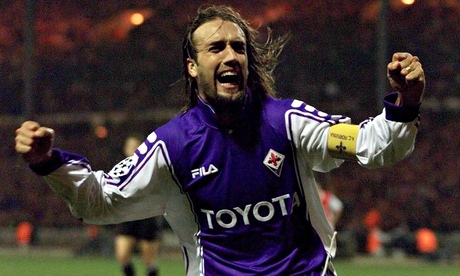
“I’ve found a couple of examples from around Europe, not including various teams (like Juventus in 2006; or Bordeaux, Brest and Nice in 1991) who were relegated despite positive goal differences due to points deductions for dodgy finances or flat-out cheating,” writes Mark van Dijk. “In Italy in 1992/93 Fiorentina finished 16th in Serie A and were relegated, with a goal difference of –3. They were a great attacking side, scoring 53 goals in their 34 games, with big wins against Ancona (7-1), Foggia (6-2) and Sampdoria (4-0). Gabriel Batistuta scored 16 goals, and the team were marvellously entertaining to watch. But they were utterly toilet at the back. This game against Milan, where they were torn apart 3-7, pretty much sums it all up.
“Then Bologna were relegated from Serie A in 2004-05 with a goal difference of –3. They finished 18th in the table, kept things tidy at the back, and conceded just 36 goals in their 38 games. But they also failed to score in 16 of those games, which might explain the whole relegation thing. They ended up losing a relegation tie-breaker against Parma (who had the same points total, and a far worse goal difference of –17), which hardly seems fair.
“In Sweden, spare a thought for IFK Norrköping, who in 2002 were relegated from the top-flight Allsvenskan to the not-so-super Superettan, despite a not-too-shabby goal difference of –3. AIK, who also had a –3 goal difference, finished 10 points and 8 places about them.
In France, light a candle for AS Nancy, who were relegated to the French Division 2 in 1999-2000 despite a goal difference of just –2 after 34 games. They finished level on 42 points with Marseille, who, funnily enough, had a better goal difference. Both teams conceded 45 goals, but Marseille scored 45 (Nancy scored 43) to end on a zero balance.
“In Denmark’s Superliga, Silkeborg IF ended the 2002-03 season with a goal difference of –2. They conceded 54 goals in their 33 games (only 5 of the other 12 teams conceded fewer), and scored 52 (one more than champions FC København) … But still went down.
“In England, Leicester dropped down from the Championship to League One at the end of 2007-08, despite a remarkable record of just 45 goals conceded in 46 games. Only Crystal Palace (with 42, up in 5th place) had a meaner defence that year. It didn’t help that Leicester’s strikers didn’t show up for work: the Foxes only scored 42 goals that season (worst in the league), and ended with a –3 goal difference.
“But the team you really want to hold in your arms and comfort is Manchester City. In 1997/98, they were relegated from the First Division into England’s third tier, despite a more-than-respectable goal difference of –1 (56-57) after 46 games. Typical City.
OLD STAGERS
“Since any player born in the decade of Choppers, glam rock and being fondly remembered by Stuart Maconie – that is, the 1970s – would now be a veteran, I was wondering who was the last player active in any of the top four tiers of English football to have been born in the 1960s?” wonders James Murton.
Burton Albion goalkeeping coach Kevin Poole, born in 1963, played in the Johnstone’s Paint Trophy in 2010-11 and last played league football in January 2010 at the age of 46.
And, when it comes to outfield players, Dean Windass (born in 1969) last played league football for Darlington in September 2009
“To be honest I don’t have an answer to that question,” begins Michael Gahler rather unpromisingly. “However I came up with an even more interesting answer: Dave Beasant was born in 1959 and featured as a substitute this season (11 October 2014) for Stevenage in League Two. Even though he stayed on the bench for the whole game I find it quite remarkable for a 55 year old to make it into a matchday squad. His first game in English Football League was in 1979 for Wimbledon which makes it a time span of 35 years between his first and his last inclusion in a matchday squad.”
SPAIN AGAIN AND AGAIN
“Last week’s Knowledge mentioned Manchester City’s Uefa Cup campaign from the 2008-09 season,” writes Andrew Thomas. “After a quick look at their campaign trail, I noticed that including the qualifying round they played three teams from Denmark. Has a team ever played more teams from the same country in a European cup campaign?”
“Yes!” writes Joe Skinner. “Leeds also played three Scottish teams back in the 67-68 Fairs Cup: Hibs, Rangers and Dundee. But in that brilliant (and beginning of the end) actual European Cup run in 2000-01, we played Barcelona, Real Madrid, Deportivo and Valencia. Albeit in those eight games to the semi we only won one.”
A SEASON OF TWO HALVES
“Hamilton Accies are having a season of two halves: challenging and holding top spot in the Scottish Premiership before Christmas they haven’t won since Alex Neil left to become manager of Norwich, who have since seen their own fortunes change for the good,” wrote Andrew Tomlinson last week. “My question is: what’s the biggest shift in results from before Christmas to after? I remember Villa imploding under Marin O’Neill, and Everton traditionally failed to play before winter under Moyes. Has anyone been top at Christmas but managed to get relegated?”
“Not quite top at Christmas and relegated, but not far off,” writes Robin Horton. “On the morning of 9 December 1995, Millwall were top of the Second Division; they finished the season 22nd and relegated. A 6-0 defeat to Sunderland saw them go from 1st to 7th – the last of six clubs on 34 points – in one fell swoop, and by Christmas they were 11th; but at the end of January they were 6th, so that might have been the latest anyone’s been in the play-offs and gone down.”
SECOND IS RIGHT AFTER FIRST …
“I noticed the other day that Graham Taylor has a history of finishing runner-up,” begins Jeremy Orbell. “He’s done it in the top three divisions with Watford and top two divisions with Aston Villa. While he did manage two fourth tier championships in three years in the 70s he lost out again in the FA Cup Final in 1984. Can anyone better the list for coming second in domestic and European competition?”
For an answer that we to 1982-83 and those eternal runners-up … Real Madrid. “Alfredo Di Stefano and ‘El Madrid de las cinco finales’ in the 1982-83 season,” suggests Jorge P. “Real Madrid started the season by losing the Spanish Supercup and ended up as runners-up in La Liga, La Copa, the Cup Winners’ Cup, and the inaugural Spanish League Cup.”
It makes for a traumatic set of results:
13 October 1982 win 1-0 against Real Socieded in Supercopa first leg
28 December lose 4-0 to Real Socieded in Supercopa second leg
1 May 1983 Missed out on La Liga by one point to Athletic Bilbao
11 May lost 2-1 to Aberdeen in Cup Winners’ Cup final
4 June lost 2-1 to Barcelona in Copa del Rey final
26 June draw 2-2 with Barcelona in first leg of Spanish League Cup
29 June lose 2-0 to Barcelona in the second leg
KNOWLEDGE ARCHIVE
“In the early 90s Farnborough Town were sponsored by the indie band Mega City Four,” wrote Peter McKnight back in 2009. “At around the same time Clydebank were sponsored by soggy, Scottish balladeers Wet Wet Wet, while in recent years, Norman Cook’s label Skint has sponsored Brighton & Hove Albion. I wondered if there were any other instances of football clubs having been sponsored by bands, groups, musicians or labels?”
Leaving aside the musicians who have been involved as shareholders or on a board level at clubs – such as Elton John at Watford and Robbie Williams at Port Vale, for example – there have been plenty of other instances of both bands and labels putting their money where their hearts lie.
After borrowing their name from the former club of one of Leeds United’s ex-defenders, the Kaiser Chiefs (who were named in honour of Lucas Radebe’s stint at Kaizer Chiefs) thought they ought to give something back. When the club signed Tore Andre Flo in 2007, the band sponsored the player. “We just thought it would be a good thing to do to show our support and try and do something for the club,” said bassist Simon Rix.
Back in 2004, Welsh rappers Goldie Lookin’ Chain lent their names to Newport County AFC for their run in the Football Association of Wales Premier Cup. So it was that, as the club ran out for their first match against Caernarfon, they wore bright gold shirts, emblazoned with GLC and complete with a delicate gold medallion motif around their necks. Band member Mike Balls said the band’s contribution to the shirt design, however, was minimal. “It was just towards the actual medallion vibe,” he claimed.
It seems to be a Welsh tradition as, five years earlier in 1999, Welsh indie-psychedelic band Super Furry Animals also put their weight behind Cardiff City’s FAW Cup campaign, after agreeing a five-figure deal. The players themselves were nonplussed. “Once you get the shirt on, you tend to forget about it,” said striker Kevin Nugent.
In 1996 Margate FC managed to persuade music label Link Music to sponsor the side, leading to Bad Manners singer and renowned gourmand Buster Bloodvessel not only becoming a board member but also splashing the name of his band across their shirts. It obviously worked, an unbeaten run of 14 games gave the club their best finish in nine years.
Indie label Cherry Red Records has a proud history of being involved in lower-league football, having sponsored both the Hellenic League and Kingstonian FC, the team who currently carry the name of their local high street record store, Banquet Records, on their chests.
But perhaps the greatest music-based sponsorhip deal was struck by the manager of Lincoln boy’s side Greenbank Under-10s B Team. In 2006, their opponents were no doubt stunned to see the lads run out on to the pitch to the strains of Motorhead’s Ace Of Spades, while wearing shirts decorated by the band’s famous Snaggletooth skull logo. “I knew Lemmy years ago,” said the manager Gary Weight. “I think the thought of a football team running out with the Motorhead logo made him chuckle a bit, so that’s where it’s come from. The hope is that we can go out on the football pitch and terrorise the opponents ...”
For thousands more questions and answers take a trip through the Knowledge archive.
Can you help?
“Real Madrid fired Radomir Antic as coach in January 1992, after 19 games and immediately after a home win that left Real three points ahead in the table at the time of a two points for a win,” writes Jorge P. “Has a coach ever being fired with his team further away in front?
“In 1973-74, Millwall had what you might call an ‘average’ season,” writes Jon Butcher. “Their record for the season reads: P42, W14, D14, L14, F51, A51, Pts 42, finishing in 12th spot in a 22 team league. Is this as unusual as it sounds or have any other teams had a similar or even more average season?”
“I heard Pep Guardiola managed Barcelona B before he managed the first team,” writes Ankur Jain. “What I hadn’t realised is that in his first season as Barcelona B manager in 2007-08, he won the Tercera Division, which is the equivalent of winning League Two. Now that isn’t exactly a ground breaking achievement, but in the context of the following season in 2008-09 he stepped up to the senior side and won La Liga which is ridiculous if you think about it. Has anyone ever won a fourth-tier title one season and then managed to win the top-flight title in the next season, either as a player or a manager? Can anyone even come close to matching this achievement?”
“If Aston Villa keep up their ‘cup goalkeeper’ policy for the FA Cup Final, Shay Given is set to appear in his second final, 17 years after his first, for Newcastle, in 1998? Surely this span is a record?” asks Sam Carney.
“I am a tennis fan and would like to know if a major knockout football tournament has ever been organised on a seeded basis (not including World Cup etc early stages league manipulations),” writes Peter Clarke.
“Following the piece about the perfect set-piece hat trick, it got me wondering whether it would be possible to score a perfect hat trick (left-foot, right-foot, header) from set pieces?” writes Ben Heilbron. “The penalty would be the only set piece that would be remotely possible to score with your head – but has it ever been done (or even attempted)?”
“Who was the first goalkeeper to get penalised for picking up a backpass?” tweets Chris van Thomas.
“I’m a Sheffield United fan,” writes Andy Browne. “We’re all but certain of a League One play-off spot despite a pretty dismal run of form. If we make it, we’ll be limping into the post-season. So I need a reason to feel optimistic – does end of season form have any impact on how teams do in the play-offs? Has anyone got the time/inclination to do a proper statistical analysis on, say the last six games, last 10 games and final game?”
Send your questions and answers to knowledge@theguardian.com