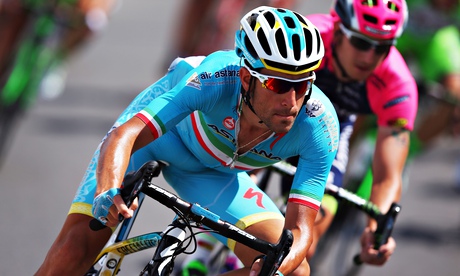
Professional cycling was waiting on Friday to see the finer details of the UCI licence commission’s decision to award a WorldTour racing licence to the Astana team of the Tour de France winner, Vincenzo Nibali, after a process involving a wealth of twists and turns. Of particular interest were the conditions under which the licence was granted – said in a press release to be strict and to include “special measures” – but there was no indication of when they might be revealed.
“We request the licence commission to make the reasoning public, for the sake of transparency towards the fans, the media and fellow cycling teams,” said a statement from the cycling teams’ umbrella body, the AIGCP. But the UCI was unable to say when the “reasoned decision” would be disclosed because their hands were effectively tied: the process lies with the licence commission which is kept distant from the governing body.
Apparently referring to the UCI’s request at the end of February that Astana should have its licence revoked over a number of doping cases and the initial outcome of an internal audit by the University of Lausanne, the AIGCP continued: “We feel that there are discrepancies between the public statements of the UCI on several occasions on this case and the outcome of the process. It is harmful to our sport for the international federation to prejudge a case against anyone if that case hasn’t been brought forward to the right instances and that hasn’t come to a conclusion.”
The UCI under its new president, Brian Cookson, had entered uncharted waters when it asked the Institute of Sport and Science at the University of Lausanne (ISSUL) to audit Astana’s ethics when the licence was granted provisionally in December. While the processes for sanctioning riders over doping infractions are clearcut there is no set method for taking steps against teams suspected of condoning doping. This is why throughout the saga there has been a feeling policy is being created on the hoof.
The UCI and Cookson had talked tough, with Cookson telling the Guardian after the initial decision that the Kazakh squad was “very much on probation” and that they had nothing to be happy about. At the end of February, following the Lausanne audit, the governing body took the unprecedented step of referring Astana back to the licence commission – a four-man body presided over by Pierre Zappelli, a former Swiss High Court judge – stating an initial audit contained “compelling grounds to refer the matter to the licence commission and request the Astana Pro Team licence be revoked”.
Since then, however, the process has stalled, with the most likely explanation being that the investigative methods used by ISSUL may not withstand possible legal scrutiny funded by Astana’s ample cash reserves if the team were to have its licence revoked. The ISSUL criteria appear to be more about the environment within a team; a research document online quoted by the website cyclingnews.com says it is “based on an analysis of team practices, and the ways in which riders produce their achievements [with] an alternative perspective which emphasises doping as a product of socio-economic condition.”
In the background, clearly, is the UCI’s need to be seen to function differently from the pre-Cookson days when – as highlighted in the Cycling Independent Reform Commission report – its president Hein Verbruggen had a relationship with Lance Armstrong that was too close.
This leaves Cookson keeping several balls in the air: being tough on doping and creating a legally watertight process which is totally independent from the UCI. As juggling acts go it is a tough one which may prove impossible to perform to anyone’s satisfaction.