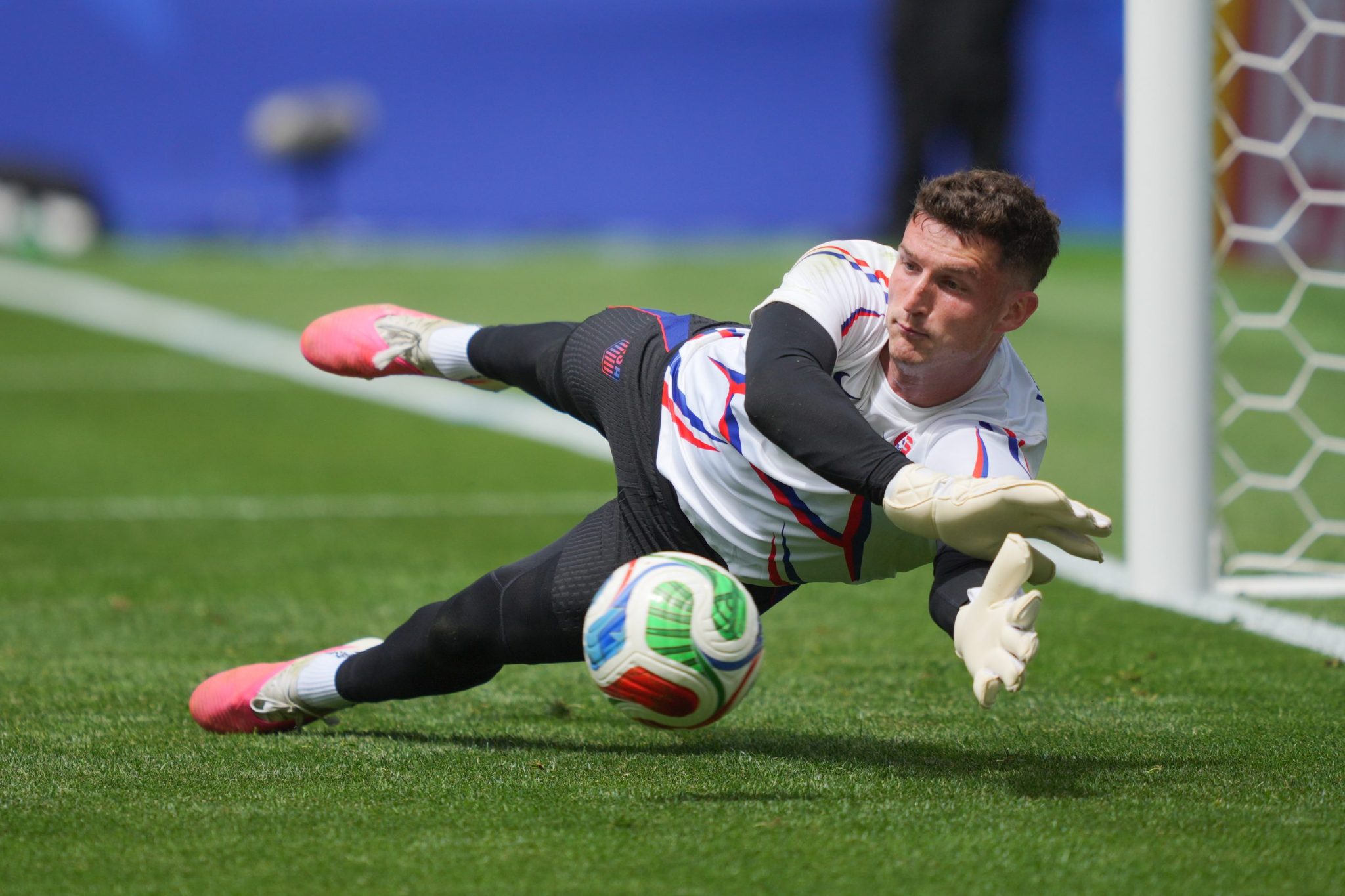
Before he became Team USA’s starting goalkeeper, Matt Freese had a choice many young student athletes might only dream about: sign an apprenticeship contract with Manchester United—or walk away and attend Harvard University.
Instead of joining the English club that helped produce stars like David Beckham and Cristiano Ronaldo, the Pennsylvania native chose the Ivy League. At Harvard, he studied economics and computer science while continuing his soccer career with the Crimson, straddling two worlds that rarely overlap at an elite level.
But turning down what could have been an early path to global stardom—and significant financial upside—became something Freese now says was central to his development as a player.
“It really allowed me to thrive on the field,” Freese told ESPN, speaking about his experience attending Harvard while later playing for Major League Soccer’s Philadelphia Union.
The overlap between academics and athletics extended beyond time management. During his studies, he completed a project on the tendencies of penalty takers, research he believes has sharpened his understanding of the game.
“There’s also a lot of research about the development of the brain in the classroom and how the neural pathways can allow you to learn more quickly on the field. Certainly, the problem-solving that I learned in the classroom and the social element, as well as from the emotional quotient perspective, working on group projects.”
Now 27, Freese has helped anchor the U.S. men’s national team to a strong start on home soil at the 2026 World Cup, positioning the team for a potential deep run in the tournament.
Freese dropped out of Harvard on his path to the World Cup
Freese’s work ethic emerged long before college or professional soccer.
As a teenager growing up in Pennsylvania, he often arrived at school before dawn so he could train alone. His mother would drop him off around 5 a.m., leaving him time to work on his game, lift weights, eat a breakfast of scrambled eggs packed in tinfoil, shower, and still make it to class by 7:45.
“I wasn’t thinking, I’m doing this to earn something or to deserve something,” Freese said. “It was just fun. In my family it was expected that you were going to work hard.”
But Freese’s father—a neurosurgeon who earned both his undergraduate and medical degrees from Harvard—was a strong advocate for education and often encouraged his youngest of four children to prioritize academics.
It’s why Freese told New York soccer publication Hudson River Blue that his choice to turn down Manchester to stay in school was a “family decision.”
“There were some tough conversations between me and my parents about this one. There was a clear path that I wanted to go on, but I had to respect what they wanted. They sacrificed so much for me, so I had to repay that and honor what they wanted and then, when the time was right, make my decision for myself.”
Still, just three semesters into college, Freese briefly dropped out after signing with the Philadelphia Union, turning professional while many of his classmates were still settling into college life. A year later, he re-enrolled and mostly took online courses or flew up to Cambridge, Massachusetts, whenever he had to sit for an exam. He completed his degree in 2022.
“It was hard, but it was super beneficial,” Freese said to ESPN. “When you’re a 20-year-old professional athlete, it’s a little bit difficult to stay focused. Me being in classes, on my computer every single day, forced me to be super focused and not be doing things I shouldn’t be doing. It kept me to a schedule and a regimen that I otherwise don’t know if I would have.”
In 2025, he earned a call-up to the U.S. men’s national team. He has since established himself as one of the country’s top goalkeepers, starting for the Americans and landing endorsement deals with brands including Nike and Procter & Gamble. After passing away in 2021, his father did not get to see his son’s rise in professional soccer.
The path to soccer’s biggest stage is rarely a straight line
Freese’s journey from Harvard classroom to the World cup may be unusual, but it underscores a broader truth about modern soccer: there is no single blueprint to reaching the sport’s biggest stage.
Take Roberto “Pico” Lopes. Before helping lead Cape Verde to international awareness, Lopes was balancing a career in soccer with a day job at a bank in Dublin.
About eight years ago, he received a seemingly random LinkedIn message written in Portuguese. The sender turned out to be the coach of Cape Verde’s national team, who was searching for eligible players with ties to the island nation. Lopes, whose father is Cape Verdean, initially thought the message might be spam. Instead, it became his invitation to join the team—and his life was changed.
“From when I was a young child, and I imagine every aspiring footballer when they were young, they wanted to play at the highest level possible and, for me, it doesn’t go any further than the World Cup,” Lopes said.
Freese’s U.S. teammate Ricardo Pepi followed a more traditional soccer path, making his professional debut as a teenager. But his family’s story reflects a different kind of sacrifice. Pepi’s parents immigrated from Mexico and struggled financially while supporting their son’s soccer ambitions. At one point, the family pawned the title to their car to help keep his dream alive.
“We kind of started our life from nothing, trying to live day by day,” Pepi’s father recalled in The Long Game, a new book about U.S. men’s soccer. “Back in El Paso, life was not that easy. Starting a family, you have to work long days and sometimes it’s really hard.”
The stories differ, but the common thread is persistence. And now, the stakes could hardly be higher. FIFA is set to distribute a record $871 million to the 48 teams competing in the 2026 World Cup, with the tournament winner eligible to earn as much as $50 million.
Will you be skipping out on work to watch the World Cup? Fortune wants to hear from you. Email preston.fore@fortune.com.