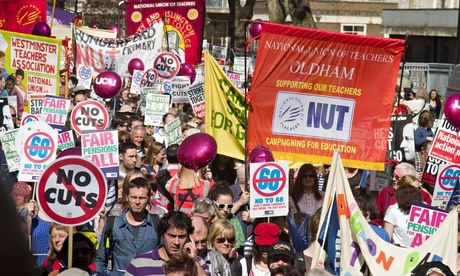
There is something about the threat of teacher strikes that leaves me uneasy. Union membership and the freedom to withhold labour are basic rights, but as a tactic to elicit change in policy the threat of industrial action is a blunt instrument.
It is used too often and now has a touch about it of the “boy who cried wolf”. And strikes are divisive. However worthy and widely supported the cause, they pit teachers against parents struggling with childcare, and against heads and governors under pressure to deliver progress and results. This usually gives whoever is in power the ability to divide and rule; the real nightmare for government must surely be, instead, a united coalition of these four powerful interest groups that can’t be ignored.
The National Union of Teachers’ call for strike action over school funding last week provides an interesting test case. Might this be the issue that unites us all? The NUT did manage to propel the issue of funding momentarily into the headlines in the middle of an election campaign, which is where it should be.
None of the main parties’ claims to protect school income over the next five years bears close scrutiny. The Conservatives are promising to protect, but not inflation proof, per-pupil funding in the five to 16 age range. But they avoid any commitment on post-16 education, which endured funding cuts of more than 13% in the last parliament.
According to the Institute for Fiscal Studies, if sixth forms experience the same rate of cuts in the next five years, their budgets will have fallen by 28% in a decade – which is presumably why the Association of School and College Leaders, the heads association, is warning that this issue alone could bring some secondary schools close to insolvency.
Labour and the Liberal Democrats are promising to protect the overall school budget for three- to 19-year-olds in real terms, but there is no indication of how this would be distributed across each key stage. This funding commitment would also have to cover an estimated 7% increase in pupil numbers over the next five years. Add to that a hike in national insurance contributions, an increase in pension payments and any potential pay rises, and the IFS estimates cuts in school budgets of between 7% and 12 % over the next parliament. This is austerity on an unprecedented scale for most parents of school-age children, pupils and many headteachers.
And it comes on top of swingeing cuts in spending on school buildings, which rose by almost 12% a year under Labour and has fallen by a third since 2010. Some heads now openly talk of having to choose between teachers and the investment in equipment such as IT to deliver the basic curriculum.
In the 13 years under Labour before the 2010 election, school spending rose by about 5% a year. Now the future may require drastic cuts to some curriculum areas, larger class sizes and collaboration across institutions.
The prospect of funding being cut to the bone raises the other contentious issue that was kicked into the long grass by the coalition government: a national funding formula. Differences in pupil funding across the country, sometimes between pupils in schools only a couple of miles apart, though on different sides of a local authority boundary, may become more deeply resented.
Recent changes to the way funding is distributed from Whitehall mean some equalisation is starting to take place by the back door, but probably not quickly enough to right what many heads and governors see as a terrible injustice. It is still the case that a child eligible for free school meals in one part of the country can attract almost twice as much money as in another.
It is doubtful that any of the main parties will have the stomach for the radical solution: a single formula weighted for local need and bypassing local authorities altogether. It is too politically difficult in a time of austerity to bring the most poorly funded schools up to the level of the better-off without leaving the better-off significantly disadvantaged.
Sir David Bell, the former Department for Education permanent secretary, recently pointed out that our fractured political system means the party manifestos are less important than in the past and will be “starting points for negotiation” rather than blueprints for government.
The prospect of another hung parliament is unlikely to help school funding, an area where the smaller parties may have little impact. Education funding changes don’t require primary legislation, and of the anti-austerity parties only the Greens have a specific commitment to restore funding to 2010 levels in real terms. The fact that education is devolved in Scotland and Wales may make it difficult for the nationalists to exert influence in this area.
Which leaves that other coalition: parents, heads, governors, pupils and teachers. Once it becomes clear it isn’t just school trips and extra curricular activities that face the axe but real subjects along with the teachers who teach them, the politics of school funding could become messy for whoever is in power.
Getting more money for schools and a fairer distribution maybe the single most important issue of the next five years. But strikes aren’t the solution. The combined force of the local education community, making life difficult for MPs of whichever party, just might be.