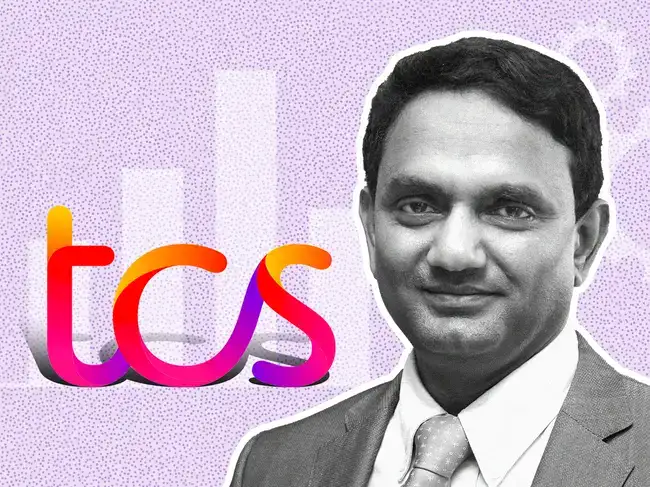
Tata Consultancy Services (TCS) chief executive officer K Krithivasan earned more than Rs 28 crore in remuneration in FY26, according to the company’s latest annual report, with his pay rising 6.3%, reaching 332.8 times the median employee remuneration.
The FY26 remuneration disclosures showed Krithivasan earned more than Rs 1.67 crore as salary, Rs 1.43 crore in benefits and allowances, and Rs 25 crore in commissions last fiscal year.
This compares with rivals Wipro CEO Srinivas Pallia’s earnings at Rs 53.6 crore, Infosys CEO Salil Parekh's Rs 80.6 crore, and HCLTech C Vijayakumar's CEO Rs 84.16 crore in FY25, the latter being the highest in the industry so far.
TCS’ annual report also disclosed that newly appointed executive director and chief operating officer Aarthi Subramanian got nearly Rs 1.51 crore in salary and Rs 1.83 crore in benefits and allowances and Rs 15 crore as commissions. She had assumed the role effective May 1, 2025.
TCS is focusing on building an “AI Operating System” for enterprises as the technology moves from experimentation to scaled deployment, the management highlighted in the report.
“Enterprises will need an AI Operating System,” said N Chandrasekaran, chairman, TCS. “This Operating System will be a foundation of infrastructure, data, models, context, agents, and governance," he said, adding that building such systems will require deep industry expertise and partnerships.
CEO Krithivasan said enterprises are looking for partners who can manage a unified control plane across the AI stack from infrastructure to applications.
“This control plane - an AI Operating System - makes AI repeatable and governable through orchestration in an enterprise’s context and embeds trust mechanisms such as security, monitoring, evaluation, and auditability,” he said.
He noted that while many enterprises already have access to tools and models, they lack the standardised control and context needed to safely deploy agentic AI systems in day-to-day operations. This is an opportunity TCS is targeting as an “Enterprise Intelligence Integrator,” said Krithivasan.
Chairman Chandrasekaran outlined four key focus areas for TCS in the coming years: building industry-specific AI operating systems to accelerate the deployment of agentic AI solutions; constructing India’s first high-density AI data centre with rack density exceeding 160 kW; expanding “Infrastructure to Intelligence” stack through 3,600 partnerships with hyperscalers, AI firms and industrial OEMs; and developing secure, resilient and sovereign AI infrastructure.
The strategy comes against a backdrop of slowing global growth and heightened geopolitical tensions which have led to tighter technology spending and greater scrutiny on returns.
Global GDP growth moderated to 3.4% in 2025 and is projected to slow further to 3.1% in 2026, amid rising energy costs, trade disruptions, and financial market volatility, the management said in the annual report.
Despite this, enterprises continued to prioritise technology investments, particularly in AI, core system modernisation, and data infrastructure.
FY26 marked a turning point for enterprise AI adoption with companies moving beyond pilots to scaled deployments for the first time since generative AI emerged in 2022.
The broader IT services market remains robust, with global services spending expected to grow 6.8% to over $1.87 trillion in 2026, underscoring continued demand for implementation, managed services and infrastructure, the company said.