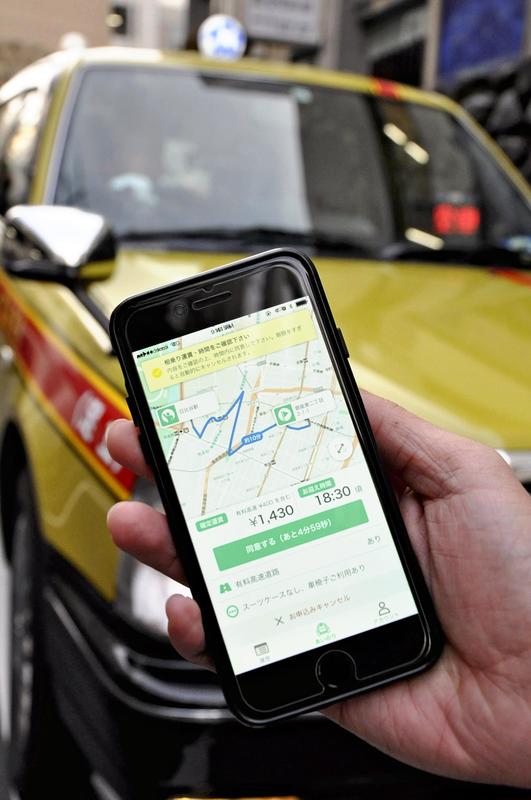
Services offered by taxi companies are changing. The taxi industry and the Land, Infrastructure, Transport and Tourism Ministry are conducting practical trials of new services such as ride-sharing, followed by a flat-rate unlimited ride system.
By improving convenience via information technology, they aim to halt the decline of taxi usage and counter emerging services such as vehicle-dispatching.
Paying your fare share
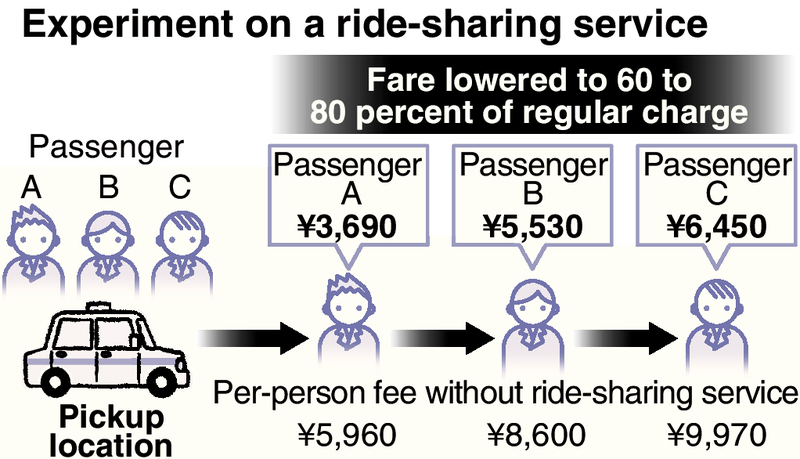
According to the Tokyo Hire-Taxi Association, two taxi firms began testing a taxi ride-share service on Jan. 24, entailing cost-reducing rides for people in Tokyo's 23 wards and other locations, in cooperation with the transport ministry. Passengers can use the service in Daiwa Motor Transportation Group and Nihon Kotsu Group taxis.
If a user inputs pickup and drop-off locations via a smartphone app, the passenger can share a taxi with others heading in the same direction. The taxi fare will be split among the users, according to their respective travel distances. The fare for each user will be 20 to 40 percent cheaper than normal.
The payments are automatically made by credit card, registered in advance, so there is no need for money transactions among passengers. For drivers, the service will improve efficiency because they can simultaneously transport multiple customers.
Based on the results of the trial, the transport ministry will discuss rules for the full-scale implementation of the service and other issues.
The transport ministry and the taxi industry last year lowered base taxi fares to 410 yen in some parts of Tokyo. They have also conducted a practical trial of a new service to fix taxi fares. According to the association, many people in their 20s and 30s -- an age bracket that tends to use taxis less often -- used the service, effectively boosting demand.
In the next fiscal year, they plan to hold a practical trial of a flat-rate service to allow unlimited taxi rides within fixed zones and areas -- akin to a train pass.
Declining revenue
The taxi industry developed new service plans because the public has been shifting away from taxis year by year, something that has also led to a decline in revenue from fares.
According to the transport ministry, passengers of car services and taxis totaled 1.466 billion in fiscal 2015, falling to about 70 percent of the figure a decade ago.
Moreover, the taxi industry has seen a faster aging of its drivers than the bus and truck industries, with the average taxi driver aged 58.7 in 2016.
The salary of a taxi driver is about 30 percent lower than the average of all occupations. In addition to securing enough drivers and other workers, improving how these employees are handled -- such as bumping up income -- is a challenge facing the industry.
The transport ministry plans to spread a more profitable structure within the taxi industry by utilizing vehicle-dispatching apps to reduce unproductive driving.
The recent move is also aimed at countering emerging services that have become widespread overseas. U.S.-based Uber Technologies Inc. and other companies offer ride-share services that use an app to match individuals who hope to share a taxi or ride alone with individual drivers. The app also helps dispatches taxis.
This type of service has been increasingly used worldwide. In Japan, however, transporting passengers without a license to do so is prohibited, in principle, as illegal unlicensed taxis.
Under such circumstances, the Japanese taxi industry wants to increase its presence by offering new dispatch and ride-share services at discounted fares.
"Japanese taxis have a responsibility to be safe and secure," Ichiro Kawanabe, chairman of the association, said at a press conference. "We would like to increase the convenience of the app and guarantee service levels."
Read more from The Japan News at https://japannews.yomiuri.co.jp/