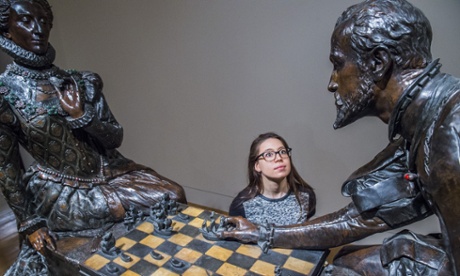
Lots of people hate Victorian sculpture – it can be hilariously over the top, boring and supremely uncool, they say. Tate Britain hope visitors will see it as“jaw dropping”, “mind boggling” and “nothing short of incredible”.
The argument is being put forward in the first major exhibition devoted to British sculpture during Queen Victoria’s long reign, from 1837 to 1901.
Members of the public will be able to make their own mind up when it opens on Wednesday. The early view from critics, however, shows that the subject generates strong opinions on all sides.
The Guardian’s Adrian Searle, giving the show two stars, wondered who the audience is meant to be: “Victoriana buffs, coin fanatics, metallurgists, jewel thieves?” The Daily Telegraph’s Richard Dorment was similarly scathing, calling it a deadly dull show from start to finish and fuming: “Its incoherence is frightening.”
Tate said it would not be commenting on the reviews. It is also true that others who have seen the show beg to differ. The historian and Labour MP Tristram Hunt, writing in the Guardian last week after an early preview, called the show compelling, that it had been “painstakingly curated in remarkable scholarly detail”. Similarly, Peter York, writing in the Independent, called staging the show “a brilliant and brave idea” and praised curators for their ambition.
Greg Sullivan, Tate’s curator of British art 1750-1830, accepted it was a subject that generated strong opinions. “I think people probably have a slightly dowdy impression of what it is all about,” he said.
“What you should get from this exhibition is the invention and ingenuity, as well as the power and politics underpinning it.”
He said Victorian sculpture could be jaw-droppingly beautiful and mind-bogglingly inventive and recalled his horror at listening to people argue that the sculptures in Trafalgar Square should be removed because no one knows who the subjects are.
“That’s terrifying,” he said. “This was an incredible age for sculpture. It had its dark side and its fusty side but you can’t look at some of it and not think, ‘blooming heck, that was incredible’.”
The exhibition features works by big Victorian names such as Francis Chantrey and Alfred Gilbert as well as less well-known artists such as Mary Watts, the first president of the Women’s Guild of Arts.
Highlights include a statue that usually stands seven metres (24ft) high in the House of Lords – James Sherwood Westmacott’s 1854 effigy of Baron Saher de Quincy, Earl of Winchester.
It is being removed for the first time and lent to Tate Britain – an example of British industrial revolution inventiveness, given it was made by being cast in zinc and then electroplated with copper.
In another room is a challenging, hard-to-look-at sculpture of a chained black slave being sold at a market - John Bell’s The American Slave, being lent by the National Trust’s property Cragside in Northumberland. The 1853 work was seen as an attack on slavery and, according to one contemporary commentator, as an appeal “against the blasphemous hypocrisy which attempts to justify human bondage on the ground of external physical differences”.
The sculpture exhibition is being staged alongside a separate show at Tate Britain, which shines another rare light on Victorian artistic ingenuity: salt prints.
The 90 salt-print photographs are examples of the earliest form of paper photography and are rarely seen. The Tate hopes the exhibitions complement each other and whatever opinions are of the shows they are both rare events.
“People are very used to coming in to Tate and seeing Victorian painting and so they should be,” said Sullivan. “But we also have this amazing collection of Victorian sculpture and it just doesn’t get its place in the sun.”
• Sculpture Victorious: 25 February-25 May; Salt and Silver: Early Photography 1840-60, 25 February-7 June, both at Tate Britain.