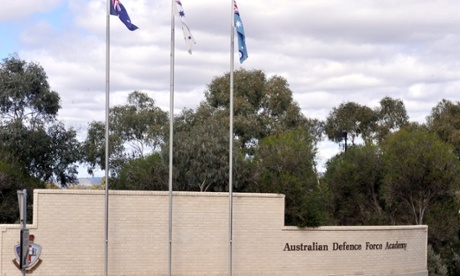
The federal government said it would “very carefully” consider holding a royal commission into allegations of abuse during the history of the Australian Defence Force training academy.
The defence minister, David Johnston, tabled two reports Wednesday by the defence abuse response taskforce (Dart) in parliament, one of which covered allegations and instances of abuse within the ADF over several decades, while the second looked more specifically at cases at the academy.
“The government believes strongly that perpetrators and those who failed to act against them should be accountable but we are also mindful that any process should not re-traumatise victims,” Johnston said. “Any accountability mechanism must go hand and hand with cultural and systemic change in the ADF.”
He said the government would respond to the reports “in the near future” and would consider all recommendations, including that of a royal commission.
In justifying its call for a royal commission into Adfa, Dart said the ADF was unable to adequately deal with the cases itself as so much time had passed since they occurred or were reported.
“The taskforce has concluded that the only way of ensuring confidence that the allegations of very serious abuse at Adfa can be thoroughly and completely investigated – and appropriately dealt with – is by way of a royal commission,” said the chairman of the taskforce, Len Roberts-Smith QC.
“Both of the reports tabled in parliament today by the minister for defence contain shocking accounts of abuse suffered by people who have served in Defence. Many complainants have never spoken of the abuse they suffered before, even to their close friends and family. I would like to commend their courage in coming forward to the taskforce.”
Dart had not recommended a royal commission into the ADF as a whole, Roberts-Smith told Guardian Australia, partly because its senior leadership had made “significant efforts” to rectify the past abuses and to make changes to prevent it happening again, or at least to be dealt with appropriately.
“The other significant factor is that ordinarily a royal commission focuses on systemic issues, cultural change, reporting things generally, they don’t focus on individual cases,” he said.
“Those issues [with the ADF] have been pretty well identified, they’re well known, so it seems to me there is very little prospect that a royal commission into abuse generally in Defence is likely to come out with anything we don’t already know.”
Roberts-Smith said there was a different problem with the academy, notably that it had trained most of the current Defence leadership. “Unlike general abuse which has occurred right across defence, these are the people who are defence leaders,” he said.
“The issue there is whether or not there are people still serving, possibly in mid-range to senior leadership positions, who have been perpetrators of abuse, particularly serious sexual or physical abuse, and I think it’s fairly clear that is the case and many of them are still serving.”
As of September, the taskforce had assessed and found plausible 2,224 allegations of abuse across the ADF, from more than 1,650 complainants. Dart found a “disturbingly high” rate of incidents of abuse of female cadets at Adfa in the 1990s.
It has assessed 63 of the 76 received complaints relating to Adfa, and found 50 to be plausible. Of those people, 35 said they experienced harassment and bullying, 33 experienced sexual abuse, 18 sexual harassment and 20 physical abuse. A “significant majority” reported being a victim of two or more categories of abuse.
All alleged sexual abuse perpetrators were male, mostly other cadets at the time of the abuse. Eight sexual abuse victims were male, but all who claimed they had been raped were female.
The vast majority of complainants were cadets aged under 20 at the time the alleged abuse occurred. Most were female. Among the complaints of each alleged victim was at least one case of defence mismanagement.
Tim White, partner at the TGB law firm which has assisted a number of defence abuse victims, welcomed the recommendation. Victims of abuse wanted more than just compensation, White told Guardian Australia.
“[They want] acknowledgement of what’s occurred so a royal commission at least into certain aspects of it will give them that opportunity.”
The chief of the defence force, Air Chief Marshal Mark Binskin, welcomed the reports.
“The ADF leadership accepts that the past abuse described in these reports has had a profound impact on victims and commends their courage in speaking up. Recognising and understanding the nature and extent of historical abuse is fundamental to improving how our people are treated,” he said.
“I believe we are making real progress on cultural change across Defence to become more fair, inclusive and respectful. I am pleased that Adfa today is at the forefront of this change. I am confident that the vast majority of our people do respect our organisation’s values and expected behaviours.”
He said holding a royal commission was a decision for the government. Binksin’s predecessor, General David Hurley, has previously said a royal commission would do victims more harm than good.
A June report from Dart revealed Defence had made payments of more than $4.6m to victims of abuse at a defence training school, HMAS Leeuwin, with 95% relating to the most severe categories of abuse, and all including extra payments for “Defence mismanagement”. An instance of Defence mismanagement was present at least once in every complainant’s case.
Dart found the ADF knew or ought to have known that, for decades, more than 200 young boys enrolled at HMAS Leeuwin were being physically and sexually abused – often by staff.
That report stopped short of recommending a royal commission, suggesting the cases fitted the terms of reference for examination by the current royal commission into institutional responses to child sexual abuse.
Dart was set up in November 2012 after the DLA Piper review into allegations of sexual and other kinds of assault within the ADF. The review was launched in response to the so-called “Skype scandal” which involved a cadet secretly filming himself having sex with a fellow cadet and broadcasting it via Skype to colleagues without the woman’s knowledge.
The case prompted more than 2,400 reports of abuse.
On Wednesday Johnston also announced he was extending the taskforce which had been due to end this month, as “considerable work” remained to be done and further support needed for complainants.
The current deputy chair of the taskforce, Robert Cornall AO, would take over as Roberts-Smith’s appointment ended.
“The government is determined to ensure that the taskforce terms of reference be fully and independently discharged,” he said.
The defence department was also directed to engage the sex discrimination commissioner, Elizabeth Broderick, to assist Roberts-Smith in examining the issues raised in the report on Defence Abuse at Adfa.


.png?w=600)