Chinese choreographer Tao Ye is so intent on purifying dance of all but its own physicality that he makes the average minimalist (Rosemary Butcher, say, or Lucinda Childs) look fussy and overblown.
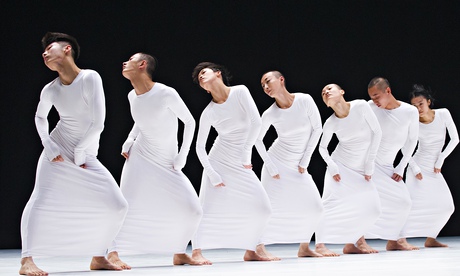
The stage design for his new double bill is monochrome, black for the first piece, white for the second. The titles, 6 and 7, refer simply to the number of dancers in each. And with choreography that never deviates from strictly unison formation, there’s not a hint of individual character or relationship.
Even so, Tao Ye is a fundamentally poetic dance-maker. In 6, the cast are lined up near the back, their arms held taut, hands gathering up folds of their long, black skirts. Most of the choreographic action is concentrated on the tilting, circling, rippling action of their upper bodies. But in the hazy, flickering light that plays over them, they shape-shift into other worlds: at moments a chain-gang of workers – a human machine; at others a line of trees swaying in wind or the thick ropey current of a swollen river.
As Xiao He’s trance-like score intensifies, the dancers advance across the stage, drawing us deeper into their hypnotic movement cycles. I almost wish the evening had stopped here, but after the interval comes 7 – and with it a startling shift to whiteness.
Here, for the first time, we can focus clearly on the specifics of the movement and on the dancers’ exquisite stamina and control. But aside from the fact that the cast make their own music, a deep collective humming, 7’s choreography is a near replica of 6. And on this bright stage the effect is far less immersive, far more analytic. It’s less poetry we see than a white-board exegesis of Tao Ye’s style.
• Until 21 October. Box office: 0844-412 4300