Few would argue with Wuppertal’s commitment to maintaining the astonishing legacy of Pina Bausch. But as the company start to pick though the choreographer’s back catalogue, I wonder if their project of reviving lesser known productions will be one of diminishing returns.
Perhaps there’s a good reason why Gebirge hasn’t been seen in the UK before. As bonkers, sublime and tender as individual moments are, and as beautifully performed as it is, this 1984 production feels sparse and slow-moving even by Bausch standards. It also feels less illuminating, with both danced and spoken material lacking those classic Bausch epiphanies of intimacy and storytelling.
Even the stage is unusually bare, with just a carpeting of thick brown mud. Nor is this the primitive, exhilarating mud of Bausch’s Rite of Spring but awkward, heavy mud that weighs the dancers down as they move, and which underlines the work’s prevailing tone of darkness and threat.
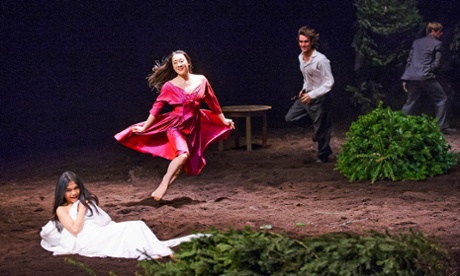
In Gebirge, the men are very aggressive, the group is very dominant. When racing gangs round up stray individuals and force them to kiss, it’s an act of humiliation rather than play. When dancers chase each other round the stage, it’s a hunt rather than a game of tag. The stage is patrolled throughout by Michael Strecker, a big juggernaut of a man. And even though he’s dressed for the entire first half in orange swimming trunks, goggles and plastic gloves, and even if he’s mostly just blowing up balloons and bursting them, he’s a terrifyingly controlling presence.
The full title, Auf dem Gebirge hat man ein Geschrei gehört (which translates as On the Mountain a Cry Was Heard), is apparently a reference to Herod’s slaughter of the innocents, and halfway through the evening, one of the men explodes into a violent monologue about raping and killing. It’s a jagged wound in the piece, and suddenly makes us see the whole production through the lens of Bausch’s Germany and its Nazi past. When two women frolic through a forest of Christmas trees, the image is a sinister fake – the trees are temporary, lying awkwardly on their sides. A delightful elderly band of musicians wander on stage to play a romantic tune, but they’ve emerged out of smoke, as though on a battlefield.
No wonder Bausch went on to create works that were specifically inspired by other places, like Brazil or Palermo. If this was her Germany, how liberating it must have been for her imagination to play elsewhere.
• At Sadler’s Wells until 18 April. Box office: 0844 412 4300. Season continues until 26 April.