Police in Tanzania broke up a peaceful gathering of hundreds of Masai last week and questioned one of the leaders of a burgeoning campaign against plans to turn their ancestral homeland into a hunting ground for members of the United Arab Emirates royal family.
President Jakaya Kikwete has said there are no plans to forcibly evict up to 40,000 Masai pastoralists for Otterlo Business Company (OBC), which offers luxury game-hunting trips in northern Tanzania for Arab businessmen and royalty.
Organisers of a rally in Loliondo district last Friday to call for the president’s promise to be enshrined in law say they were told 10 hours before it went ahead that they needed a written permit. Around 2,000 Masai turned up before police arrived.
“The policemen were very, very well armed. More and more people were still coming from different villages, walking to the meeting and the traditional leaders had to tell them to just go back. People were really disappointed. It was very peaceful, there was no threat of violence,” said a local leader who declined to be identified.
Samwel Nangiria, co-ordinator of the Ngonett civil society group that has spearheaded the protests, said he was called in by the police before the meeting and subjected to hours of interrogation.
“They held me throughout the day and asked me not to attend the meeting. They asked me about journalists I knew, and what we planned to do at the meeting,” he told the Guardian after being called in for a second day of questioning.
Nangiria said he feared being arrested and had received death threats since taking up the cause. “I’m not feeling safe, no, not at all. I’ve been receiving threats, information that doesn’t make me feel safe.”
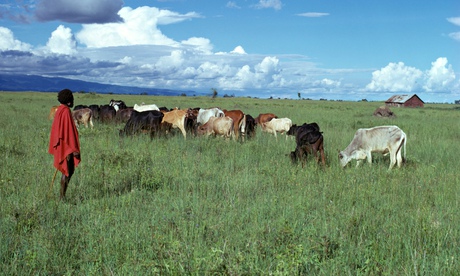
The long-running dispute over the acacia-dotted plains came to prominence this year when a petition on the activism site Avaaz.org garnered more than 2m signatures. The Masai have grazed cattle on the grasslands that stretch northwards to Kenya’s Masai Mara for millennia, but their historic land has been steadily wrenched away from them.
Loliondo was set aside as a hunting ground for European royalty in colonial times, and in 1959 the British colonial administration turfed out 10,000 Masai to create the Serengeti national park. In 1992 OBC agreed a deal for the right to use 1,500 sq km of grazing land as a hunting block. Village leaders refused to sign the agreement.
Neighbouring Kenya has outlawed big game hunting, but the Tanzanian government says if properly managed it could bring in valuable tourism trade. Villagers and herders say the high stakes have led government officials to break all hunting rules, resulting in the destruction of most of the area’s non-migratory animals.
Many fear a repeat of forcible evictions seen five years ago. In a newspaper op-ed last month, Robert Kamakia, a Masai, recalled watching flames and smoke engulf traditional homes in the village of Arash as the government drove out pastoralists in July 2009.
“Our grandparents had suffered under the fist of colonialism. Now, my people, the Masai of Tanzania, were victims of our own government – and its burning desire to kick us off our lands,” he wrote. “Although the government justified the concession by claiming OBC would help with wildlife conservation and management, rich Arab princes fly in to shoot whatever moves, blasting trees full of birds from helicopters, killing lions or leopards for a few thousand dollars a head. Heavily armed policemen guard their camp, threatening and abusing us if we come near.”
He said the support from around the world had given encouragement to the Masai in their attempt to cling on to their last remaining rump of land in Tanzania. “For us, land is not just home, it’s everything. With nowhere left to go, we knew that this would be our last stand.”
An OBC spokesperson could not be reached. Lazaro Nyalandu, the minister for natural resources and tourism, did not respond to requests for comment. Tanzania had previously rejected claims that it has ambitions to turn the land in Loliondo into a big game hunting reserve.
Sam Barratt, Avaaz campaign director, said: “The Tanzanian government is behaving like Jekyll and Hyde. One day they make a promise saying that the land is safe, so why stop activists from meeting the next? If the land is truly safe, the president has the power to put that in writing. It appears they’re playing a long game. We’re concerned that they’re just hoping this is a story the world will get bored of and forget.”