
The text nobody actually reads
The Vijnanabhairava Tantra lists 112 dharanas, meditative techniques for dissolving the boundary between individual awareness and universal consciousness. One asks you to feel the precise moment between inhaling and exhaling, and stay there. Another instructs you to contemplate the sensation of desire at its exact point of arising, before it becomes an object. A third asks you to imagine the universe as your own body, and then slowly let the imagining drop. None of these involve a partner. None of them are erotic. The Vijnanabhairava Tantra is a rigorous phenomenology of attention, composed in Kashmir sometime between the 8th and 10th centuries, and it is the closest thing Tantra has to a foundational document. Most people who have strong opinions about Tantra have never heard of it.
This is the first problem. The word Tantra covers an enormous range of texts, traditions, and practices, Shaiva, Shakta, Buddhist, Vaishnava, stretching across more than a millennium of Indian philosophical history. It is not one thing. The Kularnava Tantra, the Mahanirvana Tantra, the Tantrasara of Abhinavagupta: each operates within its own school, its own metaphysics, its own understanding of what liberation means and how the body relates to it. Collapsing all of this into a single category, and then reducing that category to sexuality, is not a misreading. It is a replacement.
What colonial scholarship did to it
When British administrators and orientalist scholars encountered Tantric texts in the 18th and 19th centuries, they were working inside a framework that divided the world into civilised religion and primitive superstition. Practices involving the body, ritual, sensation, the use of physical substances in worship, fell on the wrong side of that line. The scholars who wrote about Tantra were not neutral observers. They were men trained in Protestant categories of sin and transcendence, and what they found in certain left-hand Tantra rituals confirmed their prior conclusion: that this was degenerate Hinduism, the part that needed to be reformed or suppressed. The word "Tantric" entered English as a term of suspicion before it entered as a term of description.
The damage was compounded because some Tantric schools genuinely did use transgression as a method. The Vamachara path, the left-hand way, incorporated ritual use of substances and practices that deliberately violated caste and social norms. The point was not pleasure. The point was the dissolution of the ego's investment in purity and pollution, a philosophical move, not a lifestyle. When colonial scholars documented these rituals without the philosophical frame, they produced a picture of Tantra as licentiousness dressed in Sanskrit. That picture traveled. It arrived in Europe, mixed with Victorian occultism, and came back to India in the 20th century wearing the clothes of spiritual authority.
Shakti, desire, and what the body is actually for
The metaphysical core of most Tantric philosophy is this: consciousness and energy are not two separate things. Shiva and Shakti are not a divine couple in the way a Western reader might imagine, a god and his consort. They are the two aspects of a single reality. Shiva is pure awareness, without movement or content. Shakti is the dynamic power that makes awareness into a world. Everything that exists, thought, sensation, matter, desire, is Shakti in motion. The body is not the obstacle to liberation. The body is Shakti's most immediate expression, the place where consciousness is most densely present.
This is why Tantra takes desire seriously as a philosophical subject. Kama in the Tantric frame is not the enemy of consciousness. It is consciousness in one of its most concentrated forms. The Tantric practitioner is not asked to suppress desire or to indulge it. She is asked to turn attention toward the quality of awareness inside desire, to notice what is doing the wanting, to feel the energy before it collapses into a story about the object. Abhinavagupta, the 10th-century Kashmiri philosopher who synthesised the Trika school of Shaiva Tantra, wrote in the Tantraloka that the recognition of one's own nature as consciousness is itself liberation. The body, sensation, and desire are not distractions from that recognition. They are its instruments.
This is a demanding practice. It requires more discipline than renunciation, not less, because you are working with the full force of experience rather than stepping back from it. The confusion between Tantra and hedonism comes from reading only the method and missing the aim entirely.
Ritual as a way of knowing
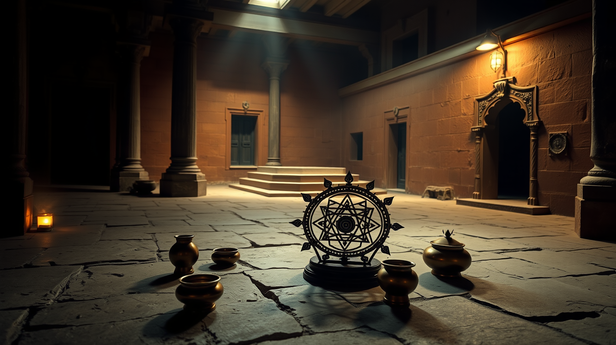
Tantric ritual, the use of yantras, mantras, specific gestures, the arrangement of objects in a particular sequence, is often the part that contemporary observers find most alien. It looks like superstition, or like theatre. What it is, within the tradition's own logic, is an epistemology. The ritual is not a petition to a deity. It is a structured practice of attention. When a practitioner traces the Sri Yantra, the geometric diagram associated with the goddess Lalita Tripura Sundari, the act is meant to train the mind to perceive the structure of reality in a particular way, to see the same pattern of expansion and contraction in the yantra that the tradition claims underlies consciousness itself.
The mantra works similarly. Sound in Tantric philosophy is not arbitrary. The Kashmir Shaiva tradition holds that the universe arises from and returns to a primordial vibration, and that specific sound patterns, mantras, resonate with specific aspects of that vibration. This is not a claim about acoustics. It is a claim about the relationship between language, mind, and reality. Whether one accepts the metaphysics or not, the practice of mantra is a practice of sustained, embodied attention. It is closer to what a musician does when she learns to hear the overtones inside a single note than it is to prayer in any conventional sense.
The ritual dimension of Tantra was the part that most offended both colonial scholars and later Hindu reformers. Both groups wanted religion to be interior, ethical, and free of the body. Tantra's insistence that the body is the site of realisation, that matter is sacred rather than fallen, put it outside the category of acceptable spirituality in two different frameworks simultaneously.
What gets lost when a philosophy becomes a brand
The contemporary wellness market has produced its own version of Tantra, and it is almost perfectly inverted from the original. In this version, Tantra is about intimacy, connection, and sexual healing. It is offered in weekend workshops, sold in books with soft-focus covers, and positioned as an ancient Indian solution to modern disconnection. The word sacred appears constantly. The word liberation almost never does.
What is missing is the philosophical seriousness. Tantra in its original form is a complete account of reality, of what consciousness is, what the body is, what liberation means and how it is possible. It has its own logic, its own texts, its own centuries-long tradition of commentary and debate. Abhinavagupta alone wrote enough to fill a small library. The tradition asks something of you: sustained practice, a teacher, a willingness to have your assumptions about the relationship between spirit and matter completely rearranged. The wellness version asks only that you show up with an open mind and a credit card.
The misunderstanding of Tantra is not really about sex. Sex is just the most visible symptom of a deeper confusion: the assumption that a philosophy which takes the body seriously must be, at its core, about bodily pleasure. The actual argument Tantra makes is stranger and harder than that. It says the body is the only place you have ever been, and that if you pay close enough attention to what is happening inside it, sensation, desire, breath, the gap between one thought and the next, you will find that what you are looking for was never somewhere else.