
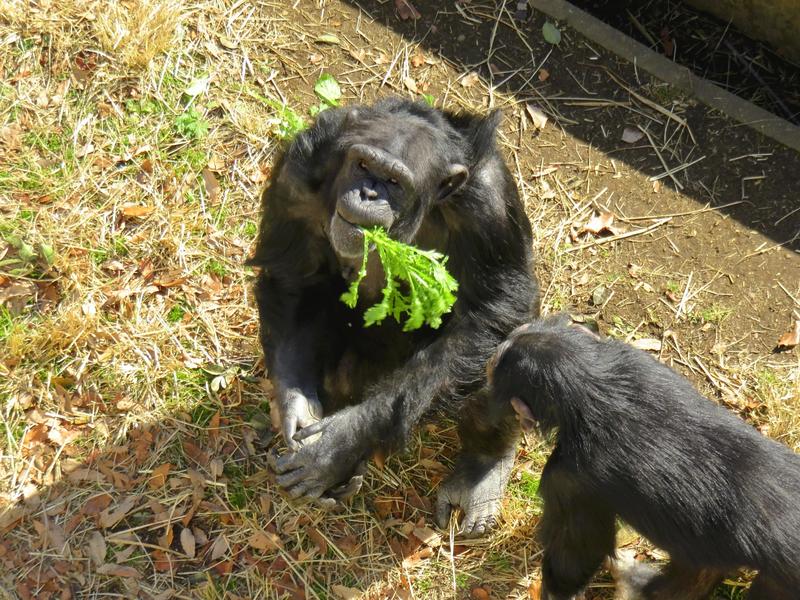
Chimpanzees with a vegetable-centered diet are less prone to catch colds and are healthier than their peers with a fruit-heavy lifestyle, the animals at a Tokyo zoo have shown.
Tama Zoological Park in Hino, Tokyo, started giving its chimpanzees vegetable-centered meals about three years ago, shifting from a fruit-heavy diet in a bid to provide them with nutrients closer to what they would get in the wild.
The change in diet has had a pronounced effect on them -- the chimpanzees who eat plenty of vegetables rich in fiber and protein have become less likely to catch colds, and their hair is shinier than before.
At lunchtime in early January, burdock roots, potatoes and onions were thrown in by a keeper standing on the roof of the chimpanzee house. Eleven chimpanzees gathered the food with their hands before biting into it with relish.
"We used to often give them fruits, but recently we mainly give them vegetables," zookeeper Sumito Sato, 25, said on a microphone, drawing sounds of surprise from the crowd of visitors.
"I always associated chimpanzees with bananas and apples. I'm surprised to see them eating vegetables," said Tomoyasu Naito, 43, a public servant who visited the zoo with seven family members from Toshima in the Izu Islands during winter vacation.
The decision to drastically review the diet of the zoo's chimpanzees was prompted by advice from Kaori Ito, 40, who was on staff at Ueno Zoological Gardens at the time.
According to Ito, who currently works as a keeper at Tama, wild chimpanzees eat nuts and fruits, a diet that is high in protein and fiber and low on carbohydrates. In Europe, where nutritional research for the animal is advanced, chimpanzees were already being given food containing nutrients similar to those in the wild three years ago.
Ito, who is also a member of the nutrition division of the Japanese Association of Zoos and Aquariums, told the Tama zoo about the situation in Europe and the fact that the Ueno zoo had also switched to vegetable-centered meals for its gorillas from a fruit-centered diet.
At the Tama zoo, chimpanzees had previously been fed bananas, apples, oranges, bread and yogurt. Upon receiving the advice, the keepers decided to drastically decrease the amount of fruit and increase the vegetables.
They served the animals burdock roots and green pepper throughout the year. Seasonal vegetables such as turnips, daikon and shungiku garland chrysanthemums were included in winter, and eggplants and zucchinis in summer.
They also stopped providing bread, which is high in carbohydrates, as well as yogurt, which often gave the chimpanzees indigestion because they cannot break down lactose well.
A comparison of their diet in 2017 and the present shows that the amount of food per animal per day has remained the same at about 3,500 grams with about 2,000 kilocalories of energy intake. However, the percentage of fruits has decreased to 27% from 42%. In contrast, the percentage of protein increased to 13.3% from 8.6%, and fiber was up to 14.2% from 8%.
As a result, chimpanzees at the Tama zoo are less likely to catch a cold and have better hair. "Their bodies have also become muscular, and their stools are less diarrheal," Ito said.
Now that the chimpanzees have gotten healthier, the Tama zoo is reportedly increasing the proportion of vegetables in orangutans' diets as well, according to Ito.
"I hope visitors will come and see how they eat vegetables while tasting them," she said.
Tama Zoological Park is open from 9:30 a.m. to 5 p.m., closed on Wednesdays. Lunchtime, when visitors can see chimpanzees eating vegetables, begins at 1:30 p.m.
Read more from The Japan News at https://japannews.yomiuri.co.jp/













