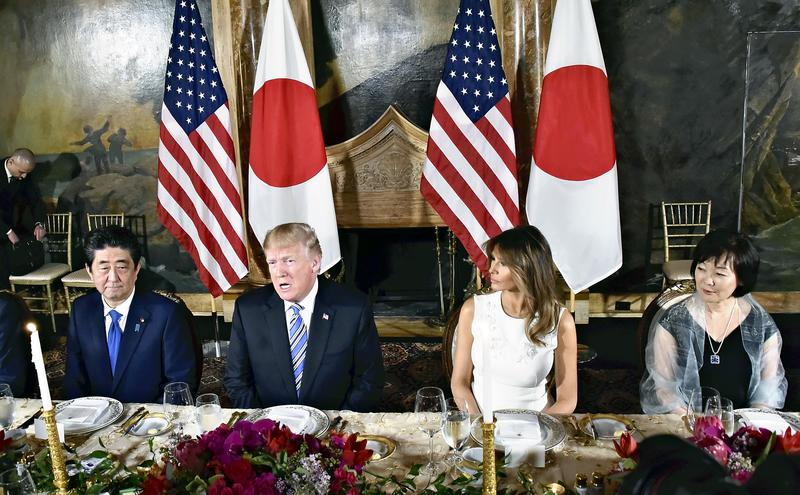
PALM BEACH, Fla. -- The latest Japan-U.S. summit talks once again highlighted conflicting positions on trade, one of the focal points of the meeting.
U.S. President Donald Trump wants to reduce his nation's trade deficit with Japan through bilateral negotiations, while Prime Minister Shinzo Abe is prioritizing the return of the United States to the Trans-Pacific Partnership free trade agreement.
The two countries will continue debate in a new framework for discussing trade issues between Japan and the United States.
At a joint press conference after the talks, Trump said, "I don't want to go back into TPP, but if they offered us a deal that I can't refuse on behalf of the United States, I would do it."
He also touched on bilateral negotiations and indicated his intention to press Japan to open its markets for automobiles and agricultural products. Abe emphasized that the TPP would be beneficial for both Japan and the United States.
According to a source accompanying Abe, the prime minister said during the summit talks that he "has no intention of discussing anything more than what was agreed on for the TPP regarding agriculture." This appears to mean that the prime minister indicated his position that Japan would not accept market liberalization broader than what was agreed upon with the United States under TPP negotiations.
There are many unclear points in the framework to be formed, other than its aiming for the free, fair and mutually beneficial trading sought by Trump. It is also unclear whether the United States will aim for a free trade agreement with Japan.
Prior to the summit talks, Trump told reporters, "We have a very big deficit and we're going to weed that down and hopefully get a balance."
Regarding the United States not exempting Japan from its restrictions on steel and aluminum imports, Trump told reporters he might be able to exclude Japan from the list if the two countries could come to a trade agreement, conveying his intention to use the issue as a bargaining chip in negotiations with Japan.
The U.S. trade deficit with Japan in 2017 was 68.8 billion dollars, the third-highest after China and Mexico. With the ruling Republican Party expecting to face an uphill battle in the midterm elections in November, Trump is keen to reduce the trade deficit, which has been a pledge of his since the presidential election.
Japan, for its part, wants to avoid being pushed to open its market on a unilateral basis through FTA negotiations. It seems to be employing a strategy of hurriedly enforcing the TPP agreement among 11 countries, excluding the United States, and urging the United States to change its stance.
Under the new framework, U.S. Trade Representative Robert Lighthizer will represent the U.S. side in negotiations with Toshimitsu Motegi, minister in charge of economic revitalization.
Lighthizer is a hard-liner in negotiations, as seen in the Japan-U.S. talks over steel in the 1980s that he attended as deputy USTR, through which Japan was driven to impose voluntary restraint on exports. He is expected to pressure the Japanese side in a bid to achieve certain "results" in reducing the United States' trade deficit with Japan.
Read more from The Japan News at https://japannews.yomiuri.co.jp/