With North Korea's request that South Korean President Moon Jae In visit North Korea, the possibility has emerged of a large shift in the situation on the Korean Peninsula. Will Moon's visit to North Korea materialize? Will talks begin between the United States and North Korea, which Moon holds to be a prerequisite for such a visit? We asked Japanese and South Korean experts for their outlook.
(From The Yomiuri Shimbun, Feb. 15, 2018)
N. Korea prepared for protracted struggle
On the front page of its Feb. 12 edition, Rodong Sinmun, the official newspaper of North Korea's Workers' Party of Korea, went so far as to print a photograph of Party Chairman Kim Jong Un's younger sister Kim Yo Jong attending a musical performance with South Korean President Moon Jae In. This is highly unusual. The North Korean people reportedly stared intently at this image. This reflects the Kim Jong Un regime's confidence that it will be able to achieve results through inter-Korean dialogue.
However, under the economic sanctions imposed by the United Nations Security Council and the South Korean government, there are limits to how far South Korea can cooperate economically with North Korea. North Korea understands that to proceed with talks will require the United States' understanding. It is also thinking of holding talks with the United States.
From this point forward, the bargaining tactics will only intensify. Progress toward talks with the United States may be made through measures such as declaring a temporary suspension of ballistic missile launches. If the United States does not agree to talks, it is possible North Korea could even consider making such a declaration at a meeting with South Korea.
The fact that joint military exercises will be conducted by South Korea and the United States has already been taken into consideration. North Korea will not ruin the atmosphere of reconciliation that has arisen by launching another intercontinental ballistic missile.
Kim Jong Un has advanced a dual course of building up North Korea's nuclear arms and its economy. Last September's nuclear test and the launch of the Hwasong-15 intercontinental ballistic missile at the end of November gave North Korea confidence in its ability to guarantee deterrence against the United States.
Therefore, it decided to concentrate on building up its economy. This is also clear from the fact that Kim Jong Un has recently conducted inspection tours not of military-related sites, but solely of farms and other economy-related sites. Sanctions imposed by the international community make it difficult for North Korea to build its economy on its own. The entity that North Korea could most quickly discuss lifting economic sanctions with was the Moon administration.
In Kim Jong Un's New Year's address, he called the Pyeongchang Winter Olympics and the 70th anniversary of the Sept. 9 founding of North Korea "deeply significant." He wants to greet that anniversary in a celebratory mood. He wants to hold a summit meeting and secure economic cooperation with South Korea by the anniversary at the latest.
In the summit meeting with Moon, Kim's aim is to confirm anew the agreement between General Secretary Kim Jong Il and President Roh Moo Hyun at the inter-Korean summit held in Pyongyang in October 2007. The content of this agreement includes the early completion of construction for stage one of the inter-Korean economic cooperation project, the Kaesong industrial complex; the organization of a meeting facility at Mt. Kumgang, where tourist business was conducted until July 2008; and the implementation of tourist business following the opening of a direct route from Seoul to Mt. Paektu, a scenic spot in the northern region of North Korea.
However, North Korea has thought the rise of the conservative Lee Myung Bak administration in South Korea led to a one-sided abrogation of this agreement. It will reconfirm this agreement with South Korea and if economic sanctions cannot be lifted because they are imposed by the United Nations, North Korea will request that South Korea work on its behalf to lift the sanctions.
Even if there are no results by September, I think North Korea will not quickly lose patience. It has no intention of giving up its nuclear missiles, and it understands that it is in a protracted struggle with the United States. All it has to do is to bide its time until the Trump administration ends. Meanwhile, it can proceed with mass producing, and fielding, nuclear missiles.
The Moon administration, which North Korea thinks it can draw concessions from, has four years left. North Korea aims to achieve results early on in this period.
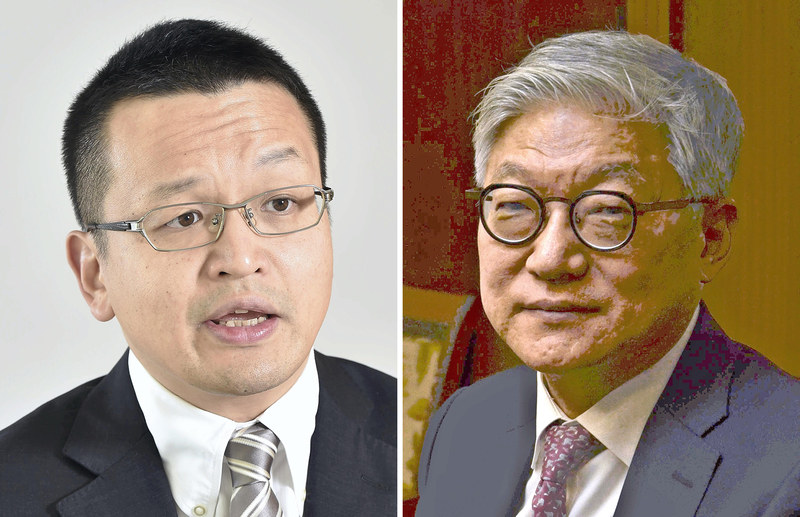
Atsuhito Isozaki
Associate Prof. at Keio University
Specializes in North Korean politics. After studying abroad at Seoul National University's Graduate School, Isozaki had been an expert investigator at the Japanese Embassy in China and a visiting researcher at the Woodrow Wilson International Center in the United States. His publications include the co-authored "Shinpan Kitachosen nyumon" (New edition: Introduction to North Korea). He is 43.
(This interview was conducted by Yomiuri Shimbun Staff Writer Takeo Miyazaki.)
Pyongyang highly likely to agree to talks
The aim of the administration of South Korean President Moon Jae In is to use the Pyeongchang Olympics as an opportunity to mediate talks between the United States and North Korea. Logically speaking, it is highly possible North Korea would agree to talks with the United States. However, South Korea does not hold the initiative here -- North Korea is merely using the Moon administration and the Olympic Games.
The current economic sanctions against North Korea have impacted a broad area of its economy, including energy and trade, and therefore must be considerably painful for North Korea. During talks, North Korea will likely aim to earn some time and loosen the sanctions. The fact that Kim Jong Un, chairman of the Workers' Party of Korea, gave a lavish welcome to the high-ranking delegation returning from visiting South Korea can be said to be a signal that North Korea is prioritizing dialogue.
The Moon administration will likely aim to realize talks between North Korea and the United States during the Olympic and Paralympic Games. It is also possible that, even if the United States and South Korea hold joint military exercises after the Games end, North Korea will judge that it is currently more advantageous to engage in dialogue. In this instance, it is conceivable Pyongyang will declare a temporary suspension of intercontinental ballistic missile launch tests, which the United States views as a threat.
During the first nuclear crisis in 1994, too, the Agreed Framework between the United States and North Korea was established, providing North Korea with such materials as heavy oil in return for freezing its nuclear development program; in the end, however, North Korean did not stop its nuclear and missile development programs. North Korea's ultimate goal is not to get the guarantee of the regime's security from the United States or conclude a peace agreement with them, but rather the "communist unification" of the Korean Peninsula. North Korea will not, of its own accord, let go of its nuclear capability and missiles, which are important means of achieving that goal. This time, too, if talks with the United States reach a dead end, North Korea will likely decide to launch another intercontinental ballistic missile.
It is imperative not to rush toward a short-term solution, but to maintain a mid- to long-term perspective. First, we should strengthen cooperation among Japan, the United States and South Korea and restore confidence in the United States' "nuclear umbrella," which has been shaken by North Korea's nuclear development. Depending upon circumstances, it may become necessary to seriously discuss the nuclear armament of Japan and South Korea.
By biding our time and continuing to impose powerful sanctions, we will convince North Korea that there is more to be lost than gained in nuclear development. It is also possible this will encourage a change on the part of North Korea.
If U.S.-North Korea talks are realized, then the Moon administration will likely think "the environment for an inter-Korean summit has been arranged," but a summit should not be held for the sake of having a summit. This would give China and Russia a justifiable reason for loosening their imposition of sanctions and could endanger the international web of sanctions that exists.
The current detente is nothing more than an "Olympics ceasefire." We must realize the essential problem of nuclear and missile development programs remains unresolved.
South Korean public opinion is also changing. Compared to the time of the Kim Dae Jung and Roh Moo Hyun administrations (1998-2008), when inter-Korean harmony advanced, the current young generation is cool toward North Korea. They have doubts about why their tax money should be used on North Korea in the midst of a tough economy where employment is unpredictable. The Moon administration will likely use inter-Korean relations to its political advantage during the local elections in June, but South Korean public opinion will not easily allow concessions to North Korea.
Yun Duk Min
Former Chancellor of Korea National Diplomatic Academy
Specialist in nuclear and security issues pertaining to North Korea. He has a master's degree from the University of Wisconsin, Madison, in the United States and a doctorate in political science from Keio University. From 2013-17, he served as chancellor of the Korea National Diplomatic Academy. He is 58.
(This interview was conducted by Yomiuri Shimbun Correspondent Yujiro Okabe.)
Read more from The Japan News at https://japannews.yomiuri.co.jp/