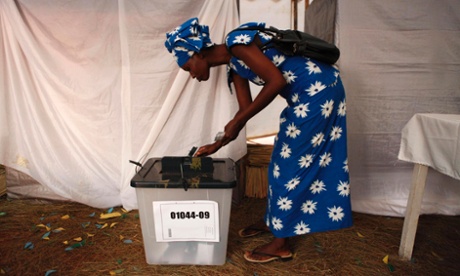
“Women in the world perform 66% of the world’s work, produce 50% of the food, but earn only 10% of the income and own only 1% of the property,” the UNDP’s newest goodwill ambassador, Connie Britton, said earlier in 2014. In politics, 21.8% of national parliamentarians were female as of 1 July 2014, a slow increase from 11.3% in 1995, according to UN Women.
Parliamentary seat holders are non-representative of the number of women in the world, and how much they contribute. Notably, the number of female parliamentarians in developing countries is significantly lower than the number of their male counterparts.
But the Global Gender Gap report released this week by the World Economic Forum (WEF) revealed that Rwanda has entered the list of top 10 countries with the smallest gender gap for the first time.
In Rwanda, there are more female elected officials than men, with 64% of parliamentary seats held by women. This is partly due to the use of a quota system to increase the number of women in parliament. The constitution written in 2003 states that Rwanda commits itself to granting women “at least 30% of posts in decision-making organs”. That same year, women won 48.8% of seats in the lower house of parliament.
Rwanda’s success in increasing the number of seats held by women in its parliament displays the efficacy of using quota systems, and shows how beneficial they can be in getting women’s voices heard and considered when discussing national affairs.
However, using quota systems may not actually the best way to get women into power. There is the potential for quotas to pressure women into power, rather than inspiring them and allowing them to make their own choice. We could possibly then assume that this may even make the idea of being in power unappealing to women.
On the other hand, quotas could be said to help women aspiring to be politicians actually gain a seat in their parliament and represent the voices of the women of their nation.
On the subject of quotas, Northern Ireland MLA, Anna Lo of the Alliance Party said: “Gender quotas have worked to increase the number of women getting elected in politics and should be looked at along with other measures to encourage women to become candidates.” Meryl Kenny, a lecturer in government and politics at the University of Leicester, also tweeted: “Women’s continuing under-representation in British politics demands a solution that works: gender quotas.”
There are many points for and against the use of quota systems; these presented here are just a few. Rwanda is a powerful example of how effective quota systems are in increasing the number of women in power. But, taking both sides into consideration, do you think quota systems are a good way to get women into power?
Leave us a comment in the thread below, sharing your experiences or taking on any of the points above. You can also email us at globaldevpros@guardian.co.uk, or tweet us your thoughts.
Read more stories like this:
• Talk point: girls and science in the developing world
• Ziauddin Yousafzai: learn from Malala, use your own voice to demand rights
• From barrier to enabler: how politics can help girls live up to their potential
• Advertisement feature: Rwanda unites to make development work for girls
Join the community of global development professionals and experts. Become a GDPN member to get more stories like this direct to your inbox