Taliban militants have increased the pressure on the Afghan government over the weekend with a spate of high-profile attacks and a message promising more violence against civilians. Since Friday evening, 19 Afghans and two foreign soldiers have been killed by insurgents.
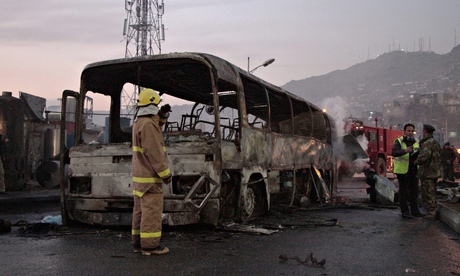
Late on Friday, an explosion killed two US soldiers travelling in a Nato convoy near Bagram airbase, north of the capital. A few hours later, unknown gunmen killed the head of the supreme court secretariat in Kabul, followed by a suicide attack on Saturday afternoon that killed at least six Afghan soldiers travelling in a bus in a Kabul suburb. The bloodiest attack, however, was in Helmand province, where Taliban fighters killed 12 mine removal specialists working to clear an area of explosives close to Camp Bastion.
The attacks come after a particularly violent month in Afghanistan in which insurgents have taken their fight to the heart of the capital.
In the last month, the Taliban have claimed responsibility for killing a South African aid worker and his two teenage children, and for bombing a British embassy vehicle. This week, insurgents killed another five Afghan soldiers travelling by bus, and deployed a teenage suicide attacker to a French cultural centre during a theatre performance on Thursday, killing a German citizen and wounding at least 15 others.
The attack on the cultural institute, located at a high school in the centre of the capital, was particularly devastating for many, as it was one of a few remaining places where young Afghans could mingle with foreign peers.
Since a string of deadly attacks earlier this year, including on a popular restaurant and a luxury hotel, most establishments catering to foreigners have been empty. The surge in violence over the past few weeks has further pushed many international NGOs and embassies to limit their travel to a minimum.
The recent attacks do not threaten the overall survival of the government’s forces, who assume security responsibility from international troops by the end of the year. But they do serve as proof that the insurgents are able to inflict pain far into the fortified capital.
In a statement released after the attack on the cultural centre on Thursday, the Taliban said that civilians were now potential targets, including media and those who “try and mislead the youth under the name of civil society.” Declaring that cultural invasion amounts to military invasion, the insurgents promised to target “foreign invaders and their Afghan slaves.” Attacks like the recent blast at the cultural centre would continue until the core of immorality is destroyed, the statement read.
At a time when newly-elected president Ashraf Ghani calls the Taliban a “political opposition,” and calls on them for peace negotiations, the insurgents appear determined to undermine this.
The recent wave of violence has bred fear in and around Kabul, and added to a pervading feeling of insecurity amid the drawdown of international military presence and the new government’s struggle to form a cabinet. After a draining election and a much-delayed agreement between Ghani and his chief executive Abdullah Abdullah to form a national unity government, many Afghans are now merely waiting for someone to lead the country.